Illinois Transfer on Death Revocation
County Specific Legal Forms Validated as recently as October 23, 2026 by our Forms Development Team
About the Illinois Transfer on Death Revocation
How to Use This Form
- Select your county from the list
- Download the county-specific form
- Fill in the required information
- Have the document notarized if required
- Record with your county recorder's office
What Others Like You Are Saying
"Site was easy to understand and use. Service was prompt. Good job Montgomery County!"
"Found the forms I needed with no problem and easy to fill out thanks to the guide that is with it. B…"
"Great service they had what i need easy to use on printing as soon as you pay you can print also as …"
"Easy to use."
"AMazing service. Fast and affordable."
4.8/5 from 4,844 reviews. Read all
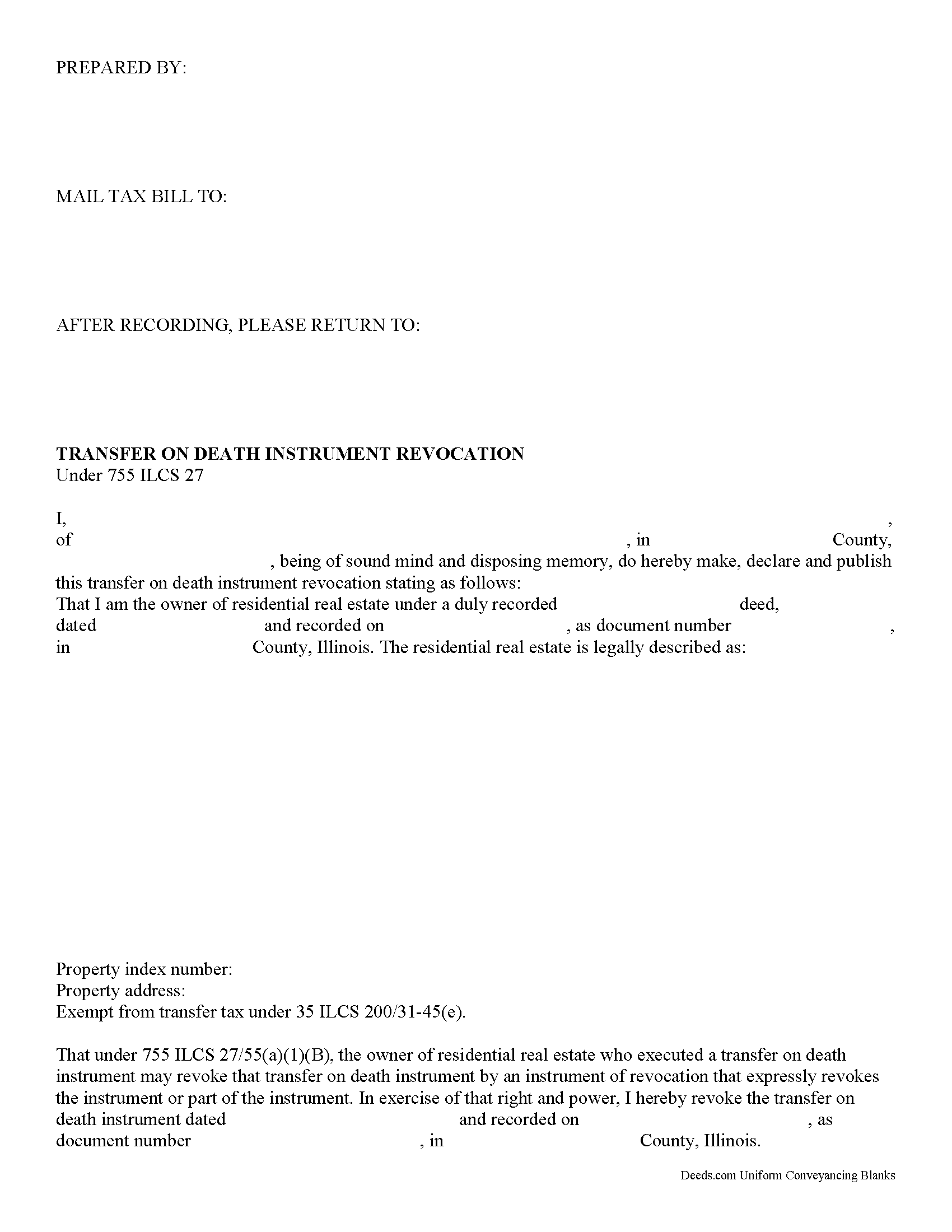
An Illinois transfer on death instrument stays in force until a recorded instrument takes it out of force. Section 55 of the Real Property Transfer on Death Instrument Act, 755 ILCS 27, allows only two things to revoke one: a new transfer on death instrument that contradicts it, or an instrument of revocation that expressly revokes it. This form is the second of those: an instrument of revocation carrying one or two owners who made a recorded Illinois transfer on death instrument, also searched for as a TODI, a transfer on death deed, a TOD deed, or a beneficiary deed, and who now revoke it in its entirety.
Why the revocation has to be recorded before death
Section 55(a) makes recording the effectiveness condition. An instrument of revocation is effective only if it is executed, witnessed, and acknowledged in the same manner Section 45 requires, on a date after the date of the acknowledgment of the instrument being revoked, and recorded before the owner's death in the office of the recorder of the county or counties where the prior instrument is recorded. A revocation that sits in a drawer at the owner's death revokes nothing. Section 55(b) states the other side of the rule: a transfer on death instrument may not be revoked by a revocatory act on the instrument, by an unrecorded instrument, or by a provision in a will. The form's first page carries that condition in capital letters, and its Section 2 identifies the instrument being revoked by acknowledgment date, recording date, document number, and county.
Signed like a will, not like a deed
Under Section 45, the owner signs, two or more credible witnesses attest in writing that the owner executed the instrument in their presence as a free and voluntary act while, in their belief, of sound mind and memory, and the signatures of the witnesses along with the owner's signature are acknowledged in front of a notary public. Section 55 applies the same formalities to the revocation, so the form carries an attestation paragraph with two witness blocks and a third acknowledgment certificate captioned for the witnesses. The capacity required to revoke is the capacity required to make a will, and Section 35 provides that an agent under a power of attorney, even one that purports to grant the authority, cannot revoke a transfer on death instrument for the owner.
One or two owners on a single instrument
The form recites no status, vesting, or capacity language of its own. One free-form owner block receives one or two natural persons with whatever status recital the record uses, and two signature blocks, headed OWNER and SECOND OWNER (if applicable), follow with an acknowledgment certificate for each, so a sole owner's revocation and a two-owner revocation are the same instrument with the second block left blank. A sole owner revoking the instrument he or she recorded, two joint tenants or tenants by the entirety who both executed one instrument and now revoke it together, and two tenants in common who executed one instrument covering their separate interests present the patterns the form carries. An owner acting through an attorney-in-fact, a fiduciary, an entity, three or more owners, and a revocation of only part of an instrument are configurations the form is not set up as. Under Section 70(b), an instrument executed by all of the joint owners is revoked only if it is revoked by all of the then living joint owners, and the last surviving joint owner may revoke it alone; the form's notice states that rule beside the recording condition.
Prepared by the owner
Section 95 of the Act provides that a transfer on death instrument or its revocation shall be prepared only by a licensed attorney, and in the same breath provides that nothing in the section prohibits an owner from preparing his or her own instrument or revocation, or renders it void for failing to be prepared by an attorney. The completed example shows that pattern: the owner's own name and address in the preparer statement that 55 ILCS 5/3-5022 requires on the face of every instrument affecting title to Illinois real estate.
The package includes the fillable instrument of revocation, a completed example filled in for a two-owner Sangamon County fact pattern, and the guide that walks through each section, the witness and notary formalities, and recording. This description and the guide describe the form and the governing Illinois statutes in general terms; they are not legal advice.
Important: County-Specific Forms
Our transfer on death revocation forms are specifically formatted for each of the 102 counties in Illinois.
After selecting your county, you'll receive forms that meet all local recording requirements, ensuring your documents will be accepted without delays or rejection fees.