Illinois Transfer on Death Instrument
County Specific Legal Forms Validated as recently as October 23, 2026 by our Forms Development Team
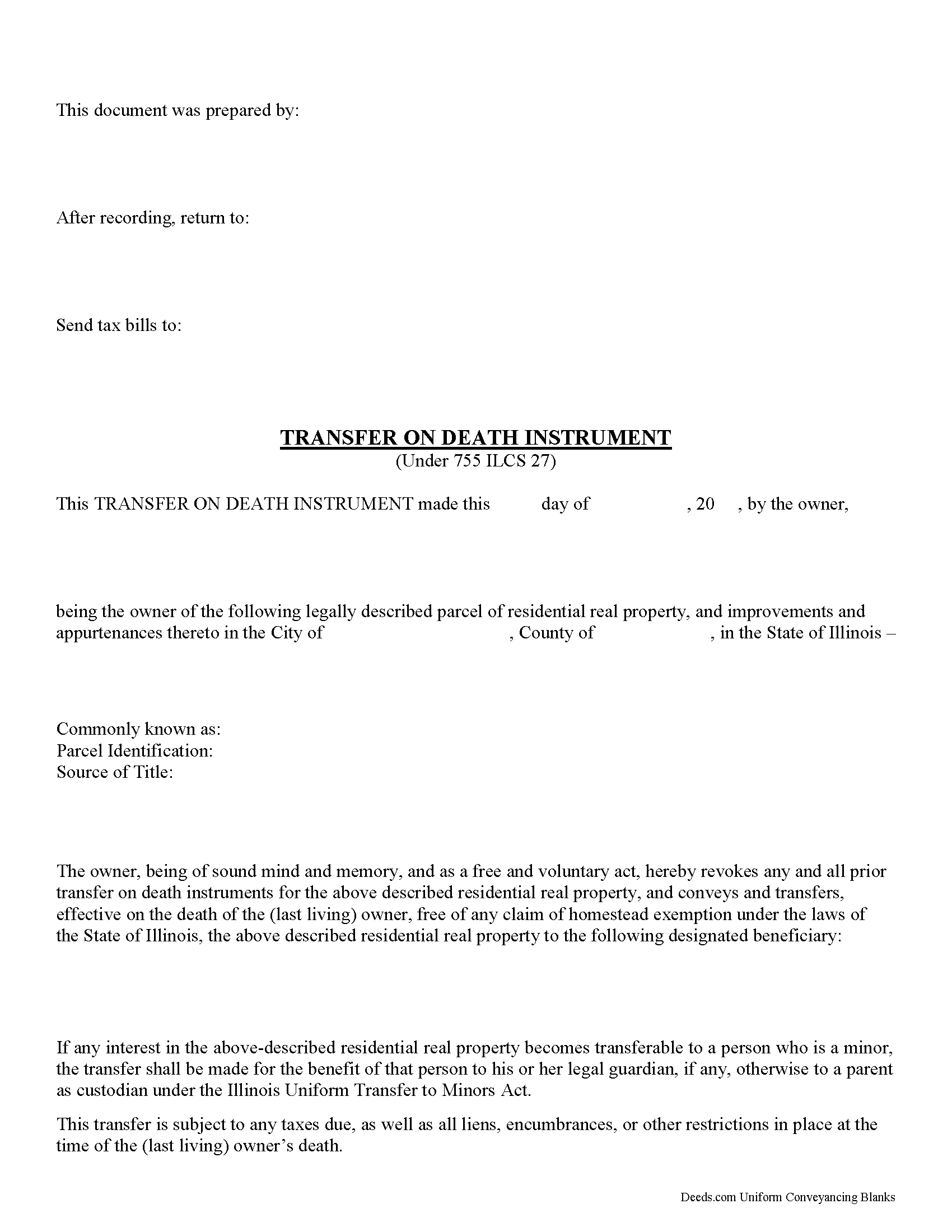
About the Illinois Transfer on Death Instrument
How to Use This Form
- Select your county from the list
- Download the county-specific form
- Fill in the required information
- Have the document notarized if required
- Record with your county recorder's office
What Others Like You Are Saying
"Great service!!! I was feeling overwhelmed but then I found deeds! I spent about 10 mins ordering, t…"
"Worked well for me to create a deed for a house I inherited. It was very thorough and easy to use. I…"
"Worked Great! First time go at the courthouse"
"Excellent service! Easy to use, great communication, quick response time and very helpful with any q…"
"YOU WERE NOT ABLE TO PROVIDE SERVICE IN THE COUNTY WE NEEDED IN NEW MEXICO. YOUR RESPONSE WAS QUICK …"
4.8/5 from 4,839 reviews. Read all
An Illinois transfer on death instrument is signed like a will and recorded like a deed: two credible witnesses attest to the owner's signature, a notary acknowledges the owner and the witnesses, and the document goes to the county recorder while the owner is alive. This form prepares that instrument under the Real Property Transfer on Death Instrument Act, 755 ILCS 27, for one or two owners of Illinois real estate. Illinois calls it a transfer on death instrument, or TODI; elsewhere it is a transfer on death deed or beneficiary deed.
A deed that waits
The instrument transfers nothing while the owner lives; under Section 60 of the Act it does not affect the owner's right to sell, mortgage, or lease the property and creates no interest in favor of the beneficiary. At the owner's death the beneficiary takes whatever interest the owner then owns, outside probate, subject to any mortgage then affecting title. Only a later transfer on death instrument or an instrument of revocation, executed with the same formalities and recorded before death, revokes it; a will cannot. Those later instruments are prepared separately and are not included in this package.
Two witnesses, one notary, and the recorder
Section 45 sets the execution formalities apart from an ordinary Illinois deed. The owner signs, two or more credible witnesses attest in writing that the owner executed the instrument in their presence as a free and voluntary act while of sound mind and memory, and the witness and owner signatures are acknowledged before a notary public. Fewer than two credible witnesses leaves the instrument void, and a beneficiary who witnesses puts that beneficiary's share at risk under Section 45(c). The form prints the statutory attestation above two witness blocks and carries three acknowledgment certificates, one for each owner block and one for the witnesses.
Recording gives the instrument effect. Section 40 requires recording before the owner's death with the recorder of the county where the property is located; an instrument not recorded in time is void. The form restates that requirement at the top of the first page, reserves the 3 inch by 5 inch recorder space, carries the preparer statement and return address the Counties Code requires, and prints the transfer tax exemption notation recorders look for.
Joint owners and the designation of the last to die
Illinois treats co-owners with a right of survivorship, joint tenants and tenants by the entirety, as joint owners under Section 70. One or more joint owners may sign, the instrument does not sever the joint tenancy, and where fewer than all sign, the designation of the joint owner who is the last to die governs. Where all sign, revocation takes all living joint owners, and the last survivor may revoke alone. A tenant in common is not a joint owner; that owner's designation operates at that owner's own death on that owner's undivided interest. The form prints only the sentence the Act requires, that the transfer is to occur at the owner's death.
One form, one or two owners
The form recites nothing about marital status, form of ownership, or capacity. One free-form owner block receives one or two natural persons with whatever status recital they state, two owner signature blocks follow, each paired with an acknowledgment certificate; a single owner leaves the second block and its certificate blank. The beneficiary block receives the classes the Act permits, individuals, trustees, and private or public entities, and absent a stated form of ownership two or more beneficiaries take equal undivided shares with no survivorship. A sole owner naming a child, a married couple holding as joint tenants naming their children, and one of two siblings holding as tenants in common naming a beneficiary for a half interest present the one-or-two-owner pattern this form recites. Trustee owners, entity owners, agents under a power of attorney, and three or more owners on one instrument are outside this configuration.
Prepared by the owner
Section 95 of the Act provides that a transfer on death instrument is prepared only by a licensed attorney, and in the same section preserves an owner's own preparation and provides that an instrument is not void for lack of attorney preparation. The package includes the fillable form, a completed example for a DuPage County fact pattern, and the guide that walks through every section and the recording process; the guide and this description explain the form and the statutes in general terms and are not legal advice.
Important: County-Specific Forms
Our transfer on death instrument forms are specifically formatted for each of the 102 counties in Illinois.
After selecting your county, you'll receive forms that meet all local recording requirements, ensuring your documents will be accepted without delays or rejection fees.