Kansas Limited Warranty Deed
County Specific Legal Forms Validated as recently as October 1, 2026 by our Forms Development Team
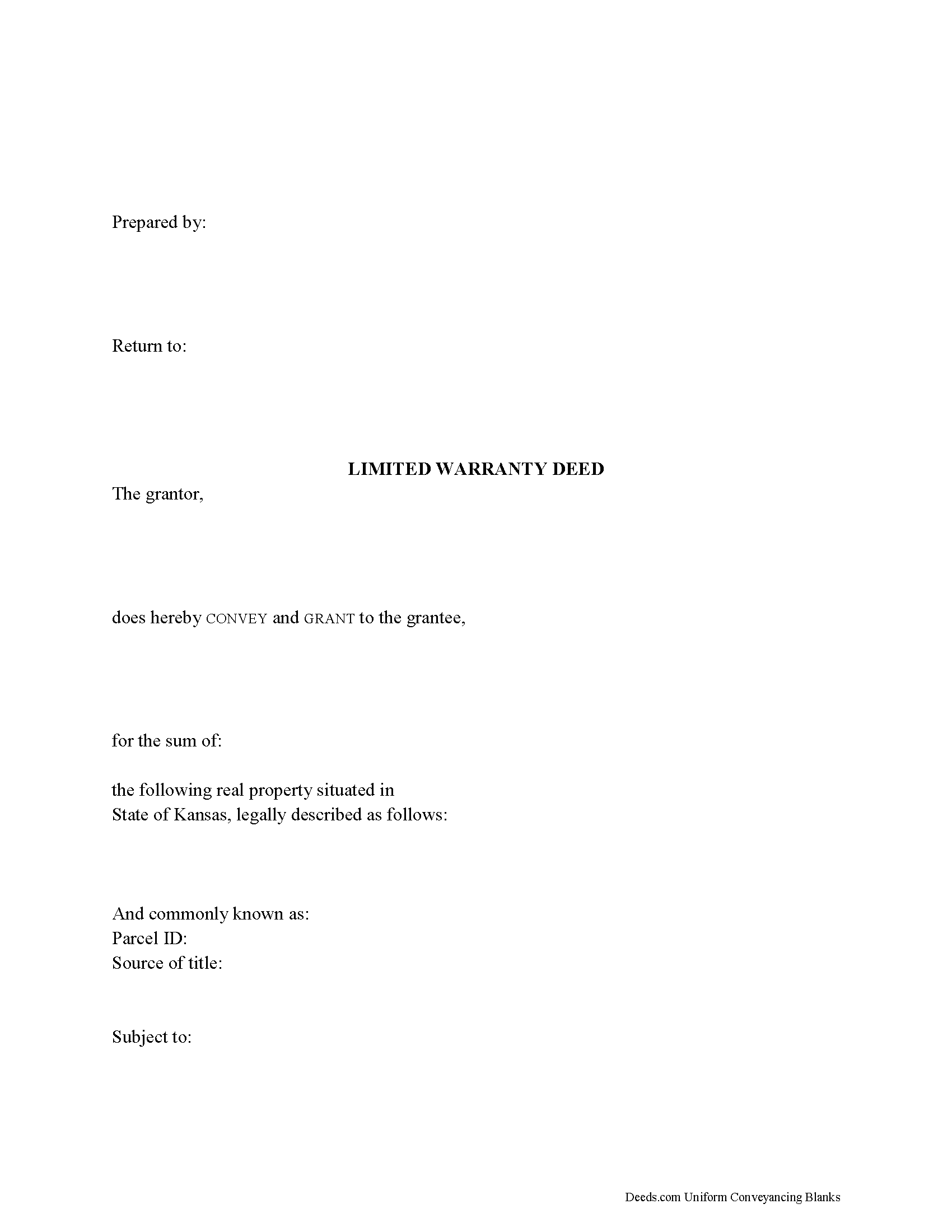
About the Kansas Limited Warranty Deed
How to Use This Form
- Select your county from the list
- Download the county-specific form
- Fill in the required information
- Have the document notarized if required
- Record with your county recorder's office
What Others Like You Are Saying
"Once I found your site it was very easy to understand, order and copy the forms. It is very helpful …"
"The site is easy to navigate and exceptional services. Unfortunately, they could find no information…"
"Saved me 1-2 hours' time dictating. Will use again."
"Could not be happier with deeds.com forms. The guide helped more than one can imagine, great resourc…"
"I have had it reviewed by a mortgage broker and a title manager and both said it was done correctly!…"
4.8/5 from 4,829 reviews. Read all
A limited warranty deed is a legal document used to transfer, or convey, rights in real property from a grantor (seller) to a grantee (buyer). This type of deed provides significant liability protection for the grantor, and less protection for the buyer. In a limited warranty deed, the grantor only warrants against defects in the title during his or her ownership, and that he or she is authorized to sell the property. However, it does not guarantee freedom from claims on the title originating before the grantor owned the property.
A lawful limited warranty deed includes the grantor's full name and marital status, as well as the grantee's full name, marital status, mailing address, and vesting. Vesting describes how the grantee holds title to the property. For Kansas residential property, the primary methods for holding title in co-ownership are tenancy in common and joint tenancy. A grant of ownership of real estate to two or more persons is presumed to create a tenancy in common, unless otherwise stated (K.S.A. 58-501).
As with any conveyance of real estate, a limited warranty deed must meet all state and local standards for recorded documents. It also requires a complete legal description of the parcel. Include the derivation of the grantor's title to the property to prove a clear chain of title, and detail any restrictions associated with the property.
Within Kansas, a deed must be acknowledged by a county clerk, register of deeds, or mayor or clerk of an incorporated city (K.S.A. 58-2211). Any deed that has been executed and acknowledged in another state before a person authorized by the Uniform Law on Notarial Acts will still be valid (K.S.A. 58-2228). The deed must be signed by the grantor, then acknowledged and recorded as directed by K.S.A. 58-2205.
Submit the deed for recording in the county where the property is located. Include all relevant documents, affidavits, forms, and fees with the along with the deed for recording. Complete a Real Estate Sales Validation Questionnaire for the deed unless it meets one of the exemptions provided in K.S.A. 79-1437e. Contact the local recording office with questions.
This article is provided for informational purposes only and is not a substitute for legal advice. Contact a lawyer with questions about limited warranty deeds or for any other issues related to the transfer of real property in Kansas.
(Kansas Limited Warranty Deed Package includes form, guidelines, and completed example)
Important: County-Specific Forms
Our limited warranty deed forms are specifically formatted for each of the 105 counties in Kansas.
After selecting your county, you'll receive forms that meet all local recording requirements, ensuring your documents will be accepted without delays or rejection fees.