Kansas Warranty Deed (Two Grantors)
County Specific Legal Forms Validated as recently as September 22, 2026 by our Forms Development Team
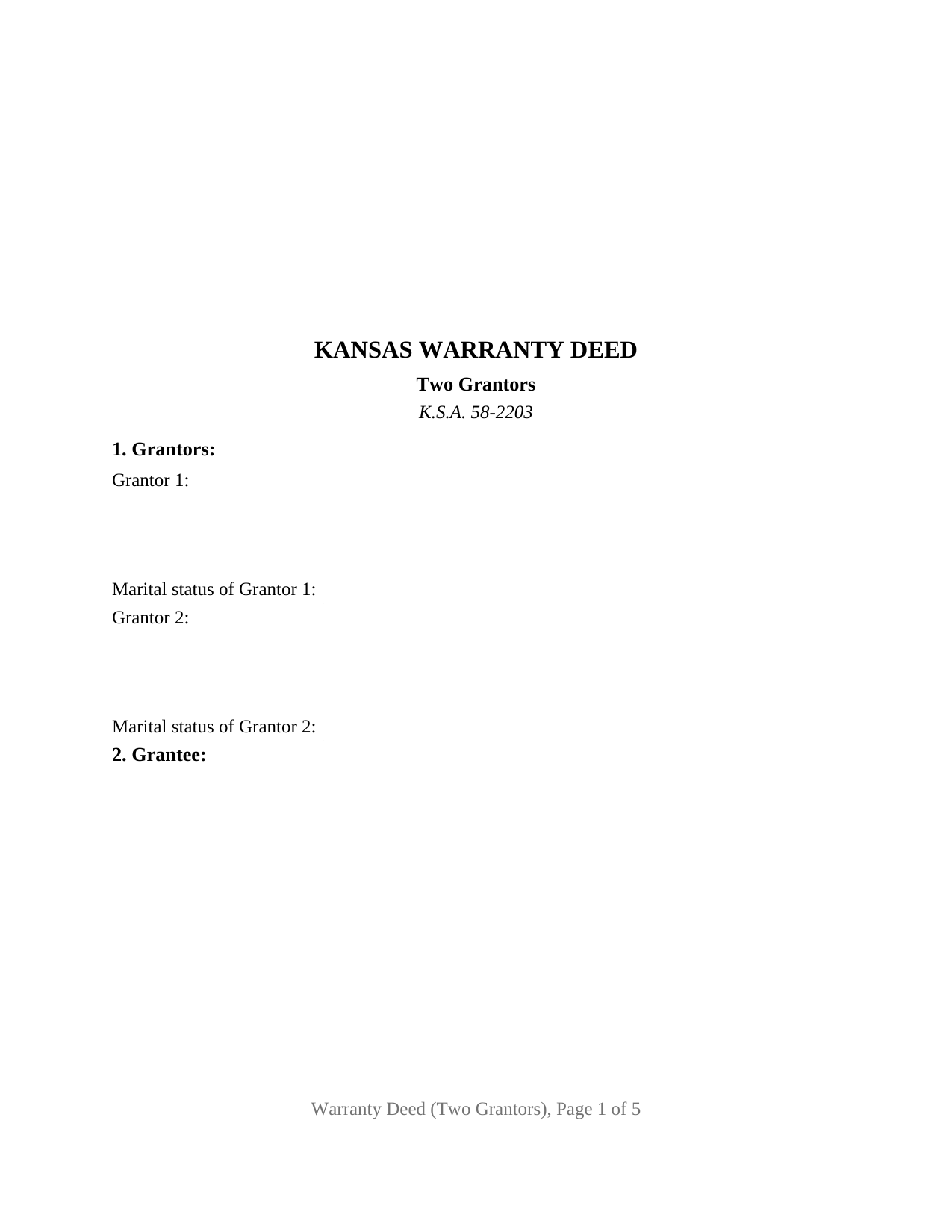
About the Kansas Warranty Deed (Two Grantors)
How to Use This Form
- Select your county from the list
- Download the county-specific form
- Fill in the required information
- Have the document notarized if required
- Record with your county recorder's office
What Others Like You Are Saying
"This is what we need and it was very helpful and easy to fill out. Thanks"
"The cost was well worth it. It was very easy to download, fill in the necessary information and then…"
"Easy and fast!"
"Excellent ...easy, timely!"
"Got Form I needed with detailed instructions and it was inexpensive"
4.8/5 from 4,825 reviews. Read all
When two record owners convey Kansas real estate in one instrument, the deed has to carry the whole record: two grantor blocks, two marital status lines, two signatures with printed names beneath them, and an acknowledgment certificate for each signer. This Kansas Warranty Deed (Two Grantors) is arranged for exactly that record, conveying the entire interest of both owners with the statutory covenants of K.S.A. 58-2203.
Two owners, one set of covenants
Kansas attaches its warranty covenants to the operative words of the statutory form, and this deed carries them in the plural: the grantors CONVEY AND WARRANT to the grantee, and the instrument states the covenants that follow from K.S.A. 58-2203, seisin, the right to convey, quiet possession, freedom from encumbrances, and a promise to defend the title against lawful claims. An exceptions section holds the recorded easements, restrictions, and current taxes that the parties intend to carve out of the encumbrance covenant, and under K.S.A. 58-2202 the deed passes the entire estate of both grantors unless its express terms show a lesser one. Because Kansas has no separate statutory form for co-owner conveyances, the same two operative words do the work whether the grantors hold as joint tenants or as tenants in common; both interests merge into the single conveyance the grantee takes.
Married grantors and the homestead consent rule
The two-grantor record appears most often as a married couple conveying a home they own together, and Kansas gives that pattern constitutional weight: an occupied homestead cannot be alienated without the joint consent of husband and wife, so a homestead deed signed by both spouses as grantors carries its own consent on its face. The same two-signature architecture serves co-owners who are not married to each other, two heirs conveying inherited land in one instrument, and joint tenants or tenants in common selling the whole parcel together. Each grantor block includes a marital status line, because K.S.A. 59-505 separately protects a spouse against lifetime transfers of other real estate made without written consent, and title examiners read marital status from the face of the record. The form recites exactly two grantors; a conveyance by a sole owner, or by three or more co-owners, presents a different signature pattern.
A certificate for each signer
Kansas notarial certificates follow the short forms adopted by K.A.R. 7-43-17, and the certificates on this deed carry the regulation's operative sentence: this record was acknowledged before me on a stated date by a named person. The form provides a separate certificate for each grantor, so the two signers may acknowledge on different dates, before different notarial officers, or in different states, with each certificate reflecting the venue where that grantor actually appeared. Kansas deed statutes call for no witnesses; under K.S.A. 58-2205, a deed executed, acknowledged, and recorded passes title without any other act or ceremony. Printed name lines under each signature answer K.S.A. 28-115(c), which reads the typed or printed name of every signer and notary into the recording fee statute.
Into the record at the register of deeds
Kansas records deeds county by county at the register of deeds, and intake turns on two companions: the statutory fee schedule of K.S.A. 28-115, published by counties at $21 for the first page and $17 for each page after it, and the real estate sales validation questionnaire of K.S.A. 79-1437c, which accompanies the deed unless a statutory exemption is stated on the document itself. The deed carries the exemption sentence with its number blank, a tax statement section for the grantee address that K.S.A. 58-2221 requires, and a first page that reserves a full three inches for the recording stamp. Kansas imposes no transfer tax on deeds. The completed example follows a Sedgwick County sale by a married couple from the grantor blocks through both notary certificates, so every blank on the form has a filled counterpart.
The package delivers three pieces: the fillable two-grantor warranty deed, the completed Sedgwick County example, and a plain language guide explaining every entry, the notarization steps, and Kansas county intake. The guide and example describe the law generally and are informational only, not legal advice.
Important: County-Specific Forms
Our warranty deed (two grantors) forms are specifically formatted for each of the 105 counties in Kansas.
After selecting your county, you'll receive forms that meet all local recording requirements, ensuring your documents will be accepted without delays or rejection fees.