Kansas Special Warranty Deed
County Specific Legal Forms Validated as recently as October 6, 2026 by our Forms Development Team
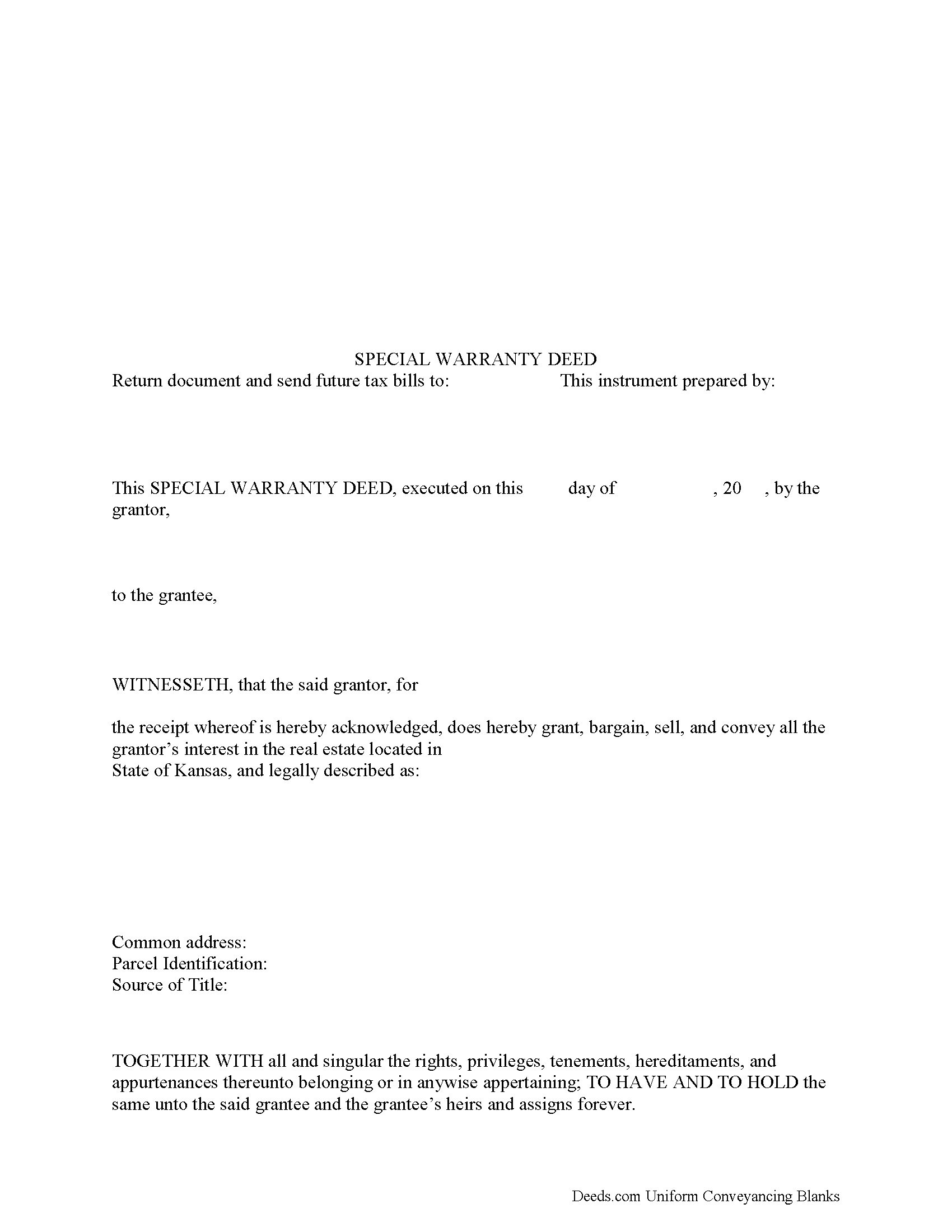
About the Kansas Special Warranty Deed
How to Use This Form
- Select your county from the list
- Download the county-specific form
- Fill in the required information
- Have the document notarized if required
- Record with your county recorder's office
What Others Like You Are Saying
"This is the first time that I have used this service. An employee at the Clerk and Register office i…"
"Good find, provides guide to use."
"Good site. Two things to note. 1. The Documentary Transfer Tax Exemption sheet, the word "compu…"
"Happy with the forms and the service, would recommend to others."
"Excellent service, great feedback and recommendations by the deed preparer, and I really appreciate …"
4.8/5 from 4,828 reviews. Read all
A special warranty deed in Kansas must be in writing, executed by a person having authority to convey the property or by that person's agent, and may be acknowledged or recorded as directed (58-2205). Fiduciaries will often convey real estate by a special warranty deed in Kansas. A special warranty deed contains some of the same covenants as a statutory general warranty deed, but those covenants only pertain to the grantor's period of ownership.
A special warranty deed should be signed by the granting party, or by the grantor's agent or attorney, and may be acknowledged or proved and certified in the manner prescribed by the uniform law on notarial acts (58-2209). A special warranty deed submitted to the register of deeds for recordation must be acknowledged before a person authorized by the uniform law on notarial acts to perform such acts or, if acknowledged within Kansas, by a county clerk, register of deeds, or mayor or clerk of an incorporated city (58-2211). A special warranty deed that has been executed and acknowledged or proved in another state in conformity with the laws of such state or in conformity with the laws of Kansas will be valid as if executed in Kansas (58-2228). If a grantor dies before acknowledging the deed or if the grantor cannot otherwise be procured to make the acknowledgement, or, if having appeared, the grantor refuses to acknowledge the deed, proof of the due execution and delivery of the deed can be made by competent testimony (58-2214).
In order for a special warranty deed to impart notice, the deed must be certified and recorded at the register of deeds in the county where the property is located in the manner provided by statute. A deed will impart notice from the time of filing for record with the register of deeds (58-2222). An unrecorded special warranty deed will be valid between the parties to the deed and those who have actual notice thereof (58-2223). After recording, all subsequent purchasers and mortgagees are deemed to purchase with notice (58-2222).
(Kansas Special Warranty Deed Package includes form, guidelines, and completed example)
Important: County-Specific Forms
Our special warranty deed forms are specifically formatted for each of the 105 counties in Kansas.
After selecting your county, you'll receive forms that meet all local recording requirements, ensuring your documents will be accepted without delays or rejection fees.