Kentucky Warranty Deed
County Specific Legal Forms Validated as recently as October 21, 2026 by our Forms Development Team
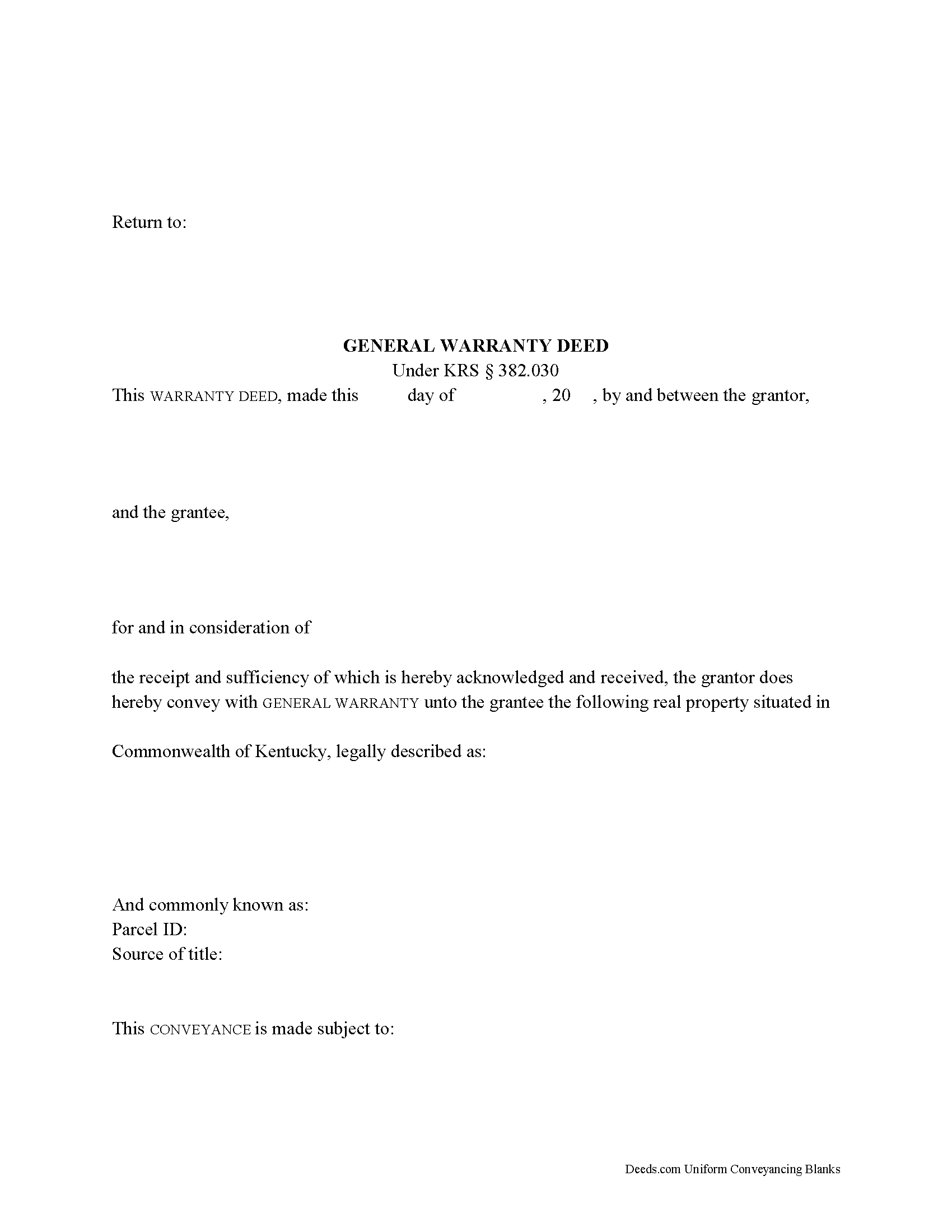
About the Kentucky Warranty Deed
How to Use This Form
- Select your county from the list
- Download the county-specific form
- Fill in the required information
- Have the document notarized if required
- Record with your county recorder's office
What Others Like You Are Saying
"EASY TO USE AND GREAT I COULD DOWNLOAD MULTIPLE DOCUMENTS"
"Very easy to use, responsive help when the document was initially rejected and very fast service (re…"
"Good document as expected"
"The form and instruction were perfect. Thank you."
"Ordered and received the quitclaim form. Exactly what I expected, perfect."
4.8/5 from 4,829 reviews. Read all
Kentucky puts the county clerk between a deed and the public record. Four sections of the conveyancing chapter tell the clerk what an instrument must carry before it can be lodged at all, so a Kentucky deed is drafted for that counter as much as for the buyer. This Kentucky warranty deed collects those items and conveys with the general warranty covenant of KRS 382.030, in a layout that takes one or two people on each side.
What the clerk is told to refuse
KRS 382.110 bars the grantor from lodging, and the clerk from receiving, a deed that fails to state the immediate source of the grantor's title by office, book, page, and date. KRS 382.135 blocks a deed missing full party names, mailing addresses, the tax-bill address, the consideration, or the sworn certificate. KRS 382.335 stops one at the door without an endorsement naming the individual who prepared it, signed by that individual. KRS 382.260 adds that nothing is legally lodged until the transfer tax is paid. Each section also provides that a deed recorded despite the defect still gives notice, which makes these intake rules rather than validity rules. The form answers each with a numbered blank and closes with a signed preparer block.
A covenant that outlasts the closing
KRS 382.030 does the drafting work in three words. A conveyance made with general warranty carries the same covenant as if the grantor had written it out: the grantor, and the grantor's heirs and personal representatives, will forever warrant and defend the property against the claims of all persons, whenever those claims arose and whoever created them. The narrower alternative in KRS 382.040 reaches only claims arising by, through, or under the grantor. This form prints the broader words in its operative section and states the covenant expressly, measured against the recorded matters listed in the exceptions blank. It also carries the KRS 382.070 statement about unpaid purchase money, the one route by which a grantor's lien for an unpaid balance survives against a later bona fide purchaser.
One deed, one or two people on each side
The party blocks are open. Section 1 receives one or two grantor names with whatever status the parties choose to recite, Section 2 receives one or two grantee names together with the vesting words the grantees select, and no marital status, tenancy, or capacity language is preprinted on the instrument. Execution follows the same shape: two grantor signature blocks, the second left blank where a single owner conveys, a grantee signature line for the sworn certificate, and one notarial certificate for each of the three. A sole owner selling a residence, two record owners passing the whole title to a buyer, a parent conveying to two children who take with survivorship, and a spouse joining only to release the interest KRS 392.020 preserves are patterns that appear in this arrangement. An entity grantor, a fiduciary signing in a representative capacity, an attorney in fact, and three or more owners on either side are configurations the form is not set up as.
Where the price is sworn to, and taxed
Kentucky asks both sides of the bargain to swear to the money. Under KRS 382.135 the deed itself contains a sworn, notarized certificate signed by the grantor or an agent and the grantee or an agent: on a sale, that the amount stated is the full consideration paid; on a gift or nominal-consideration transfer, that the transfer is by gift and that the amount stated is the estimated fair cash value. That is why a buyer signs the seller's deed at all, and why the certificates here read subscribed, sworn to, and acknowledged. The same figure drives the tax. KRS 142.050 charges the grantor 50 cents for each 500 dollars of value or fraction of it, and the clerk computes, collects, and certifies it before the deed goes to record. A false statement of consideration is a Class D felony under KRS 382.990.
The download delivers the fillable deed, a completed example filled for a Warren County sale by two owners to two buyers taking with survivorship, and a guide covering the instrument blank by blank, execution, county fees, and the recording standard the larger Kentucky clerks publish. A search for a Kentucky general warranty deed, or for a Kentucky deed of conveyance form, lands on the instrument described here. The materials cover Kentucky law and the contents of the form; they are informational and are not legal advice.
Important: County-Specific Forms
Our warranty deed forms are specifically formatted for each of the 120 counties in Kentucky.
After selecting your county, you'll receive forms that meet all local recording requirements, ensuring your documents will be accepted without delays or rejection fees.