Louisiana Quitclaim Deed
Parish Specific Legal Forms Validated as recently as July 25, 2026 by our Forms Development Team
About the Louisiana Quitclaim Deed
How to Use This Form
- Select your parish from the list on the left
- Download the parish-specific form
- Fill in the required information
- Have the document notarized if required
- Record with your parish recorder's office
What Others Like You Are Saying
"Very satisfied with what I purchased."
"This link thankfully saved us much time and expense with positive correct completion of the forms ne…"
"Thank you for responding so quickly to my question. I was able to locate the form and get everything…"
"Very easy to use. Would recommend to anyone"
"Hello, I like how easy the form is to follow. I'm unsure however of how to proceed as what I am tryi…"
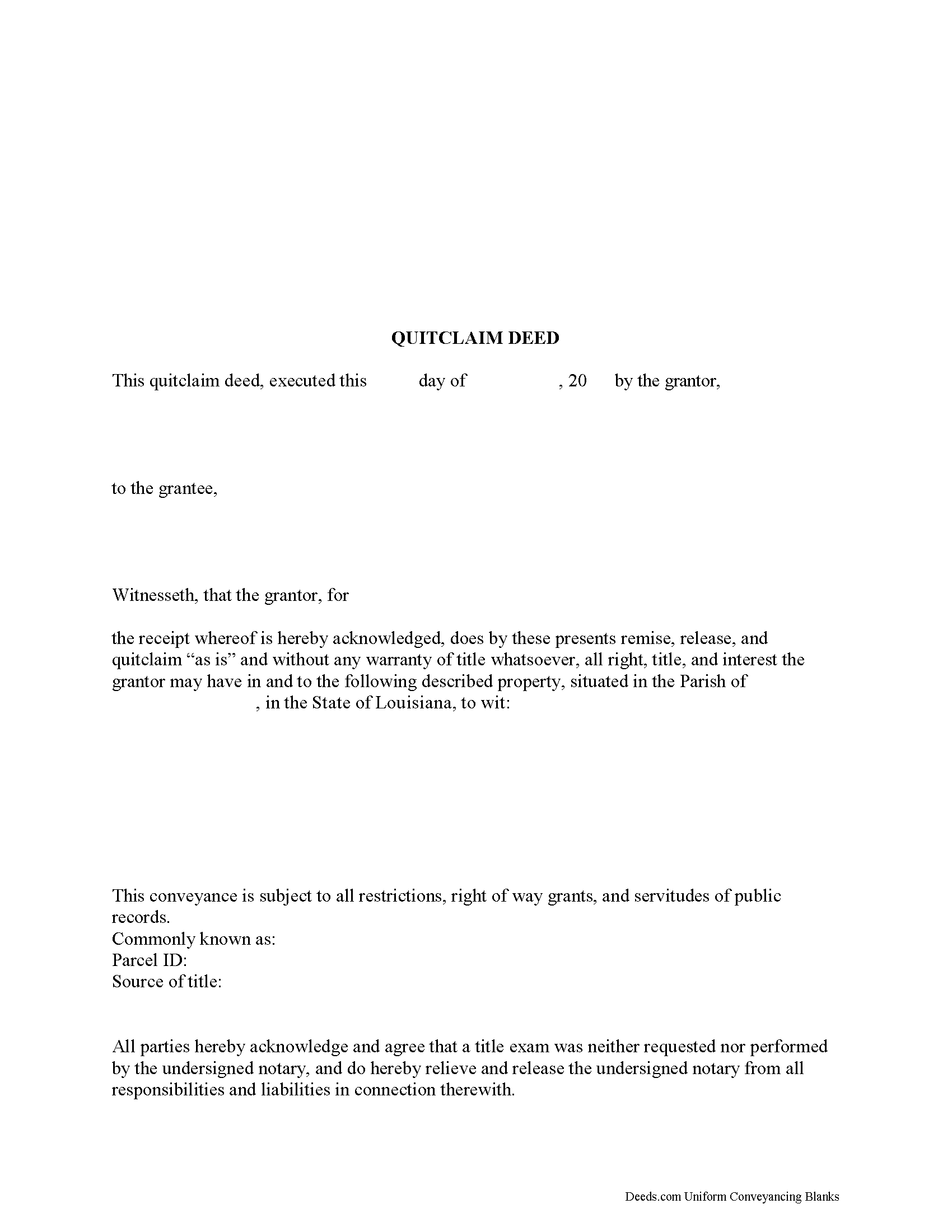
A Louisiana quitclaim deed built for one individual grantor does its work in a single sentence: the grantor quitclaims, transfers, assigns, and delivers to the grantee all of the grantor's right, title, and interest in the described property, and nothing more. This fillable form prepares that conveyance under the Louisiana Civil Code, with one grantor signature block, a joining acceptance signature for the grantee, two witness lines, and a notary certificate for each party.
All right, title, and interest, and nothing more
Louisiana has no statutory quitclaim form; the instrument's character comes from its own operative words. Waterman v. Tidewater Associated Oil Co., the Louisiana Supreme Court's characterization decision, treats a deed limited to the grantor's right, title, and interest without warranty as a quitclaim: it conveys exactly what the grantor holds at delivery, whether that is full ownership, an undivided fraction, or nothing at all, and it does not ordinarily pick up title the grantor acquires later. Transfers between family members, community property settlements between former spouses, consolidations of inherited undivided interests, and instruments that gather in an outstanding claim to clear a cloud on title are the patterns that fill Louisiana conveyance records with deeds of this construction.
A warranty exclusion written all the way down
Every Louisiana sale carries an implied warranty against eviction unless the act limits or excludes it, under Civil Code article 2503. Exclusion alone does not reach the price: even a sale without warranty ordinarily leaves the seller bound to return the price upon eviction, unless the buyer knew the danger of eviction, bought at the buyer's own peril and risk, or expressly released that obligation. This deed carries the full stack: an express exclusion of all warranty of title, the grantee's declaration of purchase at the grantee's sole peril and risk, and an express release of the return of the price. One limit survives every agreement by statute, and the deed states it: the grantor remains liable for an eviction occasioned by the grantor's own act.
One grantor signs, and the grantee signs too
The form recites exactly one individual grantor, with a marital status declaration section serving the party information Civil Code article 3352 describes for recorded acts. The grantee joins in the deed to accept the conveyance, because the peril-and-risk declaration that completes the article 2503 exclusion belongs to the buyer, and the form places it in the deed's own text above the grantee's signature. The form carries a separate acknowledgment certificate for the grantor and for the grantee, so the two parties may sign and acknowledge on different dates or before different officers. A married owner conveying a community immovable presents a two-spouse concurrence pattern under Civil Code article 2347 that this single-grantor form does not recite; the deed here recites a grantor conveying property held alone or as the grantor's separate property.
Executed and recorded the Louisiana way
The signature architecture serves both Louisiana execution paths: an authentic act, signed before a notary and two witnesses under Civil Code article 1833, or an act under private signature later acknowledged under the R.S. 35:511 form the notary certificates follow, with the venue caption naming the state and the parish. Recording happens at the clerk of court of the parish where the property is located, and timing carries unusual weight in Louisiana: under the public records doctrine, an unrecorded deed has no effect against third persons regardless of what they know. The statewide recording fee under R.S. 13:844 is $100 for an instrument of one to five pages, with parish schedules adding local charges, and this instrument runs five pages. The form reserves a two inch recording band at the top of page one and uses 12 point type, comfortably above the statutory 8 point minimum.
Sometimes searched as a quit claim deed or a no-warranty deed, the Louisiana version rewards a form written in the state's own civil law vocabulary, and this one is. The purchase delivers the blank deed as a fillable PDF, a completed example showing the form filled in for a realistic East Baton Rouge Parish fact pattern, and a plain language guide that walks through every numbered section, the execution choices, and parish recording practice. The materials describe the form and the governing statutes; they are informational and are not legal advice.
How to Use This Form
- Select your parish from the list above
- Download the parish-specific form
- Fill in the required information
- Have the document notarized if required
- Record with your parish recorder's office
What Others Like You Are Saying
"Very satisfied with what I purchased."
"This link thankfully saved us much time and expense with positive correct completion of the forms ne…"
"Thank you for responding so quickly to my question. I was able to locate the form and get everything…"
"Very easy to use. Would recommend to anyone"
"Hello, I like how easy the form is to follow. I'm unsure however of how to proceed as what I am tryi…"
Important: Parish-Specific Forms
Our quitclaim deed forms are specifically formatted for each parish in Louisiana.
After selecting your parish, you'll receive forms that meet all local recording requirements, ensuring your documents will be accepted without delays or rejection fees.