Massachusetts Warranty Deed (Two Grantors)
County Specific Legal Forms Validated as recently as October 15, 2026 by our Forms Development Team
About the Massachusetts Warranty Deed (Two Grantors)
How to Use This Form
- Select your county from the list
- Download the county-specific form
- Fill in the required information
- Have the document notarized if required
- Record with your county recorder's office
What Others Like You Are Saying
"I had overwhelming emotions taking my deceased wife's name off my condo, so it took me a year to ste…"
"This is so amazing and I truly thank you for what I needed for my documents. This is a great company…"
"The only problem I had was that it doesn't let you create a file for all documents to go into as one…"
"Your service was excellent"
"As a real estate professional, I've had the opportunity to use various legal form providers over the…"
4.8/5 from 4,828 reviews. Read all
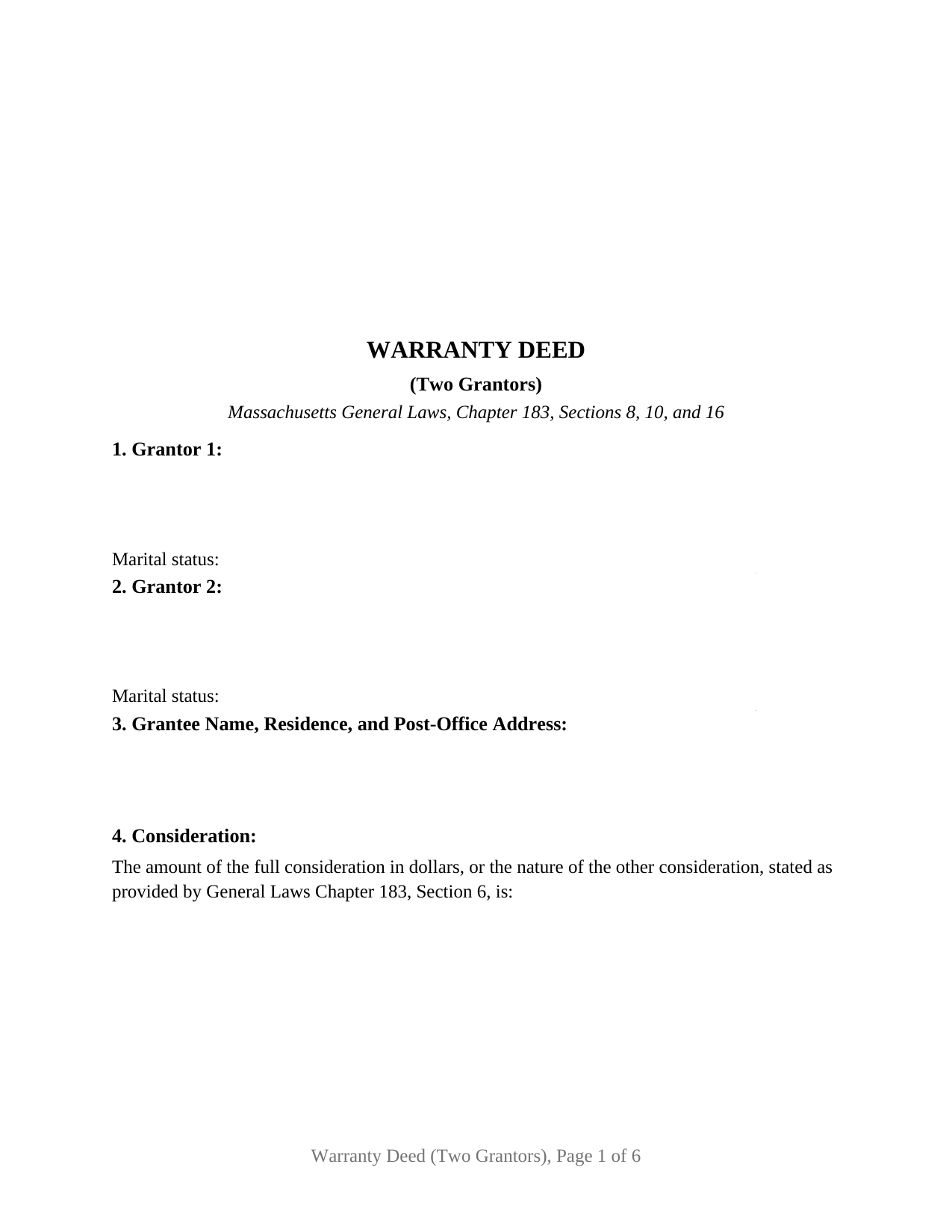
Two record owners who convey Massachusetts real estate together join in one deed, and the buyer takes the same statutory promise from each of them. This fillable Massachusetts warranty deed is arranged for exactly two grantors: a numbered party section with a marital status line for each owner, two grantor signature blocks, an acknowledgment certificate for every signer, and a conditional block a releasing spouse completes only when homestead law calls for it.
Two grantors, one set of warranty covenants
Under General Laws Chapter 183, Sections 10 and 16, a deed that grants Massachusetts land WITH WARRANTY COVENANTS conveys a fee simple backed by covenants reaching the whole chain of title: lawful seisin, freedom from encumbrances beyond those the deed states, good right to convey, and a promise to defend the grantee against the lawful claims of all persons, not merely claims tracing to the current owners. The operative section of this deed carries the statutory shorthand in capitals and adds a clause joining each grantor in those covenants as to that grantor's entire right, title, and interest, so the two owners stand behind the conveyance together rather than each answering only for a half.
Couples, co-owners, and the two-owner record
Three ownership patterns present the two-grantor configuration. Spouses holding as tenants by the entirety appear most often: the entirety estate exists only between married owners under Chapter 184, Sections 7 and 8, and a sale of the family home takes both of their signatures on one deed. Two joint tenants end their survivorship estate the same way, and two tenants in common, commonly siblings or heirs who inherited fractional shares, pass the whole title to a buyer in a single instrument. The form recites exactly two record owners; a conveyance by one owner, by a trustee, or by a business entity presents a different signing configuration, as does a title held by three or more people.
Homestead when both owners are at the table
Massachusetts homestead law supplies the deed's spousal logic. A deed to someone outside the family terminates an estate of homestead under General Laws Chapter 188, Section 10 only when the owner and any non-owner spouse or former spouse living in the home as a principal residence sign it. When the two grantors are married to each other, both owners are already signing, and the deed's homestead release operates without another name. When the grantors are co-owners and one has a spouse off the title who lives in the property, that spouse signs the releasing-spouse block and takes the third acknowledgment certificate. The marital status line in each grantor section puts the answer on the face of the record.
The statutory certificate and the registry district
Each certificate on this deed follows the substance of the Massachusetts acknowledgment form in General Laws Chapter 222, Section 15(b): the signer personally appears, proves identity through satisfactory evidence of identification entered on its own certificate line, and acknowledges signing voluntarily for the deed's stated purpose. Because every signer has a certificate, the two grantors may appear before different notaries on different dates, in Massachusetts or elsewhere. The deed then goes to the registry of deeds for the county or registry district where the land lies; several counties record through more than one district, and the correct office is the district serving the property's city or town. The first page holds its upper corner open for the registry's recording information, and the deed excise stamps are computed from the consideration the deed recites, alongside the statewide recording fee.
The download includes the two-grantor warranty deed as a fillable PDF, a completed example filled in for a Norfolk County sale by a married couple, and a plain-language guide covering each numbered section, the homestead release, the notary certificates, and the registry process. The materials are informational and are not legal advice.
Important: County-Specific Forms
Our warranty deed (two grantors) forms are specifically formatted for each of the 14 counties in Massachusetts.
After selecting your county, you'll receive forms that meet all local recording requirements, ensuring your documents will be accepted without delays or rejection fees.