Massachusetts Warranty Deed
County Specific Legal Forms Validated as recently as August 31, 2026 by our Forms Development Team
About the Massachusetts Warranty Deed
How to Use This Form
- Select your county from the list
- Download the county-specific form
- Fill in the required information
- Have the document notarized if required
- Record with your county recorder's office
What Others Like You Are Saying
"Easy to download, forms look to be pretty easy to use. Thank you!"
"I did my Lady Bird Deed in a way the instruction indicated to do. The example you provided make it e…"
"Easy to download. I like the fact that it gives me an example of how to fill it out and also the ins…"
"Thank you for making my life easier!!"
"Much good information provided. Forms easy to use. Price is a bargain."
4.8/5 from 4,828 reviews. Read all
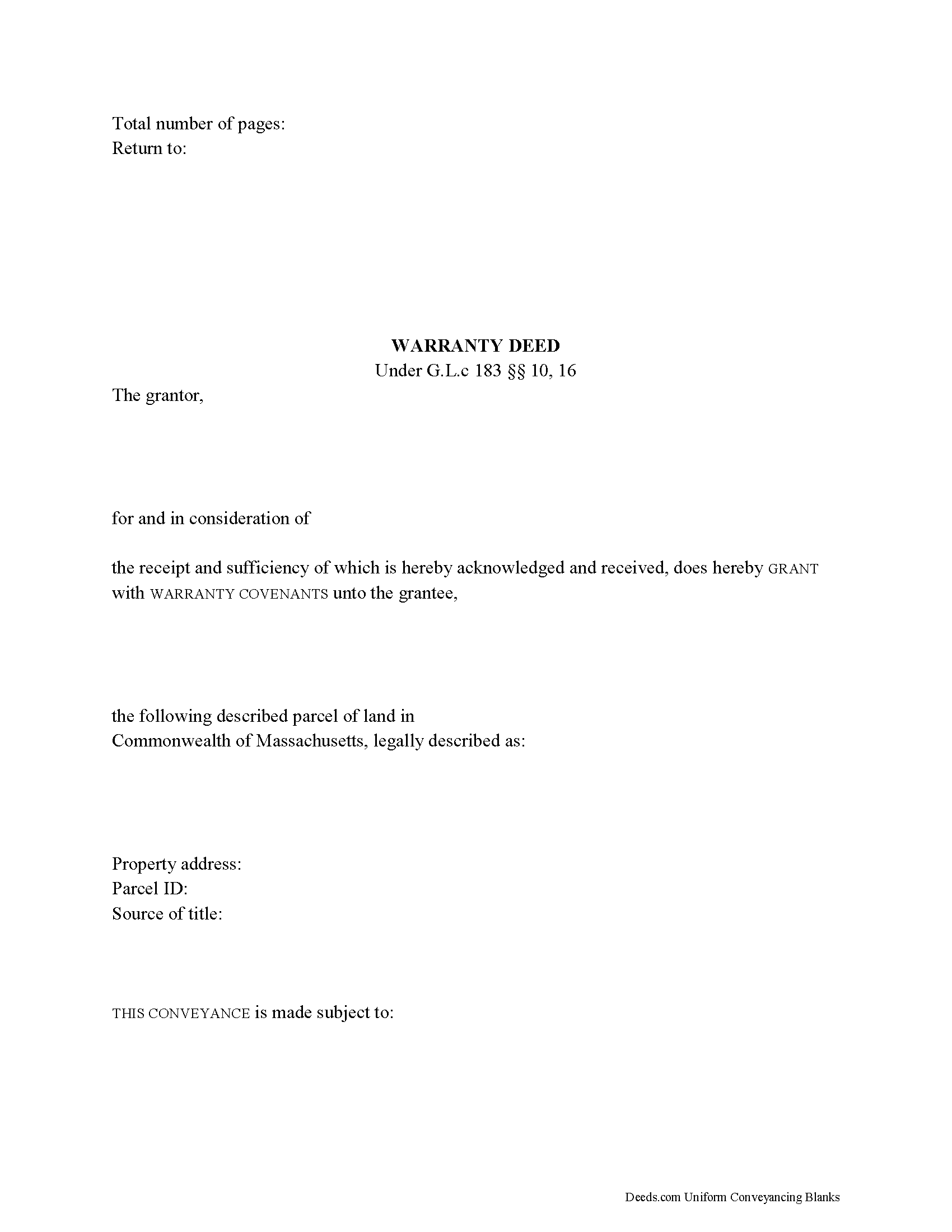
A Massachusetts warranty deed carries the longest promise this state's conveyancing law recognizes, and it is the least used of the three, because an ordinary Massachusetts quitclaim deed already comes with covenants of its own. This fillable warranty deed conveys land with the covenants of General Laws chapter 183, and its party sections are open: one or two individuals sign as grantors, one or two grantees take title, and the words describing status and vesting are entered rather than preprinted.
Three deeds, three distances
Massachusetts sorts its deeds by how far the grantor's promise travels. A release deed under sections 2 and 12 passes the estate and promises nothing, since section 12 provides that no covenant is implied from the word grant. A quitclaim deed under sections 11 and 17 answers for encumbrances the grantor made and defends against claims arising by, through, or under the grantor, but against none other, which makes the Massachusetts quitclaim a limited warranty instrument rather than the bare conveyance the same name describes elsewhere. A warranty deed travels the whole chain. Section 10 fixes its covenants at the moment of delivery: seisin in fee simple, freedom from every encumbrance, the right to convey, and a defense of the title against lawful claims from whatever point in the chain they arise. Section 16 packs all of that into two words, and the conveyance section of this deed uses them in capitals.
Party blocks the filler fills
The deed is drawn for natural persons signing in their own capacity, in any of four count patterns: one grantor to one grantee, one to two, two to one, or two to two. The grantor block is an open multi-line entry that takes each name with the status recital a Massachusetts deed customarily carries, and the grantee block takes the names with whatever vesting words the grantees use. Execution follows the same shape: a block headed GRANTOR, a second headed SECOND GRANTOR (if applicable), and an acknowledgment certificate for each one, so two signers can appear before different notaries on different days. A single grantor leaves the second block and its certificate blank. Title held by three or more owners, a trust signing through its trustee, a company signing through an officer, and a deed signed under a power of attorney each carry signing architecture this form does not recite.
Vesting words, and the default that answers their absence
What two grantees write after their names settles how they hold. Chapter 184, section 7 supplies a tenancy in common whenever a deed to two or more people says nothing else, and it holds married grantees to the same rule: the estate is a tenancy in common unless the instrument expressly states that the grantees take jointly, as joint tenants, in joint tenancy, or to them and the survivor of them. A tenancy by the entirety exists between spouses and takes express entirety words, while entirety words written for two people who are not married to each other produce a joint tenancy under that same section. The guide lays out each recognized form with the language that creates it, and the completed example shows a designation in place.
The subject-to list is part of the promise
On a warranty deed the encumbrance section is not housekeeping. The covenant that the premises are free of encumbrances is read against what the instrument itself says, so section 9 carries the easements, restrictions, rights of way, and tax matters the conveyance is made subject to, in the terms a title examination found them. The consideration section pulls its own weight too: chapter 183, section 6 calls for a recital of the full consideration, counted without deduction for liens the buyer assumes, and the registry computes the chapter 64D deed excise from the figure the deed recites. Where chapter 188, section 10 governs, a spouse who holds no record title but occupies the home signs as well, and the conveyance section states that a signer who is not an owner of record joins solely to release that estate of homestead.
The package delivers this deed as a fillable PDF, a completed example carrying a full two-grantor conveyance of a Cambridge property in Middlesex County, and a plain-language guide to the statutory framework, the numbered sections, the homestead and notarial rules, and recording at the registry of deeds district that serves the land. The materials are informational and are not legal advice.
Important: County-Specific Forms
Our warranty deed forms are specifically formatted for each of the 14 counties in Massachusetts.
After selecting your county, you'll receive forms that meet all local recording requirements, ensuring your documents will be accepted without delays or rejection fees.