Minnesota Quitclaim Deed (Married Couple as Grantors)
County Specific Legal Forms Validated as recently as October 15, 2026 by our Forms Development Team
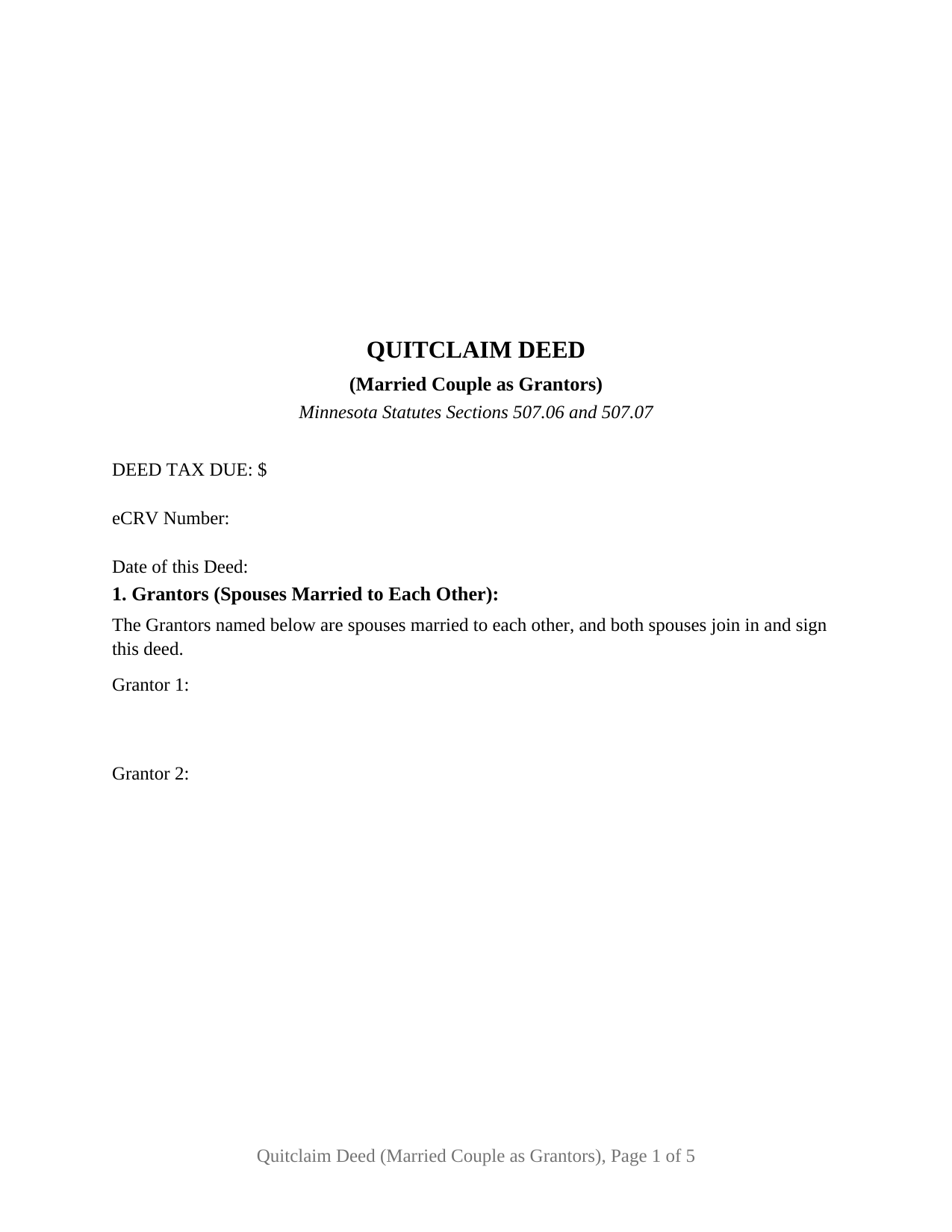
About the Minnesota Quitclaim Deed (Married Couple as Grantors)
How to Use This Form
- Select your county from the list
- Download the county-specific form
- Fill in the required information
- Have the document notarized if required
- Record with your county recorder's office
What Others Like You Are Saying
"Great service. The issue I had was uploading the file of several pages. Once I learned, everything b…"
"So far so good --- I'm helping a friend with her property! Thanks!"
"Simple and quick recording."
"With the guide everything went great"
"Worked perfect. Thanks."
4.8/5 from 4,828 reviews. Read all
Minnesota writes the second signature into the deed itself. Under Minnesota Statutes section 507.02, if the owner is married, no conveyance of the homestead is valid without the signatures of both spouses, and the Minnesota Quitclaim Deed (Married Couple as Grantors) is organized around that sentence: Section 1 recites one married couple as the grantors, and the execution section carries a labeled signature block for each spouse. Whatever right, title, and interest the couple holds in the described Minnesota real property passes to the grantee, with no covenant or warranty of title.
The statute behind the second signature
Section 507.02 is a validity statute. A married owner's conveyance of the homestead without the other spouse's signature is not merely incomplete paperwork; under the statute it is not valid, and the Minnesota Supreme Court reads the rule broadly, holding in Marine Credit Union v. Detlefson-Delano, 830 N.W.2d 859 (Minn. 2013), that a homestead conveyance to a third party takes both spouses' signatures unless a statutory exception or explicit waiver applies. Title examiners look for the second signature on any deed out of a married owner, and this deed makes the answer structural rather than incidental: the marriage is stated in the grantor section, both spouses are grantors, and both signature blocks are part of the printed architecture rather than an entry someone remembered to add.
A grantor section that recites the marriage
Section 1 names the two grantors and states that they are spouses married to each other and that both join in and sign the deed. The conveyance section then speaks the section 507.07 statutory words for a plural grantor, passing all right, title, and interest with the hereditaments and appurtenances and an express statement that nothing acquired later passes without added words. The deed closes with a labeled signature and date block for each spouse and a separate notary acknowledgment certificate for each, in the section 358.66 short form, so the spouses may acknowledge on different days or before different officers. The form recites exactly one married couple; it is not set up as a conveyance by co-owners who are not married to each other, and a sole owner's conveyance follows a different pattern. A couple conveying the home they occupy, and a home standing of record in one spouse's name alone with the other spouse joining so that any marital interest passes with the title, present the two patterns this deed recites.
When title stands in one spouse's name
Marriage reaches Minnesota land records even where only one name appears on the vesting deed, which is why the joining spouse has a full grantor line here rather than a footnote. For that pattern, Minnesota Statutes section 272.115, subdivision 1, supplies a statement the deed may substantially contain: the named spouse claims no ownership interest in the real property being conveyed and is executing the instrument solely to release and convey a marital interest, if any, in that real property. With the statement substantially included, the county auditor may accept the electronic certificate of real estate value without the joining spouse's Social Security number. The form's Additional Provisions section is built to carry an entry of that kind as part of the deed.
Numbers on the face, shown by example
The completed example runs a Washington County transfer: a married couple conveys a platted Stillwater lot for $145,000, the deed tax entry shows $478.50 at the 0.0033 rate of section 287.21, the eCRV confirmation number sits above the grantor section, and well disclosure statement (B) carries an electronically filed certificate number, the entry section 103I.235 contemplates for a property with a well. The blank form prints the same statutory furniture for any transfer by a married couple: the drafter statement of section 507.091, the tax statement address of section 507.092, a Registered (Torrens) line that routes the deed to the recorder or the registrar of titles, and the 3 inch first-page recording reserve of section 507.093. A search for a quit claim deed for a husband and wife, or a marital quitclaim form, lands on the same statutory instrument Minnesota practice records under the section 507.07 name.
The package delivers the form as a fillable PDF, a completed example prepared on the Washington County facts above, and a guide covering each numbered section, the homestead signature statute, the ways a grantee may hold title under section 500.19, and the auditor, deed tax, eCRV, well disclosure, and recording steps. The materials are informational and are not legal advice.
Important: County-Specific Forms
Our quitclaim deed (married couple as grantors) forms are specifically formatted for each of the 87 counties in Minnesota.
After selecting your county, you'll receive forms that meet all local recording requirements, ensuring your documents will be accepted without delays or rejection fees.