Minnesota Quitclaim Deed (Trustee Grantor)
County Specific Legal Forms Validated as recently as September 17, 2026 by our Forms Development Team
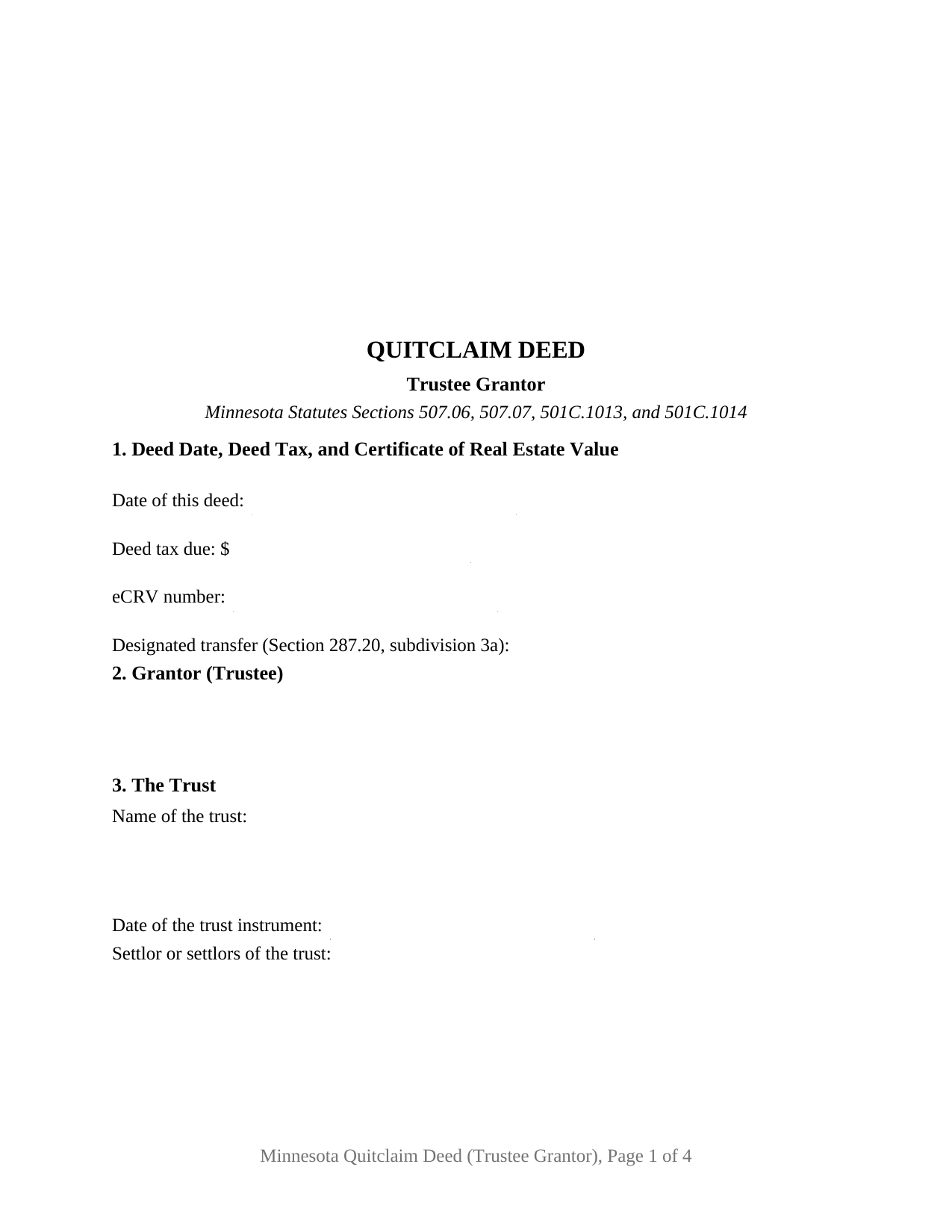
About the Minnesota Quitclaim Deed (Trustee Grantor)
How to Use This Form
- Select your county from the list
- Download the county-specific form
- Fill in the required information
- Have the document notarized if required
- Record with your county recorder's office
What Others Like You Are Saying
"The serevice was fast and accurate. I would highly recommend Deeds.com to my friends and associates."
"fast and easy to fill out forms."
"The forms and instructions were easy to follow and get complete. It was very nice to be able to just…"
"This was extremely helpful!"
"So easy and fast that even I could do it, and I'm technologically challenged! Thank you Deeds.com fo…"
4.8/5 from 4,828 reviews. Read all
Record title sits in a trust, and a trustee is the one holding the pen. The Minnesota Quitclaim Deed (Trustee Grantor) prepares a quitclaim conveyance out of a trust: one trustee is named as Grantor, one signature block and one acknowledgment certificate close the instrument, and a numbered section states where the signer's power to convey already appears in the county index. What the Grantee receives is measured by what the trust actually held, because the deed makes no promise about title.
Where a trustee's power to convey actually lives
A trustee's authority is not visible on the face of a deed, and Minnesota answers that with two recordable instruments. Section 501C.1013 authorizes a certificate of trust, an abstract of the trust instrument that subdivision 2 permits to be used for conveying or mortgaging an interest in real property. Subdivision 4 gives a recorded certificate its weight: it documents the trust's existence, the identity of the trustees, and the trustees' powers and their limits as though the whole trust instrument had been recorded. Section 501C.1014 adds the affidavit of trustee, proof that the trust is valid, that it has not terminated, that the powers reach the described land, and that the requisite number of trustees executed and delivered the conveyance. Section 4 of this form takes the instrument relied on, its document number, and the office holding it, so the deed and its authority read together in the record.
One trustee signs, and signs as trustee
The form recites a single Grantor, identified by name and by trustee capacity, with the trust named in Section 3 along with the date of the trust instrument and its settlors. Section 8 speaks the section 507.07 words conveys and quitclaims from that trustee and states in the same breath that the trustee acts solely as trustee and not individually. That sentence works rather than decorates: section 501C.1010, paragraph (a), provides that a trustee is not personally liable on a contract properly entered into in a fiduciary capacity while administering the trust if the trustee disclosed that capacity in the contract. The certificate follows the same logic, its blank carrying the signer's name together with the authority under which the signature was made, in the representative-capacity pattern of the section 358.66 short forms. Three transactions present this configuration: a successor trustee selling trust land after the settlor's death, a trustee distributing a parcel to a beneficiary, and a trustee of a revocable trust conveying back to the settlor who created it. One conveying trustee is what the form recites, so it is not set up for cotrustees who each need a signature block, nor for a conveyance into a trust.
The deed tax line runs both directions
Conveying land out of a trust does not always mean paying the percentage rate. Section 287.20, subdivision 3a, clause (4), defines a designated transfer as a transfer between a revocable trust and its own grantor, and the word between is what matters: the trip back out to the settlor qualifies just as the trip in did, so section 287.21 taxes it at $1.65 rather than 0.0033 of net consideration. A sale to a buyer and any conveyance out of an irrevocable trust sit outside the definition. Section 287.241, subdivision 1, keeps the arithmetic on the instrument by barring the recording of a taxable deed that states neither the tax due nor an exemption.
Registered land answers to the examiner first
The Abstract or Registered entry in Section 7 decides more than which office takes the deed. Section 508.62 provides that an instrument executed by an owner whose fee title to registered land is held in trust, and which transfers the land, is not registered without the written certification of the examiner of titles that the execution matches a power conferred in the trust instrument, evidenced in a certificate of trust, or otherwise authorized by law. Section 508A.62 repeats the rule for land registered under sections 508A.01 to 508A.85.
A certificate of trust and an affidavit of trustee are separate instruments, prepared and recorded on their own, and neither rides along here. A trustee's deed, a quit claim deed from a trust, and a Minnesota deed out of a living trust all name this same instrument. The package delivers the fillable form, a completed example built on a Stearns County sale by a successor trustee, and a guide covering each numbered section and the chapter 501C provisions behind it. The materials are informational and are not legal advice.
Important: County-Specific Forms
Our quitclaim deed (trustee grantor) forms are specifically formatted for each of the 87 counties in Minnesota.
After selecting your county, you'll receive forms that meet all local recording requirements, ensuring your documents will be accepted without delays or rejection fees.