Minnesota Quitclaim Deed (Two Grantors)
County Specific Legal Forms Validated as recently as October 9, 2026 by our Forms Development Team
About the Minnesota Quitclaim Deed (Two Grantors)
How to Use This Form
- Select your county from the list
- Download the county-specific form
- Fill in the required information
- Have the document notarized if required
- Record with your county recorder's office
What Others Like You Are Saying
"Documents are helpful and much appreciated. Grateful for this service when an attorney is not requir…"
"Best Way EVER to record a warranty deed! It was nice to not have to drive anywhere and find the faci…"
"Easy to use, thank you."
"The process was easy, and efficient. There was a person available to help if needed. Very pleased, w…"
"Uploading the document was simple, and it was recorded much faster than I thought! Deeds.com makes t…"
4.8/5 from 4,828 reviews. Read all
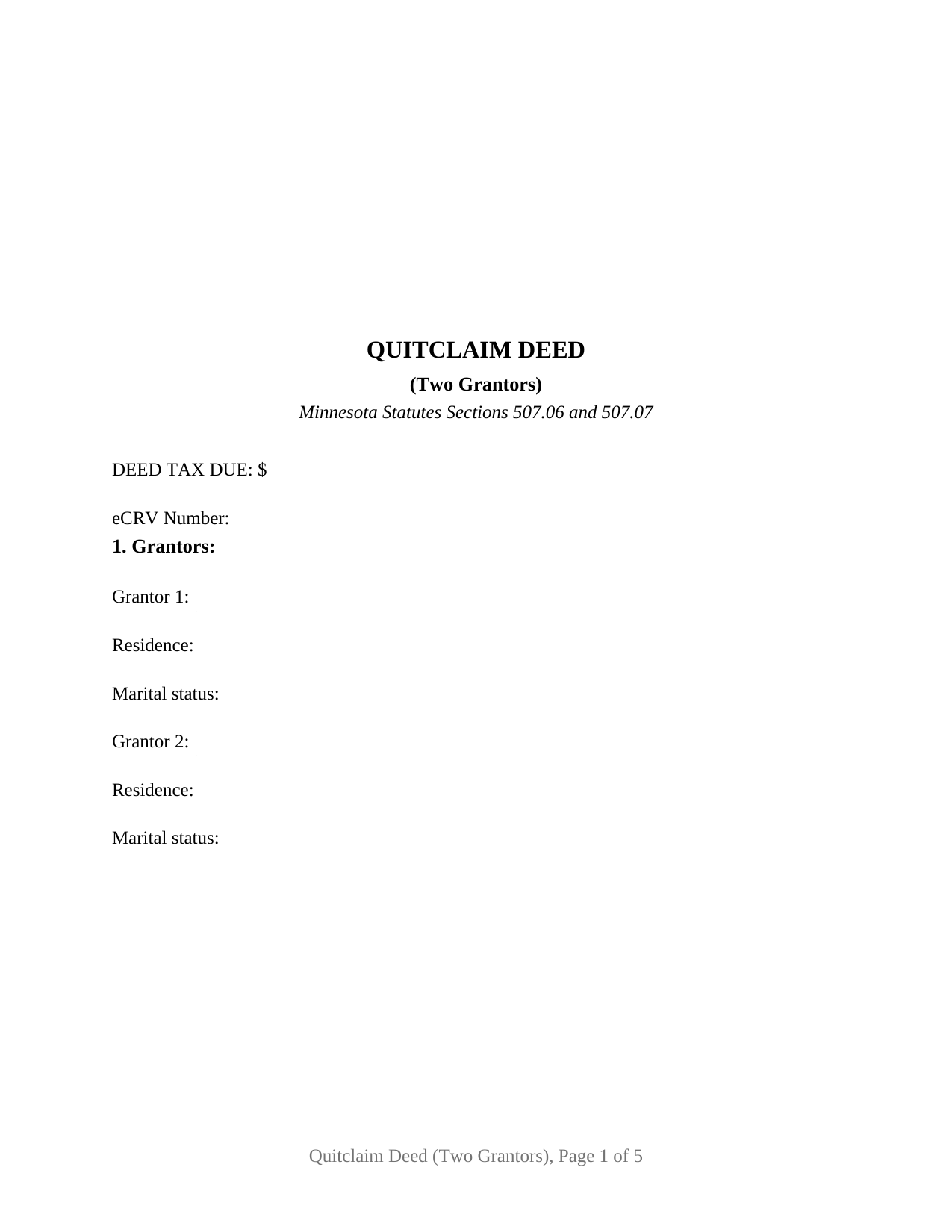
Two owners, one deed. The Minnesota Quitclaim Deed (Two Grantors) is a quitclaim conveyance built around a pair of record owners who convey together: Section 1 recites two grantors by name, with a residence and marital status line under each, and the deed closes with two signature blocks and two notary acknowledgment certificates, so each owner's execution stands on its own in the record. Everything the two grantors hold in the described Minnesota real estate passes to the grantee in a single recorded instrument, with no covenant or warranty of title.
Both halves of the title in one conveyance
Co-owned Minnesota land sits in one of the estates Minnesota Statutes section 500.19 recognizes, a joint tenancy where the deed expressly declared one, and otherwise a tenancy in common. Either way, a grantee who wants the whole parcel wants both interests, and a deed executed by both owners delivers the whole in one instrument instead of leaving the chain to assemble it from two. The two-grantor pattern fills Minnesota's indexes: spouses who took title together and convey together, siblings holding inherited fractional shares that move to a single buyer, and co-owners closing out a shared investment. The conveyance section speaks for both: the grantors, and each of them, convey and quitclaim to the grantee all interest in the described real estate, the section 507.07 quitclaim wording conjugated for a plural grantor, together with the hereditaments and appurtenances and an express statement that no title acquired later passes unless the deed adds words to that effect.
The homestead question answered on the face
Minnesota's homestead statute, section 507.02, makes a married owner's conveyance of the homestead valid only when both spouses sign. A two-grantor quitclaim deed meets that rule on its face whenever the conveying pair are spouses: both are grantors, both sign, and the marital status entries under the grantor names put the relationship in the record. When the two grantors are not married to each other, the same entries document each owner's status, and the guide describes what section 507.02 asks where a married co-owner's homestead is part of the land conveyed. That is the difference between this configuration and a single-owner conveyance: here the signature section itself can carry the whole statutory answer.
Two signatures, two certificates
The signature section dates the deed and gives each grantor a labeled block with a printed name and date line, followed by a separate acknowledgment certificate for each signer in the short form Minnesota notaries complete under section 358.66. Because the certificates are independent, the two grantors may appear before different notaries, in different counties or even different states, on different days, a practical point when co-owners live apart, as inheriting siblings often do. The certificates satisfy the acknowledgment step of section 507.24, the statute that keeps unacknowledged conveyances out of the Minnesota record, and the deed carries original signatures for paper recording.
Prepared for the counter, shown by example
The completed example walks a Dakota County transfer through the numbers: a married couple quitclaims a platted Eagan lot to a single grantee for $92,500, the deed tax line shows $305.25 at Minnesota's 0.0033 rate, the eCRV confirmation number sits on the face, and well disclosure statement (A) certifies no known wells on the property. The blank form carries the same machinery for any two-grantor transfer: the drafter statement and the tax statement address that Minnesota recording law makes conditions of recording, an Abstract or Registered (Torrens) entry that routes the deed to the recorder or the registrar of titles, and a full three inch first-page reserve for the county's recording and tax certification stamps. Searchers who reach this page looking for a quit claim deed for two sellers, joint owners, or co-heirs are looking at the same instrument Minnesota practice records every day under the statutory name.
The package delivers the Minnesota quitclaim deed form for two grantors as a fillable PDF, a completed example showing the Dakota County fact pattern above, and a guide covering every numbered section, the co-ownership forms a grantee may take under section 500.19, and the auditor, deed tax, eCRV, well disclosure, and recording steps. The materials are informational and are not legal advice.
Important: County-Specific Forms
Our quitclaim deed (two grantors) forms are specifically formatted for each of the 87 counties in Minnesota.
After selecting your county, you'll receive forms that meet all local recording requirements, ensuring your documents will be accepted without delays or rejection fees.