Minnesota Quitclaim Deed (Corporation Grantor)
County Specific Legal Forms Validated as recently as October 8, 2026 by our Forms Development Team
About the Minnesota Quitclaim Deed (Corporation Grantor)
How to Use This Form
- Select your county from the list
- Download the county-specific form
- Fill in the required information
- Have the document notarized if required
- Record with your county recorder's office
What Others Like You Are Saying
"Easy to purchase. Everything you need to get the job done!"
"So easy and fast. Since covid-19 is here, this option is perfect."
"Easy quick process to download at a reasonable price. Some good info provided."
"Very informative. It was very helpful."
"Happy to give you a 5 star rating. We have never been a position to get changes on and record our ow…"
4.8/5 from 4,831 reviews. Read all
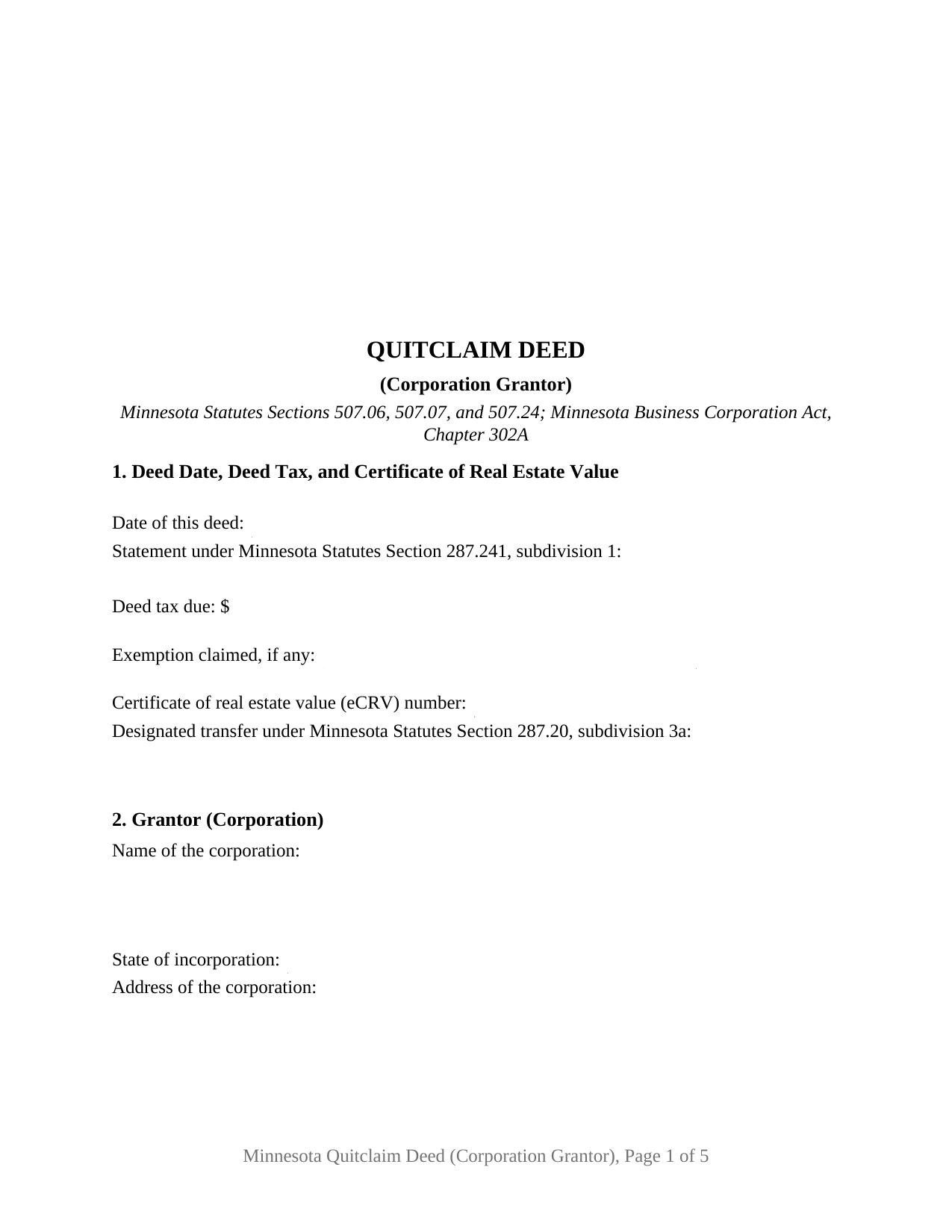
Minnesota names the officer who signs a corporation's deeds. Section 302A.305 of the Minnesota Statutes puts signing and delivering deeds in the name of the corporation among the chief executive officer's duties, and then attaches exceptions to it. The Minnesota Quitclaim Deed (Corporation Grantor) is built on that sentence: one corporation is named as Grantor, one officer signs for it, and a numbered section records where the power behind the signature comes from. Whatever interest the corporation holds in the described Minnesota real property passes to the Grantee, without warranty of title.
The signing duty, and what moves it
The clause granting that duty withdraws it in three situations: where the law requires another person to exercise the authority, where the articles or bylaws expressly delegate it, and where the board delegates it to another officer or agent. Section 302A.351 opens a fourth path, letting an officer delegate the powers of an office without board approval unless the articles, bylaws, or a board resolution prohibit it. Over all of them sits Section 302A.201, subdivision 1, under which a corporation's business and affairs are managed by or under the direction of a board. Section 5 takes the source relied on, and Section 12 takes the signer's title.
The approval question above the signature line
Section 302A.661 sorts corporate conveyances by size and by ordinariness. Subdivision 1 lets a corporation act by a majority of the directors present, with no shareholder approval, when it disposes of all or substantially all of its property and assets in the usual and regular course of business. Subdivision 2 covers the opposite case, where such a disposition outside that ordinary course takes the affirmative vote of holders of a majority of the voting power. Section 5 carries a second blank for that answer, so the deed states it on its face.
One corporation, one signature, one certificate
The form recites exactly one corporation as Grantor, with entries for its name, state of incorporation, and address, and exactly one authorized officer, whose block carries a signature, printed name, date, and officer title. Section 8 speaks the Section 507.07 statutory words conveys and quitclaims from the corporation and adds that the signing officer acts in the corporation's name and solely in a representative capacity. A single certificate follows the signature, drawn from the Section 358.66 short form for a signer acting in a representative capacity, so its blanks record the officer's name, the authority held, and the corporation the signature was made for. A corporation selling a parcel it has stopped using, a corporation moving one to an organization it owns entirely, and a corporation putting its current name on the record where an older instrument reads differently all present the single corporate grantor pattern this deed recites. It is not set up for two officers signing together, nor for a conveyance into a corporation. No spousal joinder block appears, because Section 507.02 speaks to a married owner and the record owner here is a corporation.
What conveys and quitclaims delivers
Section 507.07 supplies the statutory short form and the effect of its operative words: all right, title, and interest of the grantor passes, and title acquired afterward does not, unless added words say so. Chapter 507 carries no separate form for a corporate deed, so a corporation conveys with those same words, acknowledged under Section 507.24.
Deed tax on a reorganization, and the six month tail
Consideration usually drives the tax, at 0.0033 of net consideration above $3,000 under Section 287.21. One designated transfer category in Section 287.20, subdivision 3a, is written for corporate paper: clause (5), a transfer of substantially all the assets of one or more entities under a reorganization as that section defines it. It carries the $1.65 minimum, and Section 272.115, subdivision 6, sets the eCRV filing aside when the deed itself says on page one that a designated transfer is what it makes. Section 1 prints that entry beside the Section 287.241 tax statement. The Department of Revenue notes the tail: a change in the grantee entity's ownership within six months of recording makes deed tax retroactively due.
A corporate quit claim deed and a quitclaim deed from a corporation name this same instrument. The package delivers the fillable form, a completed example built on a Blue Earth County sale by a Mankato corporation, and a guide covering every numbered section, the chapter 302A authority provisions, and the county recording steps. The materials are informational and are not legal advice.
Important: County-Specific Forms
Our quitclaim deed (corporation grantor) forms are specifically formatted for each of the 87 counties in Minnesota.
After selecting your county, you'll receive forms that meet all local recording requirements, ensuring your documents will be accepted without delays or rejection fees.