Minnesota Quitclaim Deed
County Specific Legal Forms Validated as recently as October 5, 2026 by our Forms Development Team
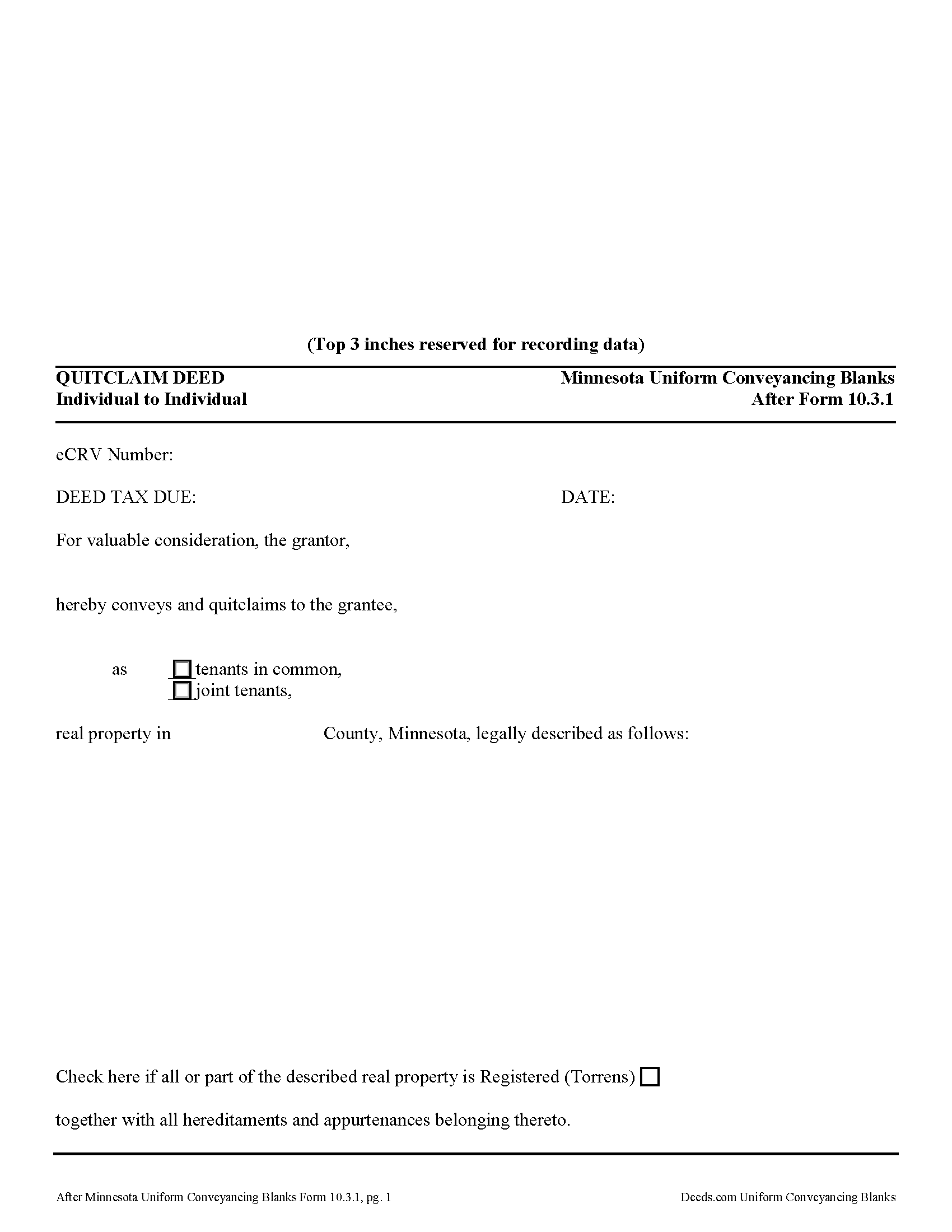
About the Minnesota Quitclaim Deed
How to Use This Form
- Select your county from the list
- Download the county-specific form
- Fill in the required information
- Have the document notarized if required
- Record with your county recorder's office
What Others Like You Are Saying
"Very easy to use."
"Your service was excellent"
"The online forms were very helpful and self-explanatory. My husband and I used several as we complet…"
"An excellent service that I would be happy to use again."
"I haven't used the forms yet, but was at the county recorders office and they looked at it and said …"
4.8/5 from 4,828 reviews. Read all
Minnesota answers the quitclaim deed's oldest question inside the recording act itself. Section 507.34 of the Minnesota Statutes protects a later buyer who takes in good faith and records first, and then adds a sentence written for this instrument: the fact that a conveyance was made by quitclaim deed does not by itself decide the question of that buyer's good faith, and is not by itself notice of an unrecorded conveyance. The deed promises nothing about title, and the statute keeps that silence from costing the grantee standing in the priority contest the record runs.
What conveys and quitclaims moves
Section 507.07 supplies the statutory short form and fixes what its operative words do. The deed passes all right, title, and interest of the grantor in the described premises, and it reaches no title the grantor picks up later unless words expressing that intention are added. Section 507.06 adds the outer edge of its reach: a deed of quitclaim and release passes all the estate the grantor could convey by a deed of bargain and sale. What travels is the grantor's present interest with the mortgages, easements, restrictions, and mineral reservations already attached to it. The conveyance section carries those statutory words, the hereditaments and appurtenances clause of Minnesota practice, and a plain statement that no covenant or warranty of title comes with the deed.
One or two names on each side
This is the general Minnesota quitclaim deed, built for individuals signing in their own right. The grantor blank takes one or two names with whatever status words the signers state, the grantee blank takes one or two names with any words describing how they take title, and the execution area carries a signature block and an acknowledgment certificate for each of the two grantor positions, the second of each left blank where one grantor conveys. Nothing about marriage, capacity, or co-ownership is preprinted anywhere on the instrument, so the four count patterns read as one document: a single grantor to a single grantee, one grantor to two grantees, two grantors to one grantee, and two grantors to two grantees. What the grantee blank says decides survivorship, because section 500.19, subdivision 2, gives two or more grantees a tenancy in common wherever the deed does not expressly declare a joint tenancy. The form is not set up for an entity grantor whose signing authority comes from its own chapter, for a trustee or an attorney-in-fact signing for someone else, for three or more owners on either side, or for a conveyance that reserves a life estate, since the conveyance section passes the grantor's whole interest without reservation.
The face a Minnesota recorder reads
Minnesota fixes a good deal of what appears on a deed. Section 507.093 leaves the top three inches of page one blank, the right half for county recording information and the left half for tax certification, and the form prints nothing there. Section 507.091 puts the drafter's name and address on the instrument, and section 507.092 conditions recording on a grantee name and address for future property tax statements. Section 287.241 bars recording a taxable deed that states neither the tax due nor an exemption, so the first numbered section carries that entry beside the eCRV number section 272.115 assigns to a sale for more than $3,000. The three lettered well disclosure statements of section 103I.235 sit in their own section with a blank for the letter that applies, and an Abstract or Registered (Torrens) entry marks whether the deed goes to the county recorder or to the registrar of titles.
Auditor, deed tax, then the record
The path runs through two county offices. Section 272.12 sends the deed to the auditor for the transfer entry and tax certification first, and the recorder refuses an instrument arriving without that statement. State deed tax under section 287.21 runs at 0.0033 of net consideration above $3,000 and $1.65 at or below it, with 0.0001 added in Hennepin and Ramsey Counties. Recording and indexing is a flat $46 under section 357.18, which section 357.182 keeps counties from adding to.
A quit claim deed, a quick claim deed, and a Minnesota quitclaim deed form all name this same instrument. Included here: the fillable form, a completed example built on a Stearns County sale by two grantors to two grantees taking as joint tenants, and a guide covering every numbered section, the estates section 500.19 recognizes, and each county step. The materials are informational and are not legal advice.
Important: County-Specific Forms
Our quitclaim deed forms are specifically formatted for each of the 87 counties in Minnesota.
After selecting your county, you'll receive forms that meet all local recording requirements, ensuring your documents will be accepted without delays or rejection fees.