Minnesota Quitclaim Deed (Individual Grantor by Attorney-in-Fact)
County Specific Legal Forms Validated as recently as October 6, 2026 by our Forms Development Team
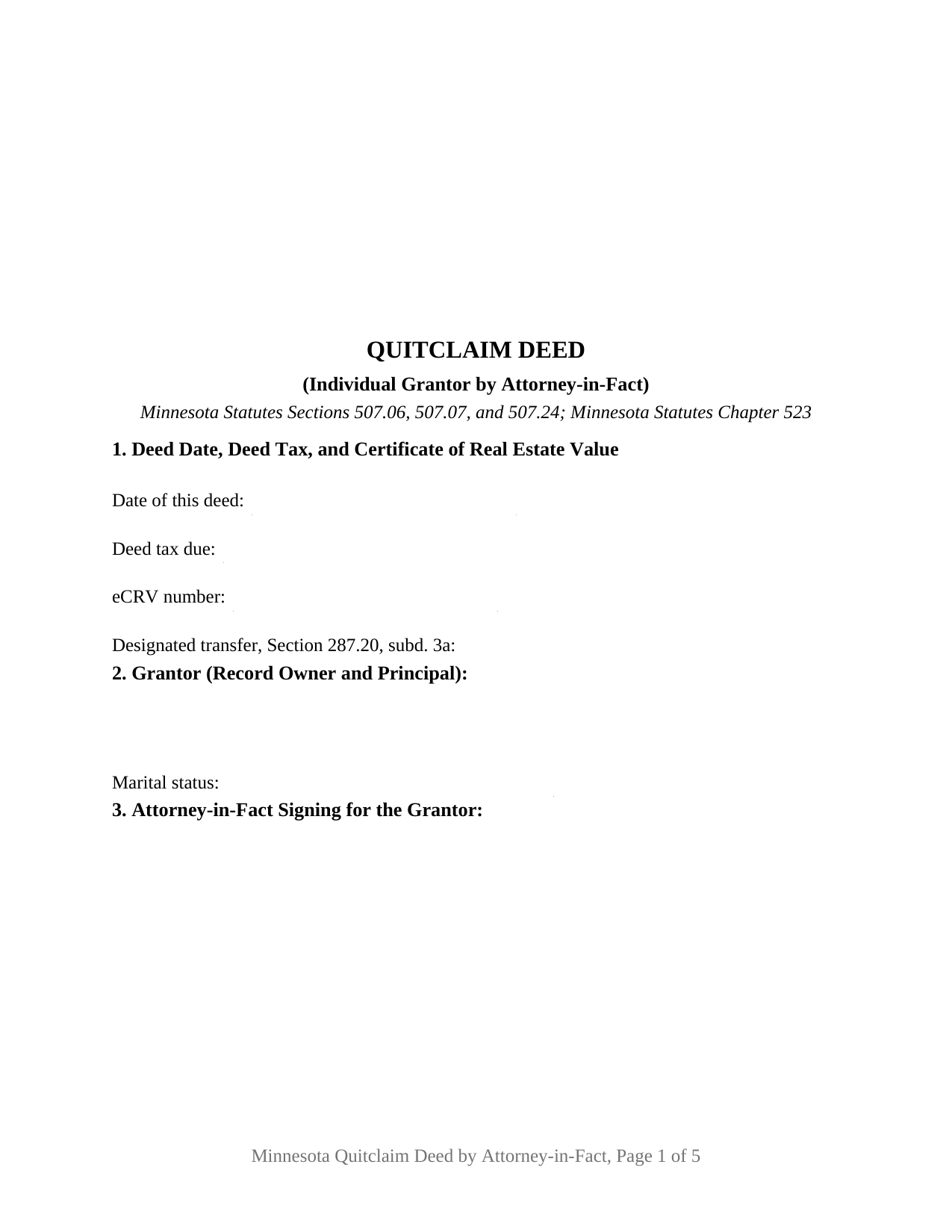
About the Minnesota Quitclaim Deed (Individual Grantor by Attorney-in-Fact)
How to Use This Form
- Select your county from the list
- Download the county-specific form
- Fill in the required information
- Have the document notarized if required
- Record with your county recorder's office
What Others Like You Are Saying
"Deeds.com recorded documents for me without any issue. It's a good service and provides a lot of ass…"
"Review: Forms are on point, to the point, and cover the vast majority of situations. Would not sugge…"
"First time user and I was pleasantly surprised how quick and easy it was to get my Deed recorded. An…"
"Easy and quick. I will always use this efficient service even if the recorders office opens again!"
"All I needed to do was changed from my previously married name to my now maiden name and a Quit Clai…"
4.8/5 from 4,833 reviews. Read all
Someone else holds the pen, and the deed still says the owner conveyed. The Minnesota Quitclaim Deed (Individual Grantor by Attorney-in-Fact) prepares that instrument: one individual is named as Grantor and principal, one attorney-in-fact signs in the Grantor's name under a written power of attorney, and a numbered section records the date, document number, and office of the power behind the signature. What the Grantee takes is the interest the principal held, measured by the record, because the deed makes no promise about title.
Minnesota names the power by name
Minnesota does not leave this authority to inference. Section 523.24, subdivision 1, of the Minnesota Statutes defines what general authority over real property transactions means in a statutory short form power of attorney, and the definition authorizes the attorney-in-fact to sell, exchange, convey with or without covenants, quitclaim, release, mortgage, encumber, and otherwise dispose of any estate or interest in real property. Quitclaim sits in that list as its own verb. The short form is section 523.23, and section 523.02 keeps common law, older, and out-of-state written powers inside the same chapter. One trap carries its own subdivision: under section 523.23, subdivision 3a, a street address used in place of a legal description under the real property power invalidates that power for every real property transaction.
One owner, one signer, one certificate
The form recites exactly one record owner as Grantor and principal, with a marital status entry, and one attorney-in-fact, whose block carries a signature, printed name, and date. Section 4 takes five entries about the authority: the date of the power of attorney, its document number, the office and county holding it, the form of the power, and the power exercised. Section 9 speaks the section 507.07 statutory words conveys and quitclaims for the Grantor acting by and through the attorney-in-fact, and adds that the signer executes in the Grantor's name and not individually, conveying no interest of the signer. One acknowledgment certificate closes the instrument, in the representative capacity short form of section 358.66, naming the signer and the capacity in which the signature was made. An adult child selling a parent's homestead under a recorded power presents the single-agent pattern this deed recites. It is not set up for two record owners, for co-agents who each sign, or for an entity principal, whose authority section 523.17, subdivision 3, routes through different statutes. No spousal joinder block appears, though section 507.02 belongs in the reading: it conditions a married owner's homestead conveyance on both signatures and states that a spouse's signature may be made by that spouse's own attorney-in-fact.
The proof of authority travels separately
Minnesota does not ask the deed to prove the agent's power. Section 523.17 supplies an affidavit by the attorney-in-fact that identifies the power by date and recording data, names the principal and the property, and states that the affiant has no actual knowledge or notice of revocation or termination by death, incapacity, or otherwise. Subdivision 2 gives it force: the affidavit is conclusive proof, as to a party relying on it, that the power has not terminated or been revoked and that the powers reached the described property, subject to the actual-knowledge exceptions listed there. Section 523.05 makes the power and the affidavit recordable when authenticated for record under section 507.24. Both are prepared and recorded separately and are not included here, which is why Section 4 asks for the data the affidavit form recites.
Scott County, by the numbers
The completed example runs a Scott County sale: an agent conveys his mother's platted Shakopee lot to two buyers who take as joint tenants for $268,000, with $884.40 of deed tax at the 0.0033 rate of section 287.21, an eCRV number in Section 1, well disclosure statement (A) under section 103I.235, and Abstract land in Section 6, which sends the deed to the recorder rather than the registrar of titles. Under section 272.12 the auditor makes the transfer entry and certifies the taxes first; then the recorder takes the instrument at the flat $46 fee section 357.18 sets, and section 507.34 does the rest.
A power of attorney deed, a quit claim deed signed by an agent, and a Minnesota quitclaim deed under a POA name this same instrument. The package delivers the fillable form, the completed example built on the Scott County facts above, and a guide covering every numbered section, the chapter 523 authority and affidavit provisions, and each county step. The materials are informational and are not legal advice.
Important: County-Specific Forms
Our quitclaim deed (individual grantor by attorney-in-fact) forms are specifically formatted for each of the 87 counties in Minnesota.
After selecting your county, you'll receive forms that meet all local recording requirements, ensuring your documents will be accepted without delays or rejection fees.