Montana Transfer on Death Deed (Sole Owner, Multiple Beneficiaries (Equal Shares))
County Specific Legal Forms Validated as recently as November 11, 2026 by our Forms Development Team
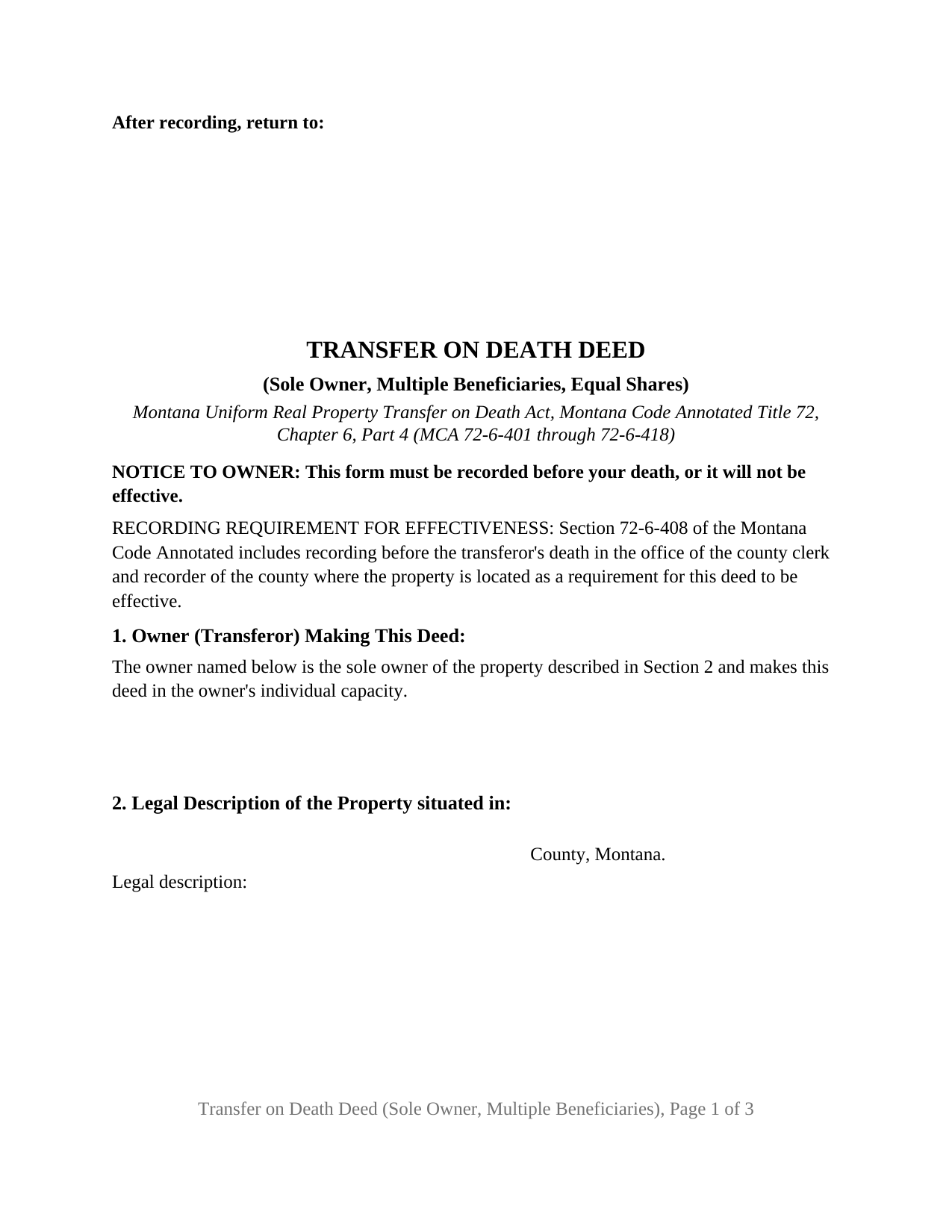
About the Montana Transfer on Death Deed (Sole Owner, Multiple Beneficiaries (Equal Shares))
How to Use This Form
- Select your county from the list
- Download the county-specific form
- Fill in the required information
- Have the document notarized if required
- Record with your county recorder's office
What Others Like You Are Saying
"It was a simple process and easily understood the process was seamless and I would highly recommend …"
"This was our first time using Deeds.Com. We were tremendously impressed. The website works well, but…"
"The forms were easy to request. I'm assuming that the download will be as well. Im so glad that I ca…"
"easy sight and extra forms that I can use any time"
"Good"
4.8/5 from 4,852 reviews. Read all
One Montana owner, holding the property alone, names several people to take it at death, each in an equal and undivided share, and the shares are written into the deed rather than left to a default. This form prepares that Montana transfer on death deed for a sole owner and two or more primary beneficiaries under the Montana Uniform Real Property Transfer on Death Act, MCA 72-6-401 through 72-6-418, the instrument Montana buyers also search for as a TOD deed or, under the pre-2019 name, a beneficiary deed.
Equal shares, stated in the deed
Montana's act supplies a rule for concurrent beneficiaries: under MCA 72-6-412(1)(c), except as the deed otherwise provides, concurrent interests pass to the beneficiaries in equal and undivided shares with no right of survivorship. That rule is a default, and a default lives in the statute, where a beneficiary, a title examiner, or a later purchaser has to go looking for it. This deed moves the rule onto the face of the instrument. Section 5 designates the beneficiaries, two or more in number, each taking if that beneficiary survives the owner, and states that the beneficiaries who survive take the property in equal and undivided shares with no right of survivorship. The equal division is a fixed term of the deed, not a blank the owner fills and not a box the owner checks, so three children named in the beneficiary block take one third each, and four take one quarter each, by the deed's own words.
The act permits an owner to provide otherwise, and a deed that divides the property unequally, that creates survivorship among the beneficiaries, or that names one beneficiary alone follows a different pattern from the one this deed recites. What the fixed term buys is certainty: the beneficiaries take exactly the shares the statute would have given them, and the deed says so where everyone reading the record can see it.
When one of the beneficiaries dies first
A transfer on death deed names people who may not outlive the owner, and the Montana act answers the question the deed cannot. Under MCA 72-6-412(1)(b), each beneficiary's interest is contingent on surviving the owner, measured with the 120 hour rule of MCA 72-2-712, and an interest that fails to survive lapses. Under MCA 72-6-412(1)(d), where the owner named two or more beneficiaries to take concurrent interests, the share of one that lapses or fails for any reason passes to the other or others in proportion to their interests in the remaining concurrently held part. Section 5 of this deed restates that lapse rule in its own text, so that a beneficiary who dies before the owner drops out and the survivors divide the whole among themselves equally. The deed does not substitute a deceased beneficiary's children, does not create a condition on any share, and does not offer the owner a menu of lapse outcomes, because the act supplies none.
Section 6 carries an optional alternate designation adapted from the optional statutory form at MCA 72-6-415: if no primary beneficiary survives the owner, the alternate beneficiary or beneficiaries named there take, two or more of them in equal and undivided shares with no right of survivorship. The alternate operates only when every primary designation has failed. The beneficiary blocks ask for each person's name and mailing address, and the act's definition of a person at MCA 72-6-402(4) reaches a trust and an entity as well as an individual, so a charity or a trust can stand among the equal takers.
One owner, one signature, one certificate
The deed recites exactly one owner, identified in Section 1 as the sole owner of the described property making the deed in the owner's individual capacity. Nothing about marital status is preprinted and no status blank is drawn; the owner's name and mailing address are entered as the vesting deed shows them. The form carries one signature block and one acknowledgment certificate in the Montana short form of MCA 1-5-610(1), which reads that this record was acknowledged before me on the stated date by the named owner, with the venue left to the place where the owner actually appears. An owner who is married but holds record title alone is still the sole owner the deed recites, and the deed draws no signature line for a spouse who is not an owner: Montana's co-ownership statute lists joint interests, partnership interests, and interests in common and no community property or tenancy by the entirety (MCA 70-1-306), the estates of dower and curtesy are abolished (MCA 72-2-122), and MCA 72-6-411 provides that the deed affects no interest and creates no interest while the owner lives; the guide sets the declared-homestead joinder statute, MCA 70-32-301, beside that rule. The form is not set up as an instrument for two record owners, for a corporation, limited liability company, or trustee holding record title, or for an agent signing under a power of attorney, and three or more owners are outside the scope of a static form.
The statutory form's sentences, and the one condition that cannot be missed
Montana's optional form at MCA 72-6-415 is permissive; the statute says it may be used and that the other sections of the act govern any instrument used to create a transfer on death deed. This deed carries the form's transfer sentence and its revocation sentence verbatim in Section 7: at the owner's death the owner transfers the owner's interest in the described property to the beneficiaries as designated above, and before death the owner has the right to revoke the deed. A third sentence states that the deed transfers the property without covenant or warranty of title, which MCA 72-6-412(4) makes true of every Montana TOD deed whatever the deed says.
The form also prints, under the title, the statutory form's own notice that the deed must be recorded before the owner's death or it will not be effective, beside a restatement of MCA 72-6-408(3). Recording in the office of the clerk and recorder of the county where the property lies is the one requirement whose absence defeats the deed silently, which is why it stays on the recorded page while every other instruction lives on the removable cover and in the guide. The layout follows MCA 7-4-2636: letter size paper, a three inch space at the top of the first page with the return name and mailing address inside it, one inch margins elsewhere, and twelve point type, with the beneficiaries' mailing addresses satisfying the grantee address prerequisite of MCA 7-4-2618. The Department of Revenue's published materials state that no Realty Transfer Certificate is filed when a transfer on death deed is first recorded; that certificate accompanies the beneficiaries' filing after the owner's death, which is prepared separately and is not part of this package.
The package includes the fillable Montana transfer on death deed for a sole owner naming multiple beneficiaries in equal shares, a completed example filled in for a Missoula County owner naming three children with one alternate, and the guide that walks through each numbered section, the acknowledgment certificate, and the trip to the clerk and recorder. The description above and the guide explain the form and the Montana statutes behind it in general terms only; neither is legal advice.
Important: County-Specific Forms
Our transfer on death deed (sole owner, multiple beneficiaries (equal shares)) forms are specifically formatted for each of the 56 counties in Montana.
After selecting your county, you'll receive forms that meet all local recording requirements, ensuring your documents will be accepted without delays or rejection fees.