Montana Transfer on Death Deed (Two Joint Owners with Right of Survivorship, Last Survivor)
County Specific Legal Forms Validated as recently as November 11, 2026 by our Forms Development Team
About the Montana Transfer on Death Deed (Two Joint Owners with Right of Survivorship, Last Survivor)
How to Use This Form
- Select your county from the list
- Download the county-specific form
- Fill in the required information
- Have the document notarized if required
- Record with your county recorder's office
What Others Like You Are Saying
"I was amazed! This company is so incredibly fast! They promised 10 minutes, it was actually less and…"
"Deeds.com has saved me quite a bit in attorney fees by making legal forms available on line. Easy to…"
"This is my very first use with your company. I submitted my package and within the hour you had resp…"
"I bought the Quitclaim deed and it was perfect to record at the courthouse"
"The service was easy, fast, and worked well. I will be back."
4.8/5 from 4,850 reviews. Read all
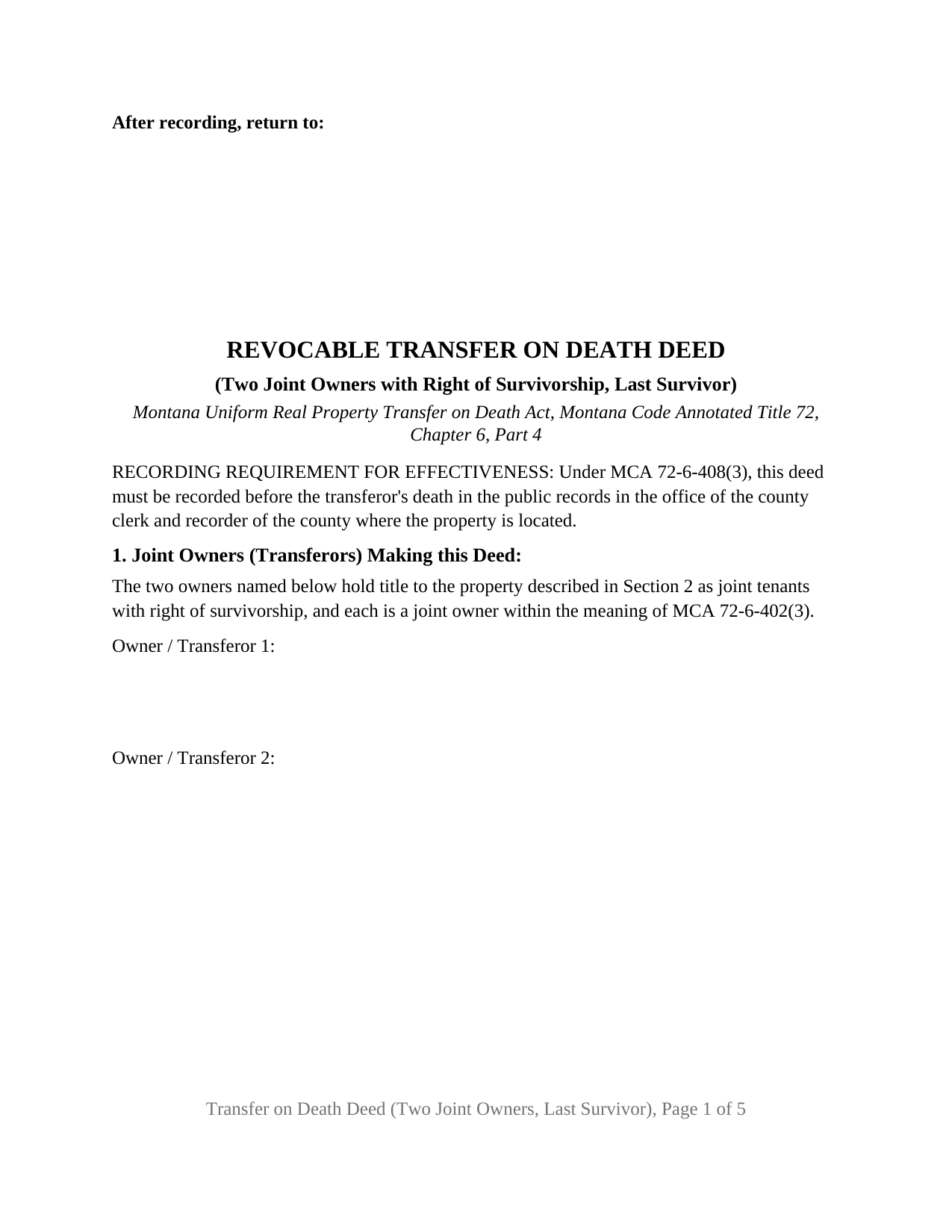
Two Montana co-owners who hold their real property as joint tenants with right of survivorship can name, in a single recorded deed, who receives the property after both of them have died. This fillable Montana transfer on death deed is drafted for exactly that pair: two joint owners signing one deed under the Montana Uniform Real Property Transfer on Death Act, MCA 72-6-401 through 72-6-418, with the transfer waiting for the death of the last surviving joint owner.
A deed that waits for the second death
Montana built the timing for co-owners into the act itself rather than leaving it to the drafter. MCA 72-6-412(3) provides that when a transferor who is a joint owner dies survived by another joint owner, the property belongs to the surviving joint owner with right of survivorship, and that when the transferor is the last surviving joint owner, the transfer on death deed is effective. The first death therefore changes nothing in the deed: the survivorship already in the title carries the whole property to the surviving owner, and the designated beneficiaries wait. At the second death the deed operates and the beneficiaries take without probate, subject to the mortgages, liens, and other interests then affecting the property under MCA 72-6-412(2).
The deed states that sequence in its own operative section. Each owner, as a transferor, transfers that owner's interest to the designated beneficiaries at the owner's death, the statement MCA 72-6-408(2) requires of every TOD deed, and the deed then recites the joint owner rule of MCA 72-6-412(3) and fixes the survival measure on the last surviving joint owner. A beneficiary who outlives the first owner but not the second takes nothing; under MCA 72-2-712(2), which the act applies, survival is measured at 120 hours.
Why the vesting deed decides whether this form applies
MCA 72-6-402(3) defines a joint owner as an individual who owns property concurrently with others with a right of survivorship; the definition includes a joint tenant and excludes a tenant in common. In Montana that distinction is written in the vesting deed. Under MCA 70-1-314, a transfer to two or more persons, a husband and wife included, creates an interest in common unless the interest was acquired in partnership or the transfer expressly declares a joint tenancy under MCA 70-1-307, and MCA 70-20-310 locates the right of survivorship in the grant itself. A deed to two people with no survivorship words makes them tenants in common, and a tenant in common's transfer on death deed passes that owner's own undivided interest at that owner's own death, with no waiting for a second death. The guide walks through reading the vesting instrument for the joint tenancy declaration and the survivorship words, and the deed's Section 4 identifies that instrument by its recording reference.
Revocation takes both living owners
A deed made by joint owners is revoked only if it is revoked by all of the living joint owners, MCA 72-6-410(2)(b). Neither owner can quietly undo the recorded designation alone while the other lives; after the first death the surviving owner, now the only living joint owner, may revoke. The revoking instrument is one of the three MCA 72-6-410(1) names, a later transfer on death deed, an instrument of revocation, or a lifetime deed that expressly revokes, each acknowledged after this deed and recorded before death in the same county. A will does not revoke a recorded TOD deed, and under MCA 72-6-410(4) a lifetime transfer of the property revokes any prior transfer on death deed to it. The optional revocation form Montana prints at MCA 72-6-416 is a separate instrument, prepared and recorded separately and not included in this package.
What this configuration recites and who signs
The form recites exactly two record owners who hold title as joint tenants with right of survivorship, each a joint owner under MCA 72-6-402(3), and prints that configuration as fixed deed text above the two owner blocks. Both owners sign the same deed, in two signature blocks that share a page, and the form carries a separate Montana short-form acknowledgment certificate for each owner under MCA 1-5-610(1), with an area reserved under each certificate for the notary's official stamp, so the two owners may acknowledge on different dates or before different notarial officers. The owner blocks take names and mailing addresses only; nothing about marital status is preprinted, because Montana recognizes no community property or tenancy by the entirety in real property and the two joint tenants may be spouses, siblings, a parent and an adult child, or business partners who took title together with survivorship words. The completed example shows two siblings in Gallatin County naming two primary beneficiaries in equal undivided shares and a nonprofit foundation as alternate. A sole owner's designation, a deed by tenants in common, a deed by three or more co-owners, and a deed by an entity, a trustee, or an agent under a power of attorney each follow a different pattern, and the form is not set up for them.
Beneficiaries, shares, and the recording condition
The primary and alternate beneficiary blocks take individuals, trusts, or entities, the full reach of the act's definition of a person in MCA 72-6-402(4), each with a mailing address, since under MCA 7-4-2618 the clerk and recorder may not receive a deed for recording unless the grantee's post-office address is contained in it. When the deed names two or more primary beneficiaries and states no shares, they take equal and undivided shares under MCA 72-6-412(1)(c), with no survivorship among them; a share that lapses passes to the remaining primary beneficiaries in proportion to their interests under MCA 72-6-412(1)(d), and the alternate takes only if no primary beneficiary survives. Recording is the condition everything else depends on. MCA 72-6-408(3) makes recording before the transferor's death, with the clerk and recorder of the county where the land lies, a requirement of the deed's effectiveness, and the form prints that requirement directly under its title. The layout is built to the standard-document rules of MCA 7-4-2636, with the return name and mailing address inside the three-inch recording reserve at the top of page one, so the deed records at the standard fee of MCA 7-4-2637, $20 for the first page and $10 for each page after it, without the nonstandard surcharge.
The package includes the fillable Montana transfer on death deed for two joint owners, a completed example filled in for a Gallatin County fact pattern, and the guide, which walks through each numbered section, the signing and acknowledgment process, the joint owner and divorce rules, and recording at the clerk and recorder's office. The description and the guide speak in general terms about the form and the Montana statutes that govern it; neither is legal advice.
Important: County-Specific Forms
Our transfer on death deed (two joint owners with right of survivorship, last survivor) forms are specifically formatted for each of the 56 counties in Montana.
After selecting your county, you'll receive forms that meet all local recording requirements, ensuring your documents will be accepted without delays or rejection fees.