Montana Transfer on Death Deed (Sole Owner, Trust Beneficiary)
County Specific Legal Forms Validated as recently as November 11, 2026 by our Forms Development Team
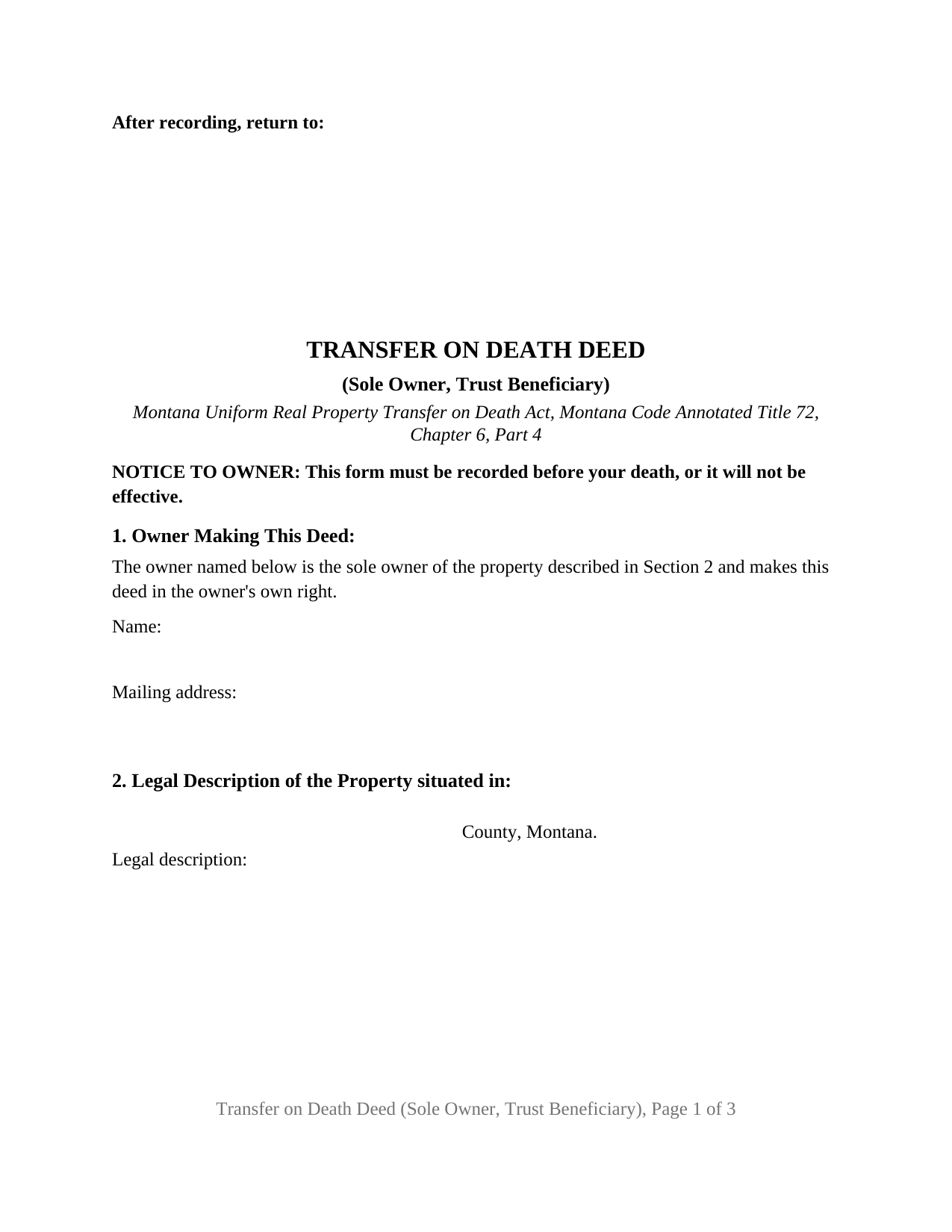
About the Montana Transfer on Death Deed (Sole Owner, Trust Beneficiary)
How to Use This Form
- Select your county from the list
- Download the county-specific form
- Fill in the required information
- Have the document notarized if required
- Record with your county recorder's office
What Others Like You Are Saying
"Thank you for being here. very easy to understand and your site is great. I will always use you."
"LOVE this site.. easy to use and very very quick to record"
"Very informative. I submitted my form.The county accepted it. Thank you."
"I got what I needed very quickly. Thank you."
"Completely painless process! Great customer service! Thank you for everything!"
4.8/5 from 4,850 reviews. Read all
A living trust holds property only after something puts the property into it. For a Montana homeowner who has signed a revocable living trust but would rather keep the house titled in the owner's own name for life, this form prepares a Montana transfer on death deed that names the trustee of the trust as beneficiary: one owner, the sole owner of the property, signing alone, and a trust rather than an individual on the receiving end. At the owner's death the property passes to the trustee under MCA 72-6-412 and is held and distributed under the terms of the trust, with no probate and no lifetime deed into the trust.
Funding a trust at death instead of during life
The usual way to put real property into a living trust is a deed from the owner to the owner as trustee, recorded now. That works, but it changes the record title during the owner's life, and it has to be undone by another deed if the owner later wants the property out of the trust. The transfer on death deed reaches the same destination from the other direction. Under MCA 72-6-411 the deed has no effect while the owner lives: the owner remains the record owner, keeps every right to sell, mortgage, lease, or give the property away, and can revoke the designation at any time, while the trustee acquires nothing. The trust is funded with the real property at the moment of death, by the recorded deed, and the successor trustee steps in under the trust instrument rather than under a probate order. The Montana Uniform Real Property Transfer on Death Act, Title 72, chapter 6, part 4 of the Montana Code Annotated, permits exactly this: MCA 72-6-402(4) defines the person who may be designated as a beneficiary to include a trust, alongside individuals, corporations, and other entities.
How the trust is named on the deed
The beneficiary section of this deed is fixed to a trust and asks for four things: the name of the trust, the date of the trust instrument, the current trustee or trustees, and the trustee's mailing address. The designation itself is preprinted, in the words of the MCA 72-6-415 statutory form followed by the trust language this configuration adds: the beneficiary is the trustee of the identified trust, and any successor trustee of that trust, to hold the property under the terms of that trust. Naming the office rather than the individual matters because MCA 72-38-103 defines a trustee to include an original, additional, and successor trustee, so the designation does not hang on one named person outliving the owner. The trustee's mailing address is there because MCA 7-4-2618 keeps a deed out of the record unless it contains the grantee's post-office address. The trust instrument itself stays private; it is not recorded with the deed, and after the death the trustee can show authority with a certification of trust under MCA 72-38-1013, a separate instrument recorded separately and not included in this package.
An optional alternate beneficiary section, again in the statutory form's own sentence, names who takes if the primary designation fails. A trust that has been revoked or has terminated before the owner's death is the case that section covers; without an alternate, the lapse rule of MCA 72-6-412(1)(b) leaves the property to pass under the owner's will or by intestacy, and the guide explains how the act's survival contingency, written for individuals, reads against a trust beneficiary.
One owner, one signature, one certificate
The form recites exactly one record owner, identified in a fixed recital as the sole owner of the property and signing in the owner's own right, with one signature block and one acknowledgment certificate in the Montana short form of MCA 1-5-610(1). Nothing about marital status is printed or asked. Montana recognizes no community property and no tenancy by the entirety in real property, and MCA 72-2-122 abolishes dower and curtesy, so a married owner who holds the whole title alone is the owner this deed describes and signs it alone; the guide sets the homestead joinder statute, MCA 70-32-301, beside the act's rule that the deed affects no interest during life. A single owner who holds a home in the owner's own name and has created a revocable living trust with a child or a bank as successor trustee presents the pattern this deed recites. The form is not set up as a deed by two co-owners, as a deed by an owner who already holds title as trustee, as a deed signed by an agent under a power of attorney, or as a designation of individuals or several beneficiaries as the primary beneficiary; each of those follows a different pattern.
Recording before death, with no transfer certificate yet
MCA 72-6-408 makes recording before the owner's death, with the clerk and recorder of the county where the property sits, a condition of the deed's effectiveness, and the deed carries the statutory form's notice of that condition on its face. The layout follows MCA 7-4-2636, with the return name and mailing address in the upper left corner of the first page inside the three-inch recording band, and for documents recorded on or after October 1, 2025 the clerk and recorder's fee under MCA 7-4-2637 is $20 for the first page and $10 for each additional page. Montana's Department of Revenue states that no Realty Transfer Certificate is filed when a TOD deed is first recorded, because no transfer has yet occurred; the certificate, with a copy of the recorded deed and a certified death certificate, belongs to the trustee's filing after the death. The completed example is filled in for a Missoula County owner naming the trustee of her own revocable living trust, with her son as alternate.
Three items make up the package: the fillable Montana transfer on death deed naming a trust beneficiary, the completed Missoula County example, and the guide, which covers every section of the form, the acknowledgment, and the recording step. Neither this description nor the guide applies Montana law to any particular owner or trust, and neither is legal advice.
Important: County-Specific Forms
Our transfer on death deed (sole owner, trust beneficiary) forms are specifically formatted for each of the 56 counties in Montana.
After selecting your county, you'll receive forms that meet all local recording requirements, ensuring your documents will be accepted without delays or rejection fees.