Montana Transfer on Death Deed (Sole Owner, Primary and Alternate Beneficiary)
County Specific Legal Forms Validated as recently as November 11, 2026 by our Forms Development Team
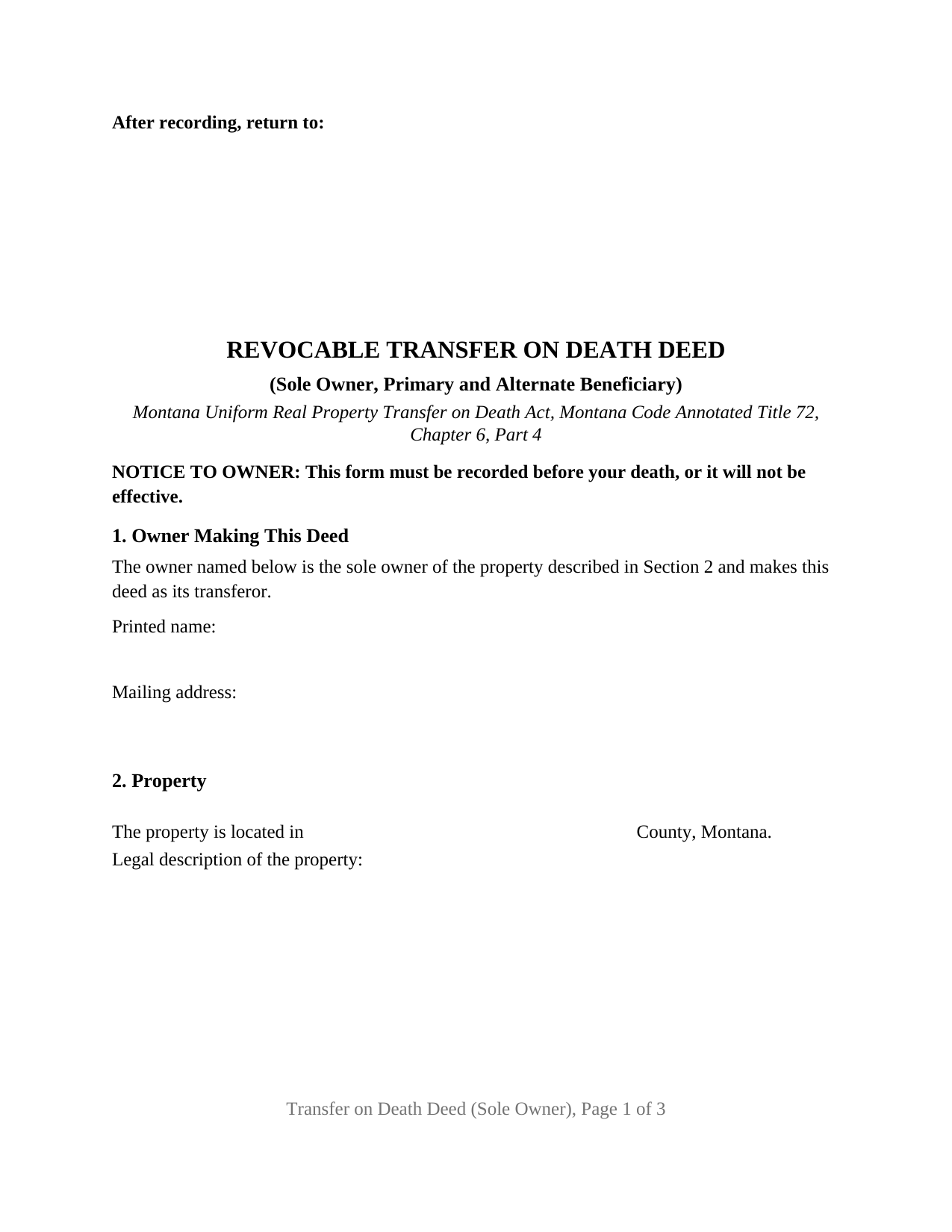
About the Montana Transfer on Death Deed (Sole Owner, Primary and Alternate Beneficiary)
How to Use This Form
- Select your county from the list
- Download the county-specific form
- Fill in the required information
- Have the document notarized if required
- Record with your county recorder's office
What Others Like You Are Saying
"Very quick process and forms were downloaded. I am very pleased with the detailed information for fi…"
"Easy, convenient, and very reasonably priced. I really appreciate the comprehensive step-by-step ins…"
"Easy to navigate. The guide and sample helped a lot, including the availability of "Exhibit A". Know…"
"It was all I needed and guided me to fill it out."
"This service was easy, quick, and to the point. It was a lifesaver! Downloaded quickly and without i…"
4.8/5 from 4,852 reviews. Read all
A Montana transfer on death deed made by one owner, naming one primary beneficiary and one alternate who steps in only if the primary does not survive, is the designation chain the Montana statutory form itself prints, and this form carries that chain in the statute's own words. It recites a single person who holds Montana real property alone and signs alone, under the Montana Uniform Real Property Transfer on Death Act, Montana Code Annotated Title 72, chapter 6, part 4.
One owner, one signature, one certificate
The form recites exactly one owner: the person named in Section 1 is the sole owner of the described property and makes the deed as its transferor. There is no second owner block, no marital status recital, and no vesting language anywhere on the instrument, because a sole owner's title is simply what the vesting deed granted to that one person. Montana has no community property regime and no tenancy by the entirety in real property, and MCA 72-2-122 abolishes dower and curtesy, so a spouse who is not on the title has no signature line. The homestead joinder rule of MCA 70-32-301 reaches a conveyance or encumbrance of a declared homestead, and under MCA 72-6-411 a transfer on death deed is neither: during the owner's life it affects no interest or right of the owner, creates no interest in the beneficiary, and keeps the owner free to sell, mortgage, or give the property away. One signature block and one acknowledgment certificate follow, the certificate in the Montana short form of MCA 1-5-610(1) with a reserved area for the notary's official stamp, which MCA 1-5-609 makes part of the certificate.
A primary beneficiary, and an alternate who waits
Montana's optional statutory form at MCA 72-6-415 designates a primary beneficiary with one sentence and an alternate with another, and this deed prints both sentences verbatim. The primary beneficiary takes if the beneficiary survives the owner. If the primary beneficiary does not survive, the alternate takes, provided the alternate survives. Survival has a statutory measure: MCA 72-6-412 applies the 120-hour rule of MCA 72-2-712, so a beneficiary who outlives the owner by less than 120 hours is treated as not surviving. Where neither the primary nor the alternate survives, the designation lapses and the deed transfers nothing; the form offers no third tier and no customer-drafted contingency; the statutory form prints none, and the act's own rules supply the result where the deed is silent. A widowed parent naming an adult child with a sibling as the fallback, and an owner naming a partner with a charity behind the partner, present the single-chain pattern this deed recites; each beneficiary block takes an individual by name, a trust by its name and trustee, or an entity by its legal name, together with a mailing address, which MCA 7-4-2618 requires the deed to contain before the clerk and recorder will receive it.
Nothing moves until death, and nothing moves at all unless the deed is recorded
Section 5 carries the statutory form's two operative sentences exactly as the statute prints them: at the owner's death the owner transfers the owner's interest in the described property to the beneficiaries as designated, and before death the owner has the right to revoke the deed. The first sentence is the statement MCA 72-6-408 requires in every Montana TOD deed, that the transfer is to occur at the transferor's death. The second states what MCA 72-6-405 makes true of every transfer on death deed whatever it says: it is revocable. Revocation, though, is not casual. Under MCA 72-6-410 a recorded deed is revoked only by a later transfer on death deed, an instrument of revocation, or a lifetime deed that expressly revokes it, acknowledged after the original and recorded before death; a will does not revoke it, and neither does tearing up the recorded original. The instrument of revocation is a separate document, recorded separately and not included in this package.
Recording is where a Montana TOD deed lives or dies. MCA 72-6-408 makes recording before the owner's death, in the office of the clerk and recorder of the county where the land lies, a condition of the deed's effect, and the form repeats the statutory form's notice to the owner at the top of its first page. The layout is drawn to the recorded-document standards of MCA 7-4-2636: letter size white paper, a three-inch recording space at the top of the first page carrying the return name and mailing address where the statute places it, one-inch margins elsewhere, and 12-point type. For documents recorded on or after October 1, 2025, the clerk's fee under MCA 7-4-2637 is $20 for the first page and $10 for each additional page.
What the beneficiary deed does and does not change
Montanans still call this instrument a beneficiary deed, the name the state used before 2019, and the act treats a beneficiary deed recorded before October 1, 2019 as a transfer on death deed. Whatever the name, the deed is nontestamentary under MCA 72-6-406 and conveys nothing during life. At death, the beneficiary takes whatever interest the owner then holds, subject to every mortgage, lien, and other interest affecting the property at that moment, and without covenant or warranty of title. Since May 1, 2025, MCA 72-6-412 also extends the owner's real property insurance to the beneficiary for a short period after the death, ending at the earliest of 45 days, the policy's expiration, or the beneficiary's replacement coverage. The beneficiary's own filing after the death, with the Realty Transfer Certificate and the evidence of death the Department of Revenue describes, is a separate step prepared and recorded separately and not included here.
Inside the package are three items: the fillable deed for a sole owner naming one primary and one alternate beneficiary, a completed example worked through on a Gallatin County fact pattern, and a guide covering each numbered section, the acknowledgment certificate, and the trip to the clerk and recorder. Neither this description nor the guide applies the law to any particular owner, beneficiary, or parcel, and neither is legal advice.
Important: County-Specific Forms
Our transfer on death deed (sole owner, primary and alternate beneficiary) forms are specifically formatted for each of the 56 counties in Montana.
After selecting your county, you'll receive forms that meet all local recording requirements, ensuring your documents will be accepted without delays or rejection fees.