Montana Transfer on Death Deed
County Specific Legal Forms Validated as recently as November 10, 2026 by our Forms Development Team
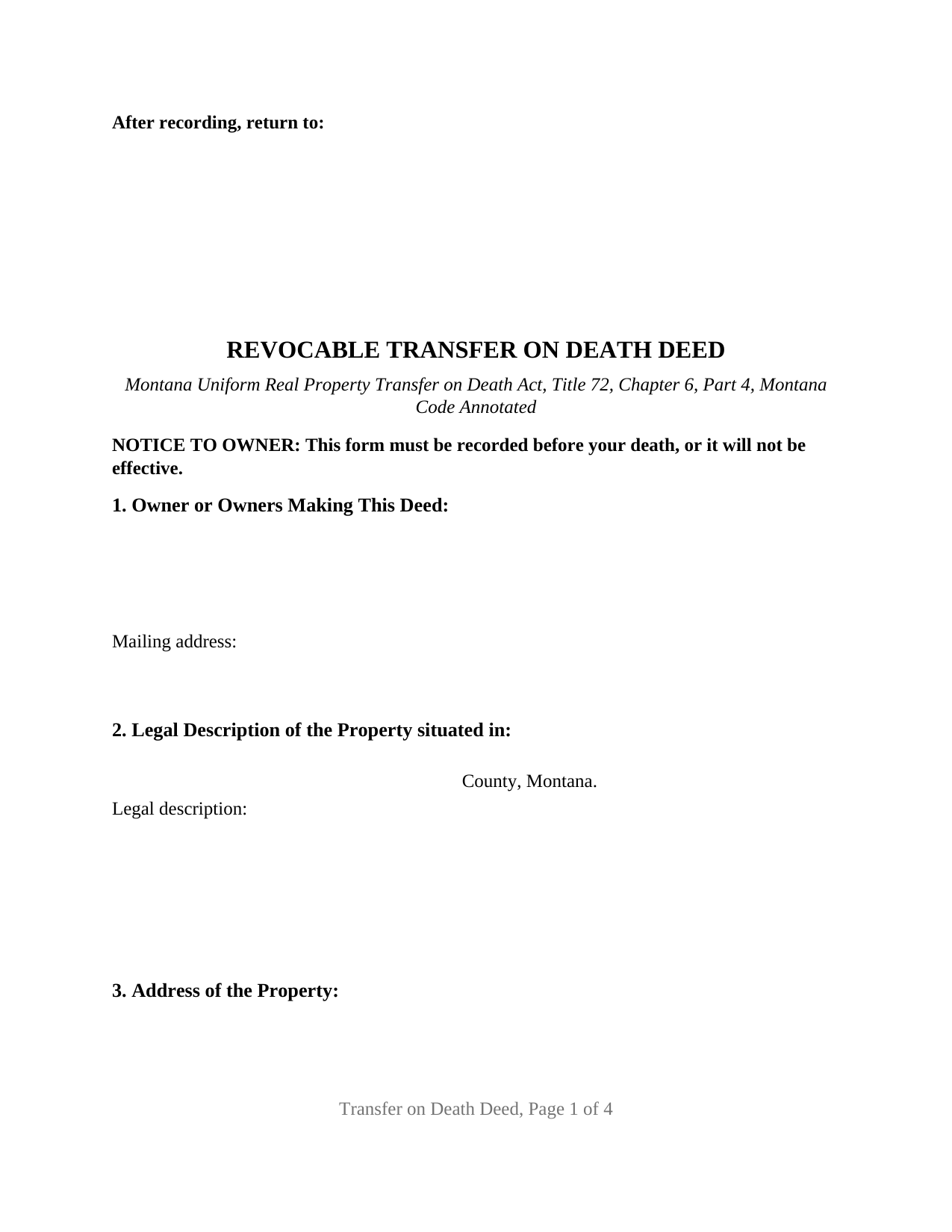
About the Montana Transfer on Death Deed
How to Use This Form
- Select your county from the list
- Download the county-specific form
- Fill in the required information
- Have the document notarized if required
- Record with your county recorder's office
What Others Like You Are Saying
"Great Form and Easy to Use Guides and Samples"
"Deeds.com does a great job getting our legal documents filed with the D.C. Recorder of Deeds. Frazer…"
"Very easy to find forms and good examples for filling out forms!"
"Your site was very informative and I was able to instantly and easily download the documents that I …"
"Easy and fast"
4.8/5 from 4,850 reviews. Read all
A Montana transfer on death deed lets the owner of Montana real property name who receives it at death, without probate and without giving anything up during life. This form prepares that deed for one or two owners under the Montana Uniform Real Property Transfer on Death Act, Title 72, chapter 6, part 4 of the Montana Code Annotated, the 2019 act that replaced the older beneficiary deed and gave the state its current TOD deed.
A deed that does nothing until it is recorded, and nothing until death
Two features define the Montana instrument. The first is timing: under MCA 72-6-411 the deed changes nothing while the owner lives. The owner keeps every right to sell, mortgage, lease, or give away the property, the beneficiary acquires no interest and no claim, the beneficiary's creditors cannot reach the land, and the deed can be revoked at any time. At the owner's death, MCA 72-6-412 transfers whatever interest the owner then holds to the beneficiaries named in the deed, subject to every mortgage, lien, and other interest affecting the property at that moment.
The second is recording. MCA 72-6-408 makes recording before the owner's death, in the office of the county clerk and recorder of the county where the property lies, a condition of the deed's effectiveness. A transfer on death deed that is signed and acknowledged but still sitting in a drawer when the owner dies transfers nothing. The form states that condition in its own notice line, and the guide walks through the recording step with the clerk and recorder's fee and format standards.
The statutory form's own words, inside a recordable layout
Montana prints an optional form of transfer on death deed at MCA 72-6-415. The statute says the form may be used, and that the other sections of the act govern the effect of any instrument used to create a TOD deed, so no particular form is mandatory. This deed carries the statutory form's operative sentences word for word: the designation of a primary beneficiary who survives the owner, the designation of an alternate beneficiary who takes if the primary does not survive, the transfer at the owner's death of the owner's interest in the described property to the beneficiaries as designated, and the statement that before death the owner has the right to revoke the deed. Around those sentences the form supplies what the statutory version leaves to the drafter: numbered sections for the owners, the county and legal description, the street address, and the source of title, signature blocks with printed names and dates, and the Montana short-form acknowledgment certificate of MCA 1-5-610(1) with a marked area for the notary's official stamp.
The layout is built to Montana's recording standards in MCA 7-4-2636: letter size white paper, a three-inch top margin on the first page with the return name and mailing address in the upper left corner where the statute places it, one-inch margins elsewhere, and 12-point type. The beneficiary blocks ask for a mailing address because MCA 7-4-2618 keeps a deed out of the record unless it contains the grantee's post-office address.
Joint owners and the second death
Montana wrote the co-owner rule into the act itself. Under MCA 72-6-412(3), a transferor who is a joint owner and is survived by another joint owner transfers nothing at that death; the property belongs to the surviving joint owner with right of survivorship, and the deed becomes effective at the death of the last surviving joint owner. MCA 72-6-402(3) defines a joint owner to include a joint tenant and to exclude a tenant in common, so the vesting deed's own words decide which rule applies to a pair of owners. Two owners who hold as joint tenants with right of survivorship make one deed that waits for the second death; two owners who hold as tenants in common each pass their own undivided interest at their own death. Revocation follows the same line: MCA 72-6-410 provides that a deed of joint owners is revoked only by all of the living joint owners, while revocation by one tenant in common leaves the deed in place as to the other's interest.
One or two owners, in their own names
The form recites one or two owners signing as natural persons in their own right, with the first signature block and acknowledgment certificate for the owner and a second block and certificate, marked if applicable, for a second owner. Where one owner makes the deed, the second block simply stays empty. Each owner has a separate acknowledgment certificate, so two owners can sign on different dates or before different notaries. The owner block is free-form: it takes the owners' names as the vesting deed shows them, with whatever marital status recital the facts call for, and nothing about status or vesting is preprinted. A married owner who holds title alone signs alone; Montana recognizes no community property, no tenancy by the entirety in real property, and no dower or curtesy, and the guide sets out the homestead joinder statute beside the act's rule that the deed affects no interest during life. The form is not set up as an instrument for a corporation, limited liability company, or trustee holding record title, for an agent signing under a power of attorney, or for three or more owners; those configurations follow different patterns.
Beneficiaries, survival, and shares
The act permits one or more beneficiaries, and its definition of a person reaches individuals, trusts, and entities, so the primary and alternate blocks can name a child, several children, a trust, or a charity. A beneficiary takes only by surviving the owner; under MCA 72-2-712, which the act applies, survival by less than 120 hours is treated as not surviving. Where two or more primary beneficiaries are named and the deed says nothing more, MCA 72-6-412(1) gives them equal and undivided shares with no right of survivorship, and the share of one who fails to survive passes to the others in proportion to their interests. The alternate block names who takes if no primary beneficiary survives. The completed example shows a married couple naming their two children in equal undivided shares, with a granddaughter as alternate.
The package includes the fillable Montana transfer on death deed, a completed example filled in for a Yellowstone County fact pattern, and the guide that walks through every numbered section, the signing and acknowledgment process, and recording with the clerk and recorder. This description and the guide describe the form and the governing Montana statutes in general terms; they are not legal advice.
Important: County-Specific Forms
Our transfer on death deed forms are specifically formatted for each of the 56 counties in Montana.
After selecting your county, you'll receive forms that meet all local recording requirements, ensuring your documents will be accepted without delays or rejection fees.