New Jersey Quitclaim Deed
County Specific Legal Forms Validated as recently as September 30, 2026 by our Forms Development Team
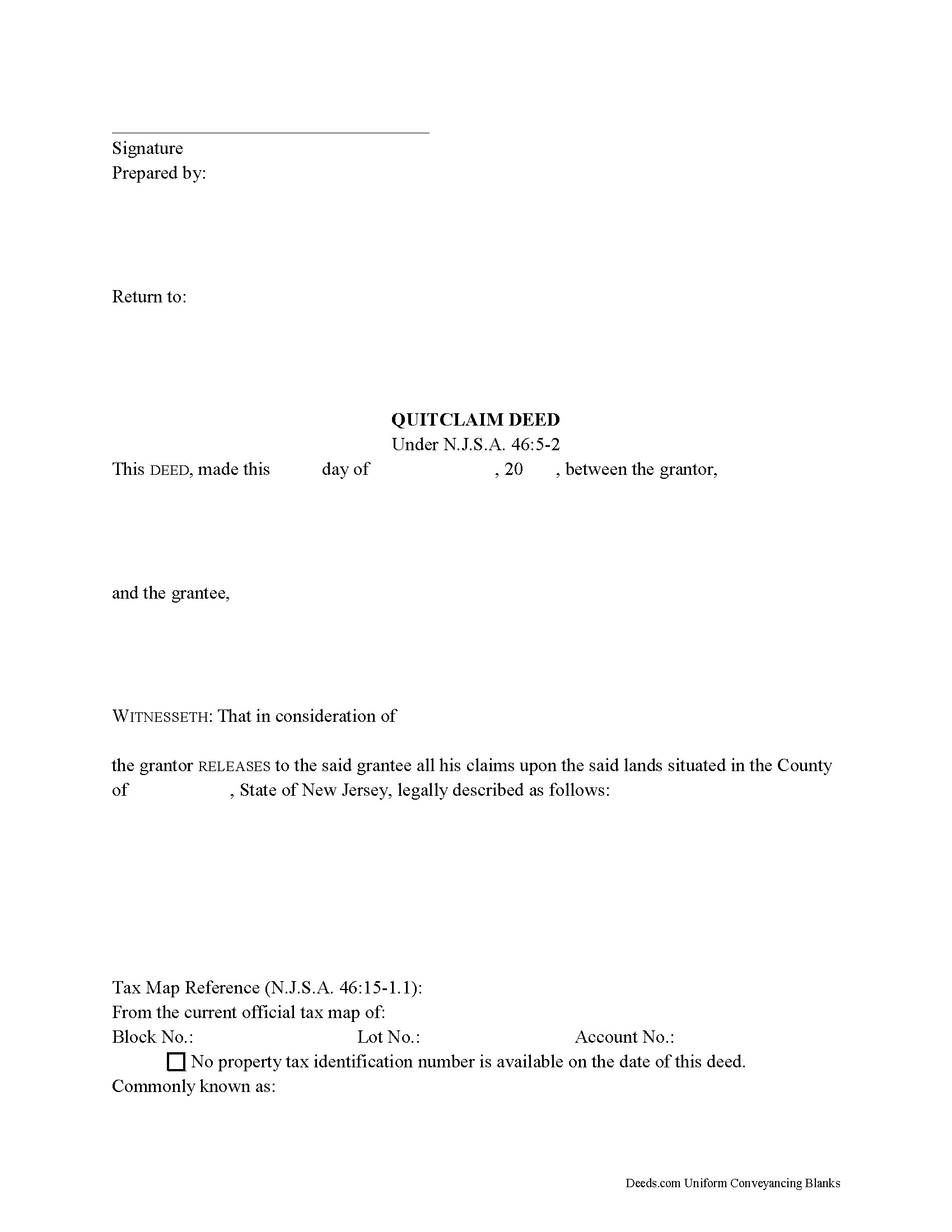
About the New Jersey Quitclaim Deed
How to Use This Form
- Select your county from the list
- Download the county-specific form
- Fill in the required information
- Have the document notarized if required
- Record with your county recorder's office
What Others Like You Are Saying
"It was quick and so very easy. Very detailed information. Love the app."
"Thank you for getting our docs recorded so quickly and efficiently! Great and dependable service, as…"
"This has been a lifesaver for me. Exactly what I needed. Forma are easy to fill in. Thank you for of…"
"Very helpful and an easy site to use so far."
"I haven't used the forms yet, but was at the county recorders office and they looked at it and said …"
4.8/5 from 4,824 reviews. Read all
New Jersey does not take the release words at face value. Under N.J.S.A. 46:5-1, a deed reciting that the grantor does remise, release and forever quitclaim unto the said grantee is construed, unless a contrary intention is set forth in it, as though it read that the grantor does grant and convey. This fillable New Jersey quitclaim deed is built on that translation: open party blocks for one or two individuals on either side, release words the statute reads as words of grant, and no covenant of title anywhere in the instrument.
A Release the Statute Reads as a Grant
Two sections carry the conveyance. The construction rule of N.J.S.A. 46:5-1 turns the release phrasing into words of grant, and N.J.S.A. 46:5-3 measures how far it reaches: where nothing in a quit claim deed indicates an intent to reserve part of the grantor's claim, what moves is the whole estate the grantor could lawfully have conveyed by a deed of bargain and sale, and the statute presumes the grantee a bona fide purchaser on that same footing. That presumption earns its keep where N.J.S.A. 46:26A-12 hands priority to a later purchaser or mortgagee for value, without notice, who records first.
The Covenants Deliberately Left Out
Short covenant phrases carry real weight in New Jersey. N.J.S.A. 46:4-3 through 46:4-10 give legal effect to seisin, the right to convey, quiet possession, freedom from encumbrances, the covenant that the grantor has done no act to encumber the lands, and the general and special warranties. None of them appears in this instrument, whose operative section prints that absence in capitals. Mortgages, docketed judgments, easements, and unpaid municipal charges survive the transfer intact, and protection against a title defect has to come from somewhere other than the four corners of this deed.
Blanks That Carry the Parties' Own Words
The party blocks are open lines rather than preprinted patterns. The grantor block takes one or two people signing in their own names, with whatever status wording they state for themselves; the grantee block takes one or two names followed by any ownership designation the parties select, and the guide sets out the forms New Jersey recognizes together with the tenancy in common default that N.J.S.A. 46:3-17 supplies where a deed to co-grantees is silent. Two signature blocks and two acknowledgment certificates follow, in the statutory short form wording of N.J.S.A. 52:7-10.12, the second pair left blank where a single owner conveys. Four counts run through these blocks: one grantor to one grantee, one to two, two to one, and two to two. What the form is not set up as is a deed executed for an entity, signed under a power of attorney, taken or given in a trustee capacity, made by three or more record owners, or carrying covenants or a reservation.
What the County Looks For
N.J.S.A. 46:26A-3 makes a short list of items recording prerequisites for a deed conveying title: printed names beneath the signatures, the name of the person who prepared the deed, the lot and block or account number or a statement that none is assigned, the grantee's mailing address, and consideration handled as N.J.S.A. 46:15-6 directs. Index data travels on a county cover sheet, or on an electronic synopsis for an e-recording, and N.J.S.A. 46:26A-5(c) adds a $20 indexing fee where neither accompanies the submission. Fees begin at $30 for the first page and $10 for each page after it under N.J.S.A. 22A:4-4.1. The Realty Transfer Fee is collected when the deed is offered for recording, with the Affidavit of Consideration, Form RTF-1, annexed where an exemption is claimed, and no county recording officer accepts a deed without the applicable GIT/REP seller residency form; both are prepared separately.
Signed, Acknowledged, and Recorded
The grantors sign before one of the officers N.J.S.A. 46:14-6.1 names, among them a New Jersey attorney at law, a notary public, and a county clerk, and acknowledgment by a remotely located individual through communication technology is available under N.J.S.A. 52:7-10.10. The signed deed goes to the recording officer of the county where the land sits, where recording is what protects the grantee against a later claimant taking for value without notice.
Inside the download: the deed as a blank fillable PDF, a completed example filled in for a Union County transfer between relatives, and a plain language guide covering every numbered section, the statutes behind each one, signing and notarization, and the papers a New Jersey recording office collects with a deed. The materials are informational and are not legal advice.
Important: County-Specific Forms
Our quitclaim deed forms are specifically formatted for each of the 21 counties in New Jersey.
After selecting your county, you'll receive forms that meet all local recording requirements, ensuring your documents will be accepted without delays or rejection fees.