Ohio Fiduciary Deed
County Specific Legal Forms Validated as recently as October 23, 2026 by our Forms Development Team
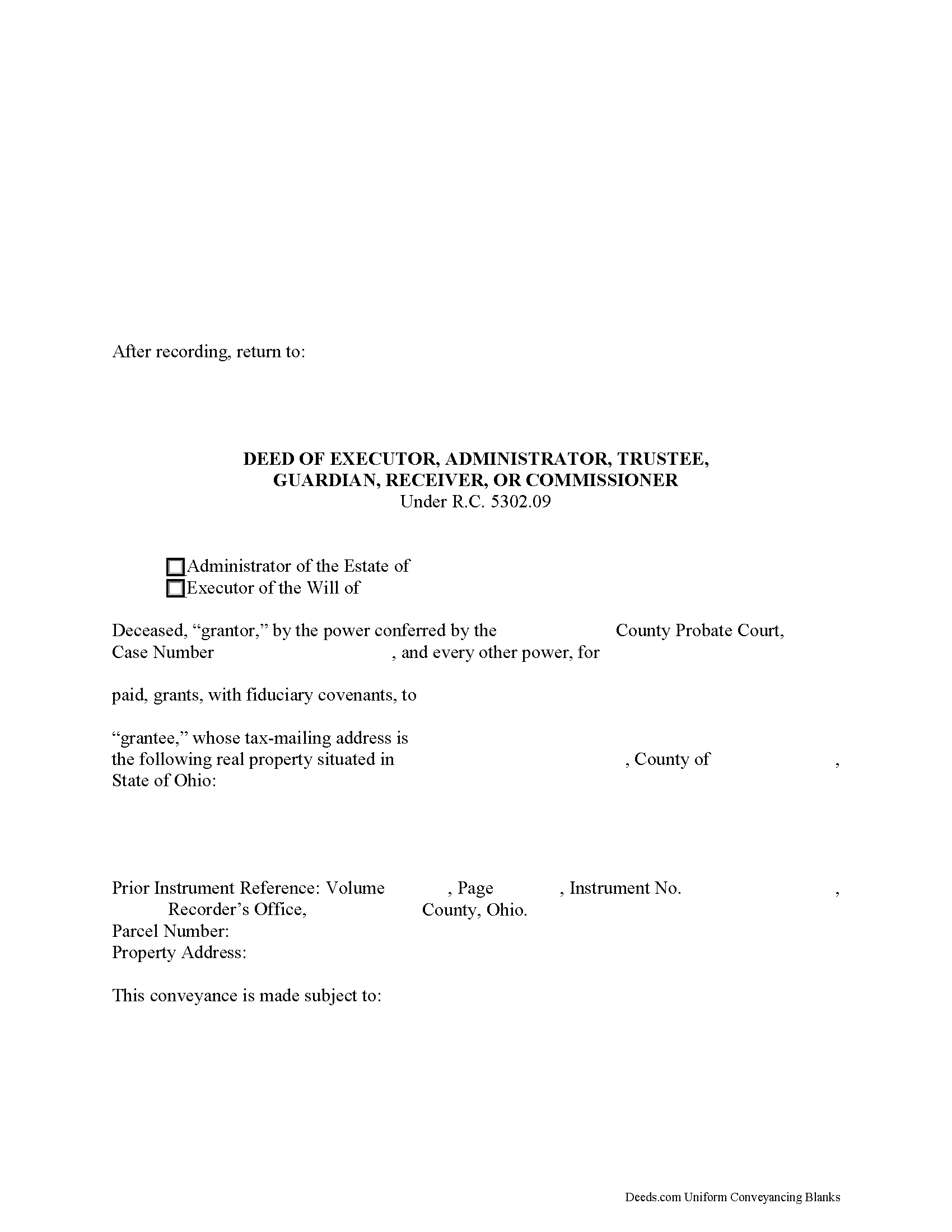
About the Ohio Fiduciary Deed
How to Use This Form
- Select your county from the list
- Download the county-specific form
- Fill in the required information
- Have the document notarized if required
- Record with your county recorder's office
What Others Like You Are Saying
"worked very good or me"
"My legal description exceeds the avaiable space in the one page Exhibit A...any way to add a second …"
"Great templates and very efficient"
"Easy to download and use the forms, however two forms needed for my county recording were not includ…"
"little expensive same document in other county is free. however quite fast in responding. and just w…"
4.8/5 from 4,831 reviews. Read all
An Ohio fiduciary deed is the deed a person signs in an office rather than as an owner: an executor, administrator, trustee, guardian, receiver, or court-appointed commissioner. Ohio Revised Code Section 5302.09 supplies the statutory form, and this form carries each of its elements for one or two fiduciaries of a single estate, trust, ward, or receivership conveying Ohio real property to one or two grantees.
Covenants that run to the office, not the title
What sets a fiduciary deed apart from every other Ohio statutory deed is its covenant set. The operative words are grants, with fiduciary covenants, to, and Section 5302.10 gives those words the full effect of a covenant by the grantor that the grantor is duly appointed, qualified, and acting in the fiduciary capacity the deed describes, is duly authorized to make the sale and conveyance, and has complied with the statutes governing the sale. The covenant concerns the person signing and the proceeding behind the signature, not the state of the title, which is the subject of the warranty covenants of Sections 5302.06 and 5302.08.
Where the power to convey comes from
The statutory form recites the power the fiduciary acts under with the words by the power conferred by, and the form carries a section for that entry. For an executor acting under a will's power of sale, Section 2113.39 provides that no probate court order is required. Where the will confers no such power, or for an administrator or a guardian, Chapter 2127 supplies the land sale proceeding, and under Section 2127.35 the court confirms the sale and orders the deed. A trustee's power rests on the trust instrument and Section 5808.16, and a trustee's conveyance also calls for a memorandum of trust of record under Section 5301.255. The deed names the source; the source does the authorizing.
Sale by deed, inheritance by certificate
A fiduciary deed is the instrument of a sale or other conveyance by the fiduciary. Real property that simply passes to heirs or devisees reaches the county records through the probate court's certificate of transfer under Section 2113.61, issued by the court and recorded separately, and that section excepts real property the fiduciary sold. The distinction also bears on the conveyance fee: Section 319.54(G)(3) exempts a transfer under a certificate of transfer, while a fiduciary's sale for money pays the state fee of ten cents per hundred dollars of value plus any county permissive tax.
One form, one or two fiduciaries
The form is the general configuration of the Ohio fiduciary deed, and it preprints nothing about the office. Section 1 receives the fiduciary's name and address, or two co-fiduciaries' names and addresses; Section 2 receives the capacity in the filler's own words; Section 3 receives the power conferred by the will, order, trust, or statute. Two co-executors selling a decedent's house under the will, a successor trustee selling trust land, and a guardian conveying after confirmation under Chapter 2127 all present the pattern this deed recites. The form carries two grantor signature blocks and a separate acknowledgment certificate for each, so co-fiduciaries may acknowledge on different days before different officers; when one fiduciary conveys, the second block stays empty. The form is not set up as a deed of a corporate trustee signing through an officer, of an attorney-in-fact signing for a fiduciary, or of three or more co-fiduciaries.
Auditor first, then recorder
Every Ohio deed of absolute conveyance goes to the county auditor before the county recorder. The grantee presents the deed with the conveyance-fee statement under Section 319.202, the auditor transfers the parcel to the grantee at the tax-mailing address the deed carries, and only a deed bearing the auditor's stamp and transfer endorsement may be recorded under Section 317.22. The form carries the tax-mailing address and prior instrument reference of Section 319.20, the preparer statement of Section 317.111, the three-inch first-page margin of Section 317.114, and the Section 147.55(F) acknowledgment short form for a trustee or personal representative.
The package includes the fillable fiduciary deed form, a completed example filled in for a realistic Franklin County estate sale by two co-executors, and the guide that walks through every numbered section, the sources of fiduciary authority, and the auditor and recorder process. This description and the guide describe the form and the governing Ohio statutes in general terms; they are not legal advice.
Important: County-Specific Forms
Our fiduciary deed forms are specifically formatted for each of the 88 counties in Ohio.
After selecting your county, you'll receive forms that meet all local recording requirements, ensuring your documents will be accepted without delays or rejection fees.