South Carolina Quitclaim Deed
County Specific Legal Forms Validated as recently as October 21, 2026 by our Forms Development Team
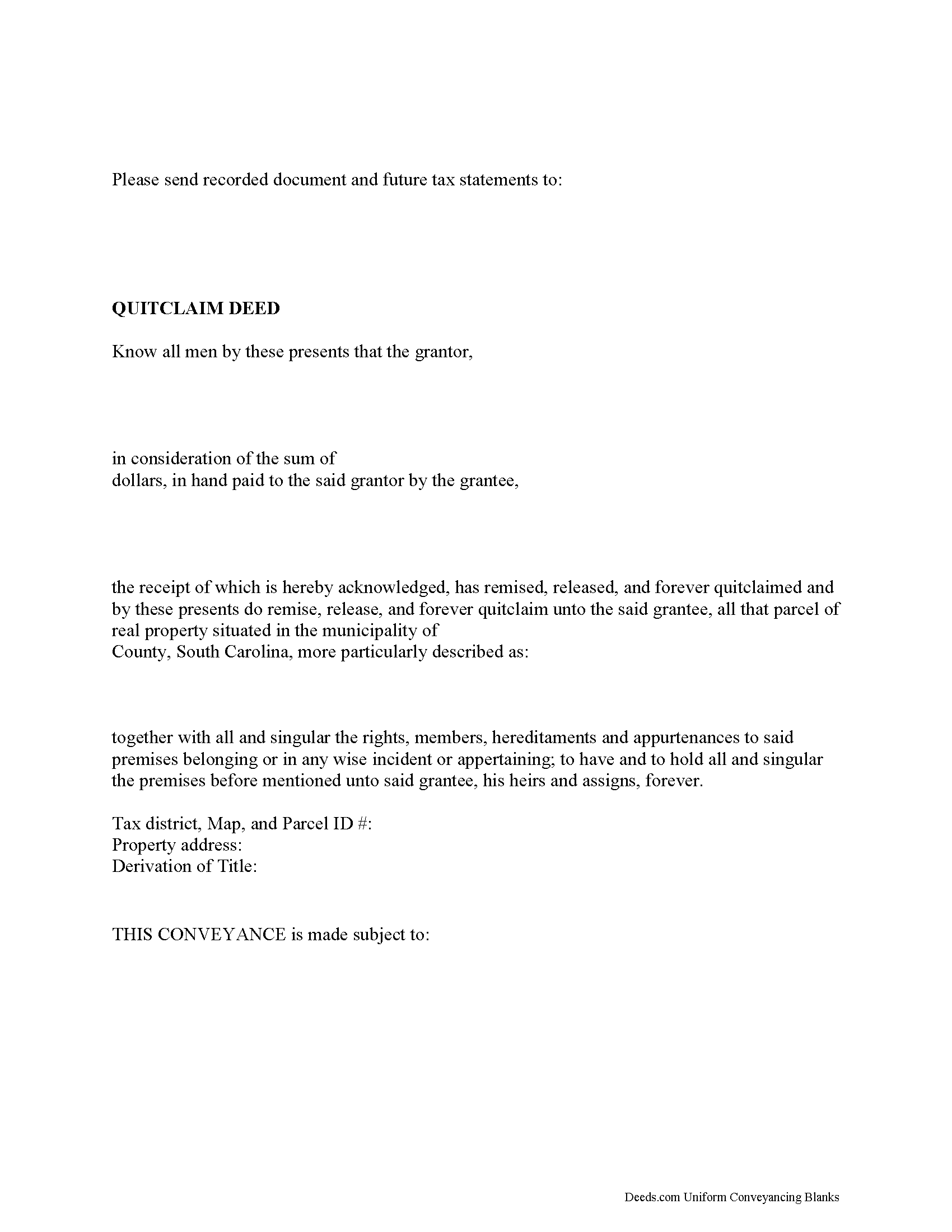
About the South Carolina Quitclaim Deed
How to Use This Form
- Select your county from the list
- Download the county-specific form
- Fill in the required information
- Have the document notarized if required
- Record with your county recorder's office
What Others Like You Are Saying
"fantastic forms, great service!"
"User friendly an FAST to access and use! Highly recommended."
"It's going well so far!"
"Seems to be just what I needed and easy to use."
"I'm very happy with your service! It saved me, at least, hundreds of dollars vs. going through a law…"
4.8/5 from 4,829 reviews. Read all
South Carolina never wrote a quitclaim deed form into its Code. What the Code wrote is a release, and a sentence letting the promise come off it. This fillable quitclaim deed is that instrument for South Carolina real property: one or two individual owners release whatever interest they hold to one or two named grantees, with no covenant or warranty of title anywhere in it.
A warranty the statute makes optional
Section 27-7-10 of the South Carolina Code prints a short form of release that carries the fee simple of land when two or more credible witnesses subscribe it, and the form ends with a warranty clause binding the grantor to defend the premises. Section 27-7-20 is the hinge: the release section neither obliges insertion of that clause nor restrains the insertion of another, and older forms stay good. Warranty here is something a deed says rather than something a conveyance carries by default, so a non-warranty deed is the same release with the clause left out and granting words reaching only what the grantor holds. Section 27-7-30 adds the last piece of the old form. Where the attestation clause shows the parties meant a sealed instrument, the deed takes that effect with no seal attached, which is why SIGNED, SEALED AND DELIVERED stands above the signature lines.
One form, one or two people on each side
The party blocks are deliberately empty of preprinting. Section 1 takes one or two grantor names with the status each states, Section 3 takes one or two grantee names followed by whatever co-ownership words the grantees take under, and no vesting or capacity language is fixed on the instrument. Section 9 performs the release in the traditional words, remising, releasing, and forever quitclaiming the grantor's right, title, and interest, if any, and holding the conveyance to what the grantor owns at delivery. The execution set answers both counts: two signature blocks, four witness blocks paired two to a signature so executions completed on separate days each carry their own attesting witnesses, and one acknowledgment certificate per signer. A sole owner clearing a doubtful interest, and two owners moving a jointly held parcel into one name, present the counts this deed recites. It is not set up as a deed executed for a corporation, a company, or a partnership, as a deed signed in a fiduciary office or by an agent under a power of attorney, or as a release by three or more owners on either side.
Two witnesses and a notary at one table
A South Carolina signing seats more people than most. Section 30-5-30 makes acknowledgment or proof before an authorized officer the prerequisite to recording, and subsection (B) describes the grantor acknowledging in the presence of two witnesses, the pair Section 27-7-10 also wants on the deed itself. Registers of deeds in the largest counties publish that rule among their intake items, and Horry County publishes that the notary may serve as one of the two.
What the counter collects
Fifteen dollars records a deed under the uniform schedule in Section 8-21-310. Deed stamps run under Section 12-24-10 at $1.85 for each $500, or part of $500, of the realty's value, and Section 12-24-40 lifts them from several transfers that arrive on this instrument: a deed whose value is one hundred dollars or less, a transfer recognizing no gain or loss under Internal Revenue Code Section 1041, a partition deed, and a quitclaim confirming title already vested where nothing is paid. The value affidavit Section 12-24-70 calls for is its own recorded document. One requirement reaches past the deed to the envelope: Section 30-9-30 wants a return address on any document submitted for filing and lets the office refuse one that lacks it, which the return block at the end of the form answers.
Also searched as a quit claim deed, and called a non-warranty deed in South Carolina practice, this is the low-assurance workhorse of the land records, and Section 30-5-35 keeps deeds of the class outside the derivation clause while still asking for the grantee's mailing address. Three files come with the purchase: the blank deed as a fillable PDF, a completed Lexington County example filled at two grantors and two grantees, and a plain language guide covering the eleven sections, the ownership forms the grantee line can carry, and the trip to the register. The material is general information about South Carolina law and is not legal advice.
Important: County-Specific Forms
Our quitclaim deed forms are specifically formatted for each of the 46 counties in South Carolina.
After selecting your county, you'll receive forms that meet all local recording requirements, ensuring your documents will be accepted without delays or rejection fees.