Texas Revocation of Transfer on Death Deed (Joint Owners)
County Specific Legal Forms Validated as recently as October 15, 2026 by our Forms Development Team
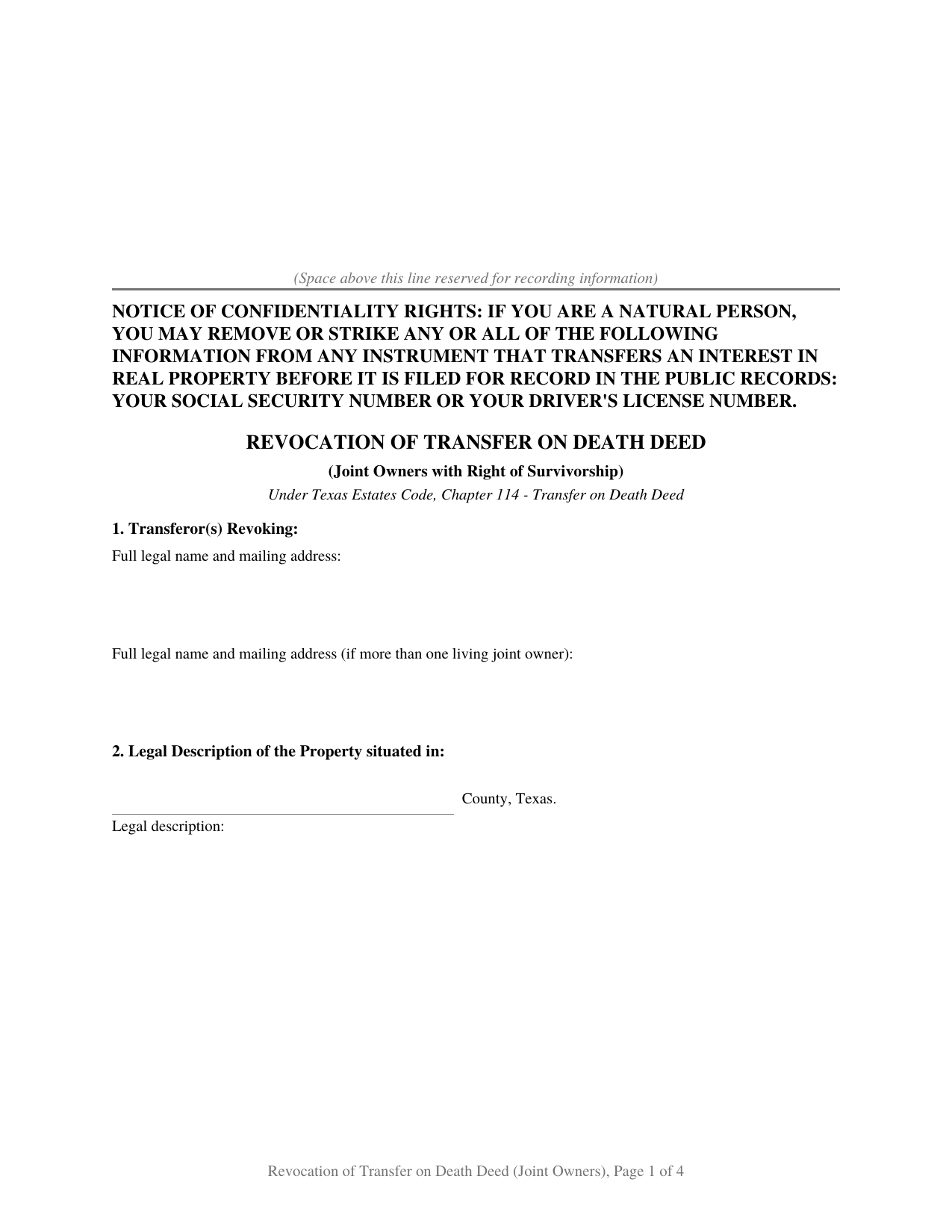
About the Texas Revocation of Transfer on Death Deed (Joint Owners)
How to Use This Form
- Select your county from the list
- Download the county-specific form
- Fill in the required information
- Have the document notarized if required
- Record with your county recorder's office
What Others Like You Are Saying
"Was very easy to use with the information and samples supplied."
"The link for the note guidelines just shows the same directions as for the mortgage. Other than that…"
"Love this site. It has been truly helpful and easy to navigate."
"Provided the template and guide I was looking for. Reasonable pricing,"
"SIMPLE, THAT IS GOOD"
4.8/5 from 4,828 reviews. Read all
When two Texas co-owners with a right of survivorship recorded a transfer on death deed together, undoing it is a joint act. This Texas Revocation of Transfer on Death Deed (Joint Owners) prepares the instrument Section 114.057 of the Estates Code describes, drawn so that the two owners who made the deed, or the one still living, take it out of effect in a single recorded document. The instrument is also known as a cancellation of transfer on death deed or a TOD deed revocation.
Every living joint owner, or the last one standing
Section 114.057(e) states the rule in one sentence: a transfer on death deed made by joint owners with right of survivorship is revoked only if it is revoked by all of the living joint owners. The form is built around that count. Its operative paragraph recites that the signers are all of the living joint owners who made the deed, or, where a single person signs, the last surviving joint owner, the path Section 114.103(c) opens once the other owner has died and the property already belongs to the survivor. Two transferor blocks, two signature blocks, and two acknowledgment certificates carry the two-owner case; the survivor completes the first of each and leaves the second blank.
The count matters because Section 114.057(d) gives a lone signature a narrower effect: a revocation by one of several transferors does not affect the deed as to the interest of a transferor who did not join.
Acknowledged after, recorded before
Under Section 114.057(a), an instrument of revocation that expressly revokes the deed operates only when it is acknowledged by the transferor after the acknowledgment of the deed being revoked, and recorded before the transferor's death in the county where that deed is recorded. Section 114.057(b) closes the other door: a will may not revoke or supersede a transfer on death deed. The form prints these conditions in capital letters directly above the signature section, so the sequence that makes the instrument work is on the recorded page itself.
What stays as it was
The revocation changes the record in one respect: the beneficiary designation that would have taken effect at the last owner's death is withdrawn. Title between the two owners is untouched, and the survivorship arrangement between them, usually a written agreement under Estates Code Section 111.001 set out in their vesting deed, keeps governing what happens at each death. The operative paragraph says so, stating that the instrument revokes the deed only and neither transfers the property nor affects the survivorship between the joint owners. Replacing the beneficiaries instead of removing them is the other recorded path under Section 114.057(a)(1)(A), a new transfer on death deed signed by all living joint owners, which is prepared separately and is not part of this package.
Where joint owner means something narrower than it sounds
Section 114.002(a)(3) defines a joint owner with right of survivorship as an individual who owns real property concurrently with others with a right of survivorship, and it excludes a tenant in common and an owner of community property, with or without survivorship. The owners this form recites are pairs holding under a vesting deed that carries a written survivorship agreement, such as siblings who inherited together or unmarried partners. Spouses holding community property with right of survivorship under a Chapter 112 agreement fall outside the joint owner rule, and a deed made by one transferor alone follows a different pattern; neither is what this form recites.
The form on the page
The instrument runs in five numbered sections: the transferors, the property, the deed being revoked by its date, recording date, document number, and recording county, the operative revocation with its capital-letter conditions, and the signatures. Each signer has a separate acknowledgment certificate in the short form of Civil Practice and Remedies Code Section 121.008, so the two owners may appear before different officers on different days. The confidentiality notice of Property Code Section 11.008 heads the first page, and the document is set in 12 point type on letter size pages within Local Government Code Section 191.007.
The package contains the blank form as a fillable PDF, a completed example showing a revocation by two Texas joint owners from the first block through the second certificate, and a guide that walks through each section, the signing rule, and the recording step, including the photo identification a county clerk takes from a person who presents a document in person. The materials are informational and are not legal advice.
Important: County-Specific Forms
Our revocation of transfer on death deed (joint owners) forms are specifically formatted for each of the 254 counties in Texas.
After selecting your county, you'll receive forms that meet all local recording requirements, ensuring your documents will be accepted without delays or rejection fees.