Texas Warranty Deed (Individual Grantor)
County Specific Legal Forms Validated as recently as September 29, 2026 by our Forms Development Team
About the Texas Warranty Deed (Individual Grantor)
How to Use This Form
- Select your county from the list
- Download the county-specific form
- Fill in the required information
- Have the document notarized if required
- Record with your county recorder's office
What Others Like You Are Saying
"Deeds.com was a wealth of information and easy to navigate through the myriad of forms to choose fro…"
"Much easier to navigate than some others I've been on. Liked the upfront pricing."
"I tried to do it myself by copying an old deed and ended up with a bunch of headaches (expensive one…"
"This is quick, easy, and very reasonably priced. I wish I found this site before doing my living tru…"
"Gift Deed is exactly what was required. Thank you!"
4.8/5 from 4,824 reviews. Read all
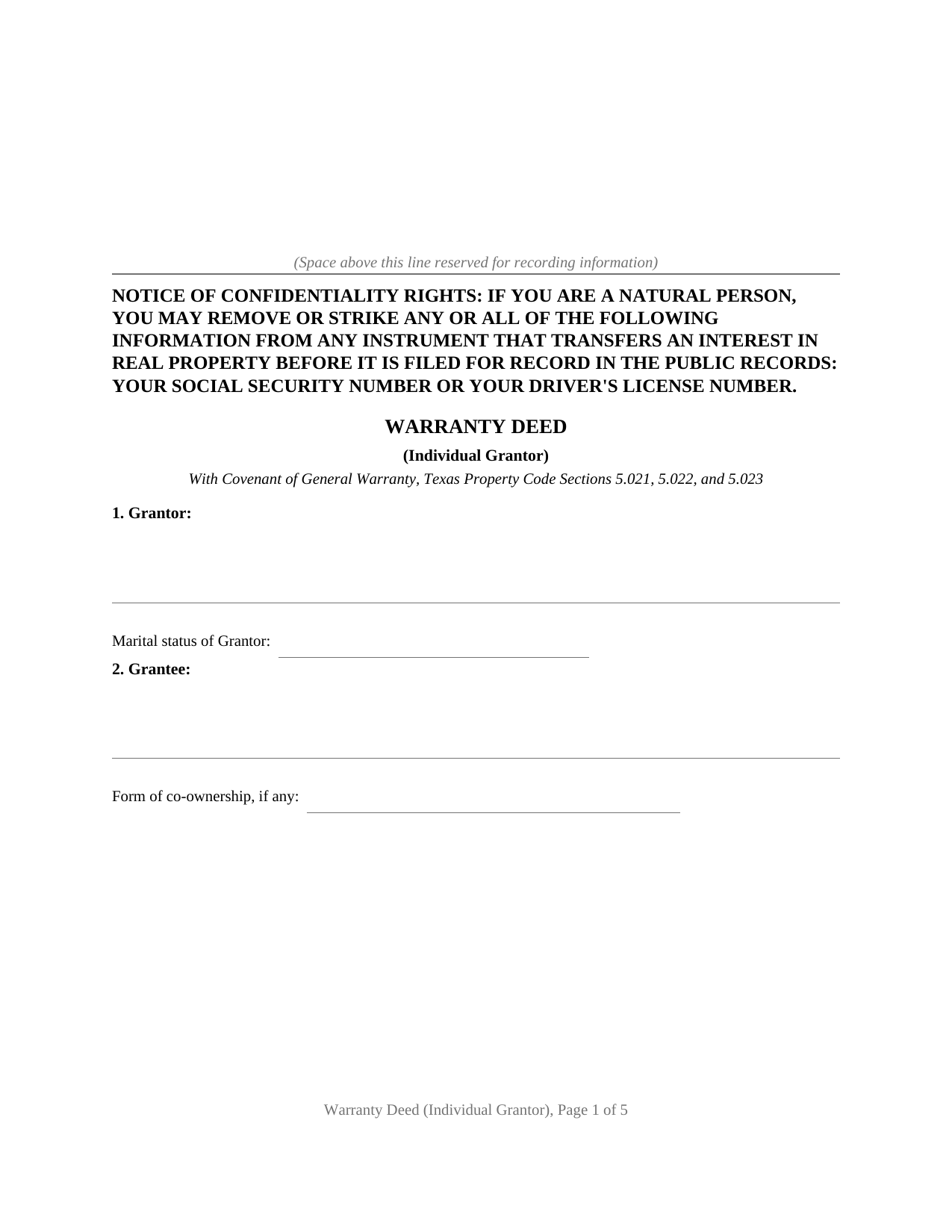
One owner of record, signing in that owner's own name, conveys Texas real estate on this deed and stands personally behind the title. The Texas warranty deed for an individual grantor carries the covenant of general warranty in a single-owner frame: one grantor block, one grantor signature with its own acknowledgment certificate, and a homestead joinder block that waits for the one situation in which Texas law adds a second signature.
A Promise Made by a Person, Not a Position
The operative section follows the pattern Texas Property Code Section 5.022 recognizes for a fee simple conveyance with a covenant of general warranty: the grantor GRANTS, SELLS, AND CONVEYS the property, then binds the grantor and the grantor's heirs, executors, and administrators to WARRANT AND FOREVER DEFEND it against every person whomsoever lawfully claiming any part of it. On an individual's deed that covenant is personal. It binds the human being who signs, and the estate that follows that person, rather than an entity or an office, and it answers for title defects arising at any point in the chain, however far behind the grantor's own years of ownership they originated. Section 5.023 places two implied covenants beneath the express one, prior nonconveyance and freedom from encumbrances, and this deed keeps both rather than excluding them, so the general warranty carries its full statutory depth.
The One-Owner Configuration
The form recites exactly one grantor: a natural person identified by full legal name and mailing address, with a marital status entry beside the name. A grantee section records each grantee's name and mailing address with an optional co-ownership designation, and the remaining numbered sections carry the consideration, the county and formal legal description, the street address, the source of title, and the reservations and exceptions that mark where the warranty stops. One acknowledgment certificate serves the grantor's signature. An unmarried owner selling, a widowed owner conveying property that stands in one name, and a married owner conveying separate property that is not the homestead all present the single-signature pattern this deed recites. The form is not set up as a two-grantor instrument: title standing in two names, or community property a married couple conveys together, presents a two-grantor record that a deed reciting one grantor does not describe.
The Second Signature Texas Sometimes Adds
Texas Family Code Section 5.001 provides that neither spouse may sell, convey, or encumber the homestead without the joinder of the other spouse, whether the homestead is community property or the separate property of either spouse. Section 9 of this deed carries that joinder: it names the grantor's spouse as Joining Spouse, who signs the second signature block and conveys any homestead or other interest in the property while making no warranty of title, so the covenant stays the grantor's alone. Where the grantor is unmarried, or the property is not the homestead of a married grantor, the deed states that the section and the second block are without effect, and the unused block never clouds the record.
Acknowledged, Then Recorded Where the Land Lies
The grantor signs before a notary public, whose certificate follows the short forms of Civil Practice and Remedies Code Chapter 121; a second certificate stands ready for a joining spouse, so the two signers may acknowledge on different dates, before different notaries, or in different states. The deed then goes to the county clerk of the county where the property is located. Texas collects no deed transfer tax, the notice of confidentiality rights described by Property Code Section 11.008 sits at the top of page one, and a grantee mailing address keeps the filing fee at the standard rate under Section 11.003. Since December 4, 2025, a person presenting a deed in person at the counter shows government-issued photo identification under the Senate Bill 16 amendments. Recording is what protects the grantee against the world: under Section 13.001 an unrecorded deed, though binding between the parties, is void as to a later purchaser for value without notice.
The download delivers the blank deed as a fillable PDF with a non-recorded instructions page, a completed example filled in for a realistic Bexar County sale, and a plain language guide covering every numbered section, the co-ownership forms Texas recognizes on the grantee side, and the recording steps. The materials are informational and are not legal advice.
Important: County-Specific Forms
Our warranty deed (individual grantor) forms are specifically formatted for each of the 254 counties in Texas.
After selecting your county, you'll receive forms that meet all local recording requirements, ensuring your documents will be accepted without delays or rejection fees.