Texas Warranty Deed (Trustee Grantor)
County Specific Legal Forms Validated as recently as October 19, 2026 by our Forms Development Team
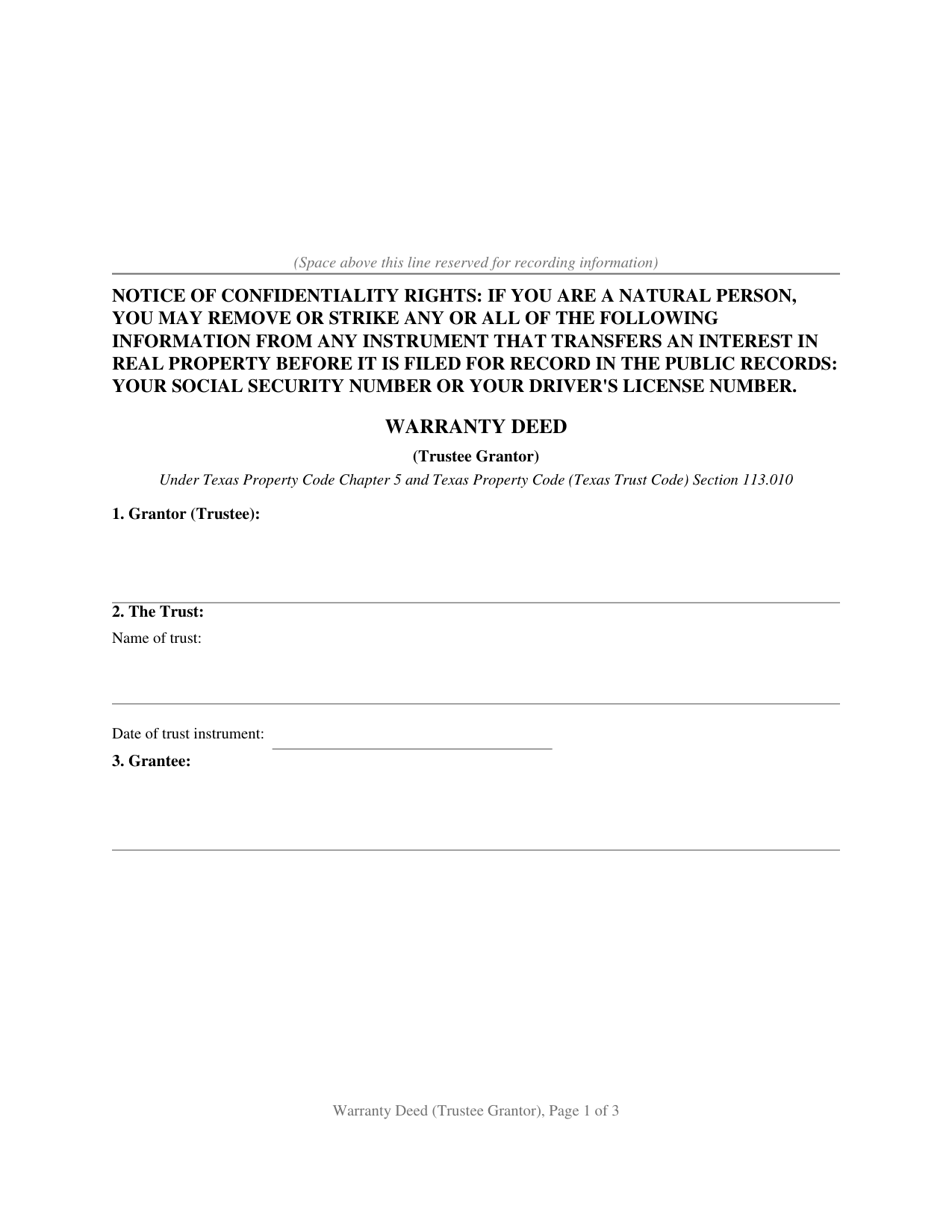
About the Texas Warranty Deed (Trustee Grantor)
How to Use This Form
- Select your county from the list
- Download the county-specific form
- Fill in the required information
- Have the document notarized if required
- Record with your county recorder's office
What Others Like You Are Saying
"GREAT SITE, HAD ALL THE FORMS I NEEDED AND INSTRUCTIONS WITH ILLUSTRATIONS."
"Website easy to use. Sample feed from helpful. Will know more after county reviews application."
"I found the site very easy to use and upfront about the cost. I had tried two other sites both of wh…"
"Absolutely great. The staff is responsive and knowledgeable. The online interface is excellent. The …"
"It all looked pretty easy to navigate. Forms are just now downloaded so I'll see how opening, fillin…"
4.8/5 from 4,828 reviews. Read all
When the grantor on a Texas real estate sale is a trustee, the deed carries a layer that an individual-owner conveyance does not: the trustee acts in a capacity, not as an individual, and every covenant the deed makes binds that capacity and successors in it. This Texas general warranty deed is built for exactly that configuration, where the trustee of a trust conveys real property out of the trust with the broadest title covenant Property Code Chapter 5 provides.
A Warranty in a Fiduciary Frame
Property Code Section 5.022 supplies the general warranty form: the words grant, sell, and convey, joined to a covenant binding the grantor to warrant and forever defend the property against every person lawfully claiming it. What distinguishes this deed from a warranty deed made by an individual is the capacity structure wrapped around that covenant. Section 9 of this form recites that the grantor holds title as trustee of an identified trust, acts under the trust instrument and the statutory power of sale in Trust Code Section 113.010, and makes every covenant solely in the trustee capacity. The deed then states expressly that no covenant is made by the trustee individually and that the trustee's personal liability is excluded. The Section 5.023 implied covenants, prior nonconveyance and freedom from encumbrances, are retained, not disclaimed, so the general warranty reaches the full scope of Chapter 5.
Trust Identity in the Record
Trust instruments are rarely recorded, and Texas law is designed to protect that privacy while keeping the public record useful. This deed identifies the trust by its full name and the date of the trust instrument, two data points a title examiner can match against the prior vesting instrument without seeing the agreement itself. Alongside the deed, title practice routinely uses a certification of trust under Property Code Section 114.086, a signed summary of the trust's existence, date, trustee, and powers that stands in for the trust agreement, with good-faith reliance protection under Section 114.082 for a person who deals with the trustee. Property Code Section 114.087, effective 2023, reinforces that framework by treating the trustee as the named party to any instrument that names the trust and giving a recorded certification of trust a presumption of correctness.
One Signer, One Certificate
The deed is built around a single trustee who signs and acknowledges in the trustee capacity. The acknowledgment certificate identifies the signer by name and representative capacity, following the Civil Practice and Remedies Code Chapter 121 short form for acknowledgment by a representative signer. Texas law does not require a separate acknowledgment certificate per signer; Section 121.008(b) expressly permits one certificate to name every signer who appeared before the officer. This form carries one certificate for the one trustee. Homestead joinder analysis under Property Code Section 41.0021(d): once real property is held in a qualifying trust, the trustee may convey it without joinder of either spouse unless the trust instrument expressly prohibits the conveyance, so the form carries a single signature block and the guide describes the statutory analysis with citations.
Inside the Package
The blank deed is a fillable PDF with numbered sections for the trustee, the trust, the grantee, the consideration, the property description, the exceptions to warranty, and the operative conveyance and warranty language, followed by a trustee signature block and a notary acknowledgment. A completed example shows the entire deed filled in for a Williamson County sale, and the guide documents every section, the signing formalities, and recording with the county clerk, including the Notice of Confidentiality Rights that Property Code Section 11.008 places at the top of page one and the photo-ID requirement at the in-person filing counter effective December 4, 2025. The materials describe Texas law in general terms and are not legal advice.
Important: County-Specific Forms
Our warranty deed (trustee grantor) forms are specifically formatted for each of the 254 counties in Texas.
After selecting your county, you'll receive forms that meet all local recording requirements, ensuring your documents will be accepted without delays or rejection fees.