Texas Warranty Deed with Vendor Lien (Individual Grantor)
County Specific Legal Forms Validated as recently as October 15, 2026 by our Forms Development Team
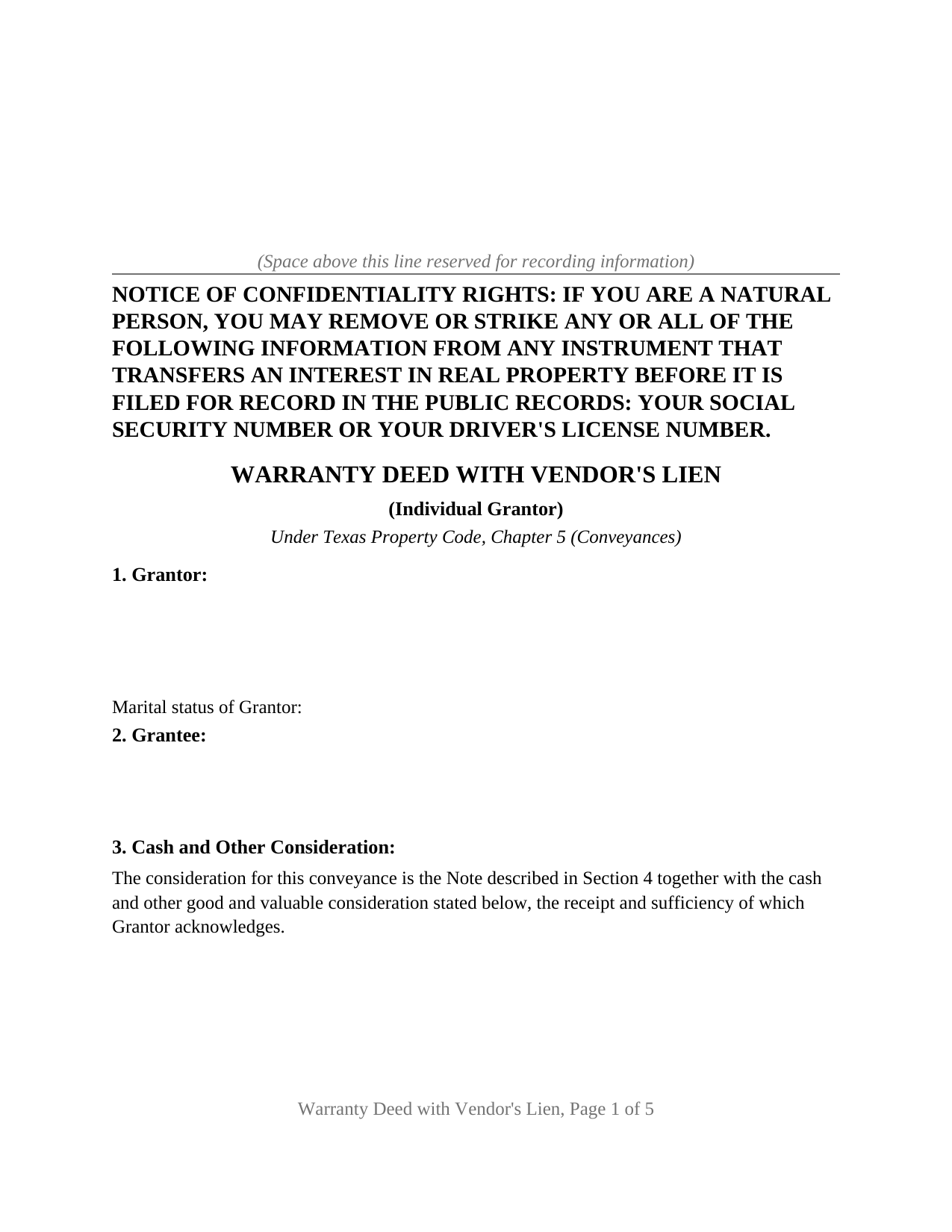
About the Texas Warranty Deed with Vendor Lien (Individual Grantor)
How to Use This Form
- Select your county from the list
- Download the county-specific form
- Fill in the required information
- Have the document notarized if required
- Record with your county recorder's office
What Others Like You Are Saying
"The forms were easy to fill in and file. I've never filed anything like this before and the forms ma…"
"Deeds.com has been a lifesaver for my house buying business. Excellent support!"
"Found this sight on the internet looking for information to add my fiance' to the house deed. Looks …"
"Straightforward instructions and very quick turnaround."
"Was helpful"
4.8/5 from 4,828 reviews. Read all
When a Texas seller carries the financing, the deed does two jobs at once: it conveys the land to the buyer, and it keeps the seller's security in the same instrument. This Texas warranty deed with vendor's lien prepares that deed for one individual grantor whose buyer signs a purchase-money note payable to the grantor: a general warranty conveyance that retains a vendor's lien and superior title until the note is paid in full, when the deed becomes absolute.
Superior Title Stays With the Seller Until the Note Is Paid
The vendor's lien is a doctrine of Texas common law rather than a statute. Where a deed expressly reserves a lien for unpaid purchase money, Texas courts treat the transaction as executory: superior title remains in the seller and ripens into title in the buyer when the purchase money is paid, and on a default the holder of the lien and superior title may sue on the note and foreclose, or may rescind and recover the land. Civil Practice and Remedies Code Section 16.035 recognizes the arrangement by name, defining a real property lien to include a superior title retained by a vendor in a deed of conveyance, and sets a four-year limitations period that runs from the maturity of the last installment. Section 11 of this deed carries that express reservation, and Section 4 recites the note as a purchase-money obligation, the description under which Article XVI, Section 50 of the Texas Constitution lets a lien reach a homestead.
A General Warranty on a Credit Sale
Carrying the financing does not thin the title promise. The operative section follows the pattern Property Code Section 5.022 recognizes: the grantor GRANTS, SELLS, AND CONVEYS the property and binds the grantor's heirs and successors to WARRANT AND FOREVER DEFEND it against every person whomsoever lawfully claiming it, subject only to the reservations and exceptions listed in Section 9, with the implied covenants of Section 5.023 left in place. The buyer takes the full general warranty on the day of closing, while the seller's lien rides along until the last payment.
One Grantor, One Note Payable to the Seller
The form recites exactly one grantor, a natural person named with a mailing address and a marital status entry, selling the whole of that person's interest on a note payable to the grantor's own order. A seller who takes part of the price at closing and the balance over time, a parent conveying a house to an adult child on installments, and a landowner selling acreage on owner terms each present the record this deed recites. The deed also identifies the deed of trust that commonly accompanies the note, a separate instrument recorded separately and not included in this package. The deed is not set up for a note payable to a bank or other lender, where the lien is retained for the lender and transferred to it, nor for community property standing in both spouses' names, a two-grantor conveyance, nor for an entity, trustee, or agent signing in a capacity the deed does not recite.
The Homestead Joinder Block
Because property sold on owner terms is so often the seller's home, the deed carries Section 12 and a JOINING SPOUSE signature block with its own acknowledgment certificate. Family Code Section 5.001 provides that neither spouse may sell, convey, or encumber the homestead without the joinder of the other. Where a married grantor conveys the homestead, the spouse is named in Section 12, signs the second block, and conveys any homestead interest without warranty; the covenants of title stay the grantor's alone. Otherwise the deed states that the section and the block are without effect, and they stay blank.
Into the County Records, and Out Again When Paid
Recording with the county clerk where the property lies is what makes the conveyance and the retained lien good against later purchasers and creditors who take without notice under Property Code Section 13.001; no transfer tax rides with a Texas deed. When the note is paid, the deed's own terms end the lien, and a release of lien recorded separately, not part of this package, shows that in the public record.
Three items make up the package: the blank deed as a fillable PDF behind a non-recorded instructions page, a completed example filled in for a Montgomery County owner-financed sale, and a plain language guide to every numbered section, co-ownership on the grantee side, signing, and recording. The materials are informational and are not legal advice.
Important: County-Specific Forms
Our warranty deed with vendor lien (individual grantor) forms are specifically formatted for each of the 254 counties in Texas.
After selecting your county, you'll receive forms that meet all local recording requirements, ensuring your documents will be accepted without delays or rejection fees.