Texas General Warranty Deed (Executed by Attorney-in-Fact)
County Specific Legal Forms Validated as recently as October 12, 2026 by our Forms Development Team
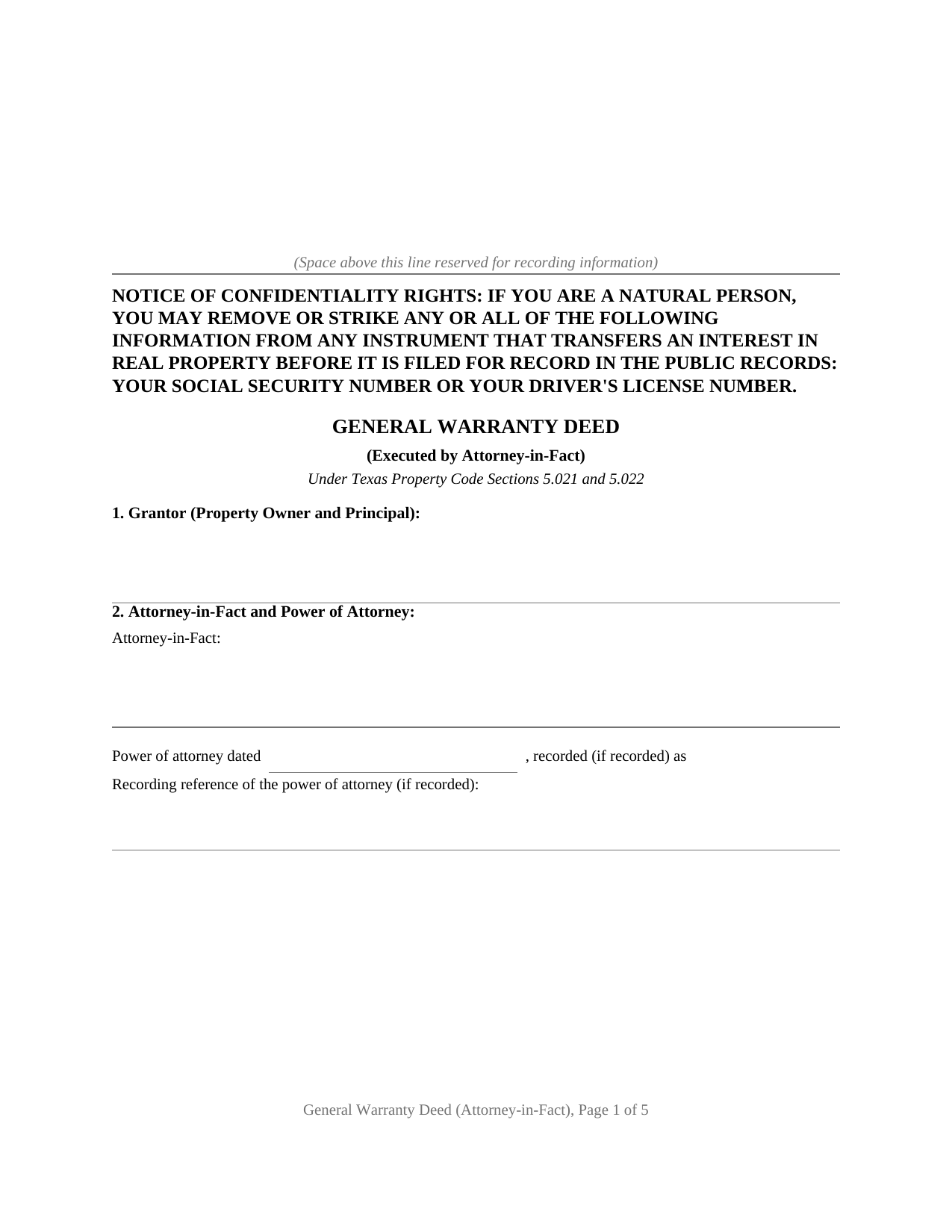
About the Texas General Warranty Deed (Executed by Attorney-in-Fact)
How to Use This Form
- Select your county from the list
- Download the county-specific form
- Fill in the required information
- Have the document notarized if required
- Record with your county recorder's office
What Others Like You Are Saying
"fulfilled all NC requirements"
"Excellent"
"Easy system to use. good information."
"The website looks good and probably like it is easy to use, but I needed a deed in lieu and couldn't…"
"I liked having the forms. Some may need to know they can look at the legal Description from online c…"
4.8/5 from 4,824 reviews. Read all
A Texas general warranty deed gives a buyer the broadest title protection the state's deeds offer, reaching the entire chain of title rather than just the years the seller owned the land. This form prepares that deed for the situation where the owner does not sign it personally: an attorney-in-fact signs for the owner under a power of attorney, using the authority Texas Property Code Section 5.021 gives an agent authorized in writing.
Who Signs, and Who Warrants
The two roles stay distinct throughout the deed. The grantor is the property owner and the principal under the power of attorney, the party who conveys the property and gives the covenant of general warranty. The attorney-in-fact is the agent, the hand that signs the grantor's name because the grantor authorized it in writing. The warranty is the grantor's promise, not the agent's, and the agent signs as the act of the grantor. Section 5.021 is the foundation: a conveyance must be subscribed and delivered by the grantor or by the grantor's agent authorized in writing, and that written authority is the power of attorney.
A Warranty That Reaches the Whole Chain
Section 5.022 supplies the statutory general warranty form and allows any lawful form the same in substance. This deed uses the customary granting words, grants, sells, and conveys, and binds the grantor to warrant and forever defend the property against every person lawfully claiming it. That full covenant separates a general warranty deed from a special warranty deed, which warrants only against claims arising during the grantor's ownership, and from a deed without warranty, which conveys while disclaiming the promise. Executing through an agent does not narrow the warranty; the grantor gives the same full protection an owner signing in person would give.
Recording the Power of Attorney
Because an agent signs, the deed carries a step an ordinary deed does not. Texas Estates Code Section 751.151 contemplates recording the power of attorney in the county where the property is located no later than the thirtieth day after the deed is filed, and in practice the two are recorded together, so a later title examiner finds the conveyance and the agent's authority in the same records. The deed relies on that authority and cannot supply one the power of attorney withholds, so the scope of the agent's power is always a question of the power of attorney's own terms.
The Signature and the Acknowledgment
The signature shows both names and the capacity, such as the grantor's name followed by, by the agent, as Attorney-in-Fact. The notary certificate follows the statutory short form in Civil Practice and Remedies Code Section 121.008 for a person acting by attorney-in-fact, so the record shows the agent acknowledged the deed on the grantor's behalf. Where the property is the homestead of a married grantor, Texas Family Code Section 5.001 calls for the grantor's spouse to join to release homestead rights, and the form provides a joining-spouse signature and certificate; otherwise that block stays blank. The package includes the blank deed as a fillable PDF, a completed example for a realistic Denton County transaction, and a plain-language guide that walks through every numbered section. The materials are informational and are not legal advice.
Related Texas Forms
An owner signing in person uses the Texas General Warranty Deed. An owner who wants to limit the warranty to the period of that owner's ownership uses the Texas Special Warranty Deed, and an owner conveying without warranties uses the Texas Deed Without Warranty. The authority this deed relies on is created with the Texas Statutory Durable Power of Attorney or a specific power of attorney for the sale of property.
Important: County-Specific Forms
Our general warranty deed (executed by attorney-in-fact) forms are specifically formatted for each of the 254 counties in Texas.
After selecting your county, you'll receive forms that meet all local recording requirements, ensuring your documents will be accepted without delays or rejection fees.