Vermont Correction Deed (Individual Grantor by Attorney-in-Fact under POA)
County Specific Legal Forms Validated as recently as October 7, 2026 by our Forms Development Team
About the Vermont Correction Deed (Individual Grantor by Attorney-in-Fact under POA)
How to Use This Form
- Select your county from the list
- Download the county-specific form
- Fill in the required information
- Have the document notarized if required
- Record with your county recorder's office
What Others Like You Are Saying
"process was easy and simple to do"
"The process was straightforward, quick and reasonably priced. The agents provided updates every step…"
"Excellent service even faster then I expected. Very pleased and a reasonable priced document. I enco…"
"The sample completed form was a big help. While not exactly on point with my situation, it was enoug…"
"Fast and easy. Sample completed form & guidelines very useful."
4.8/5 from 4,823 reviews. Read all
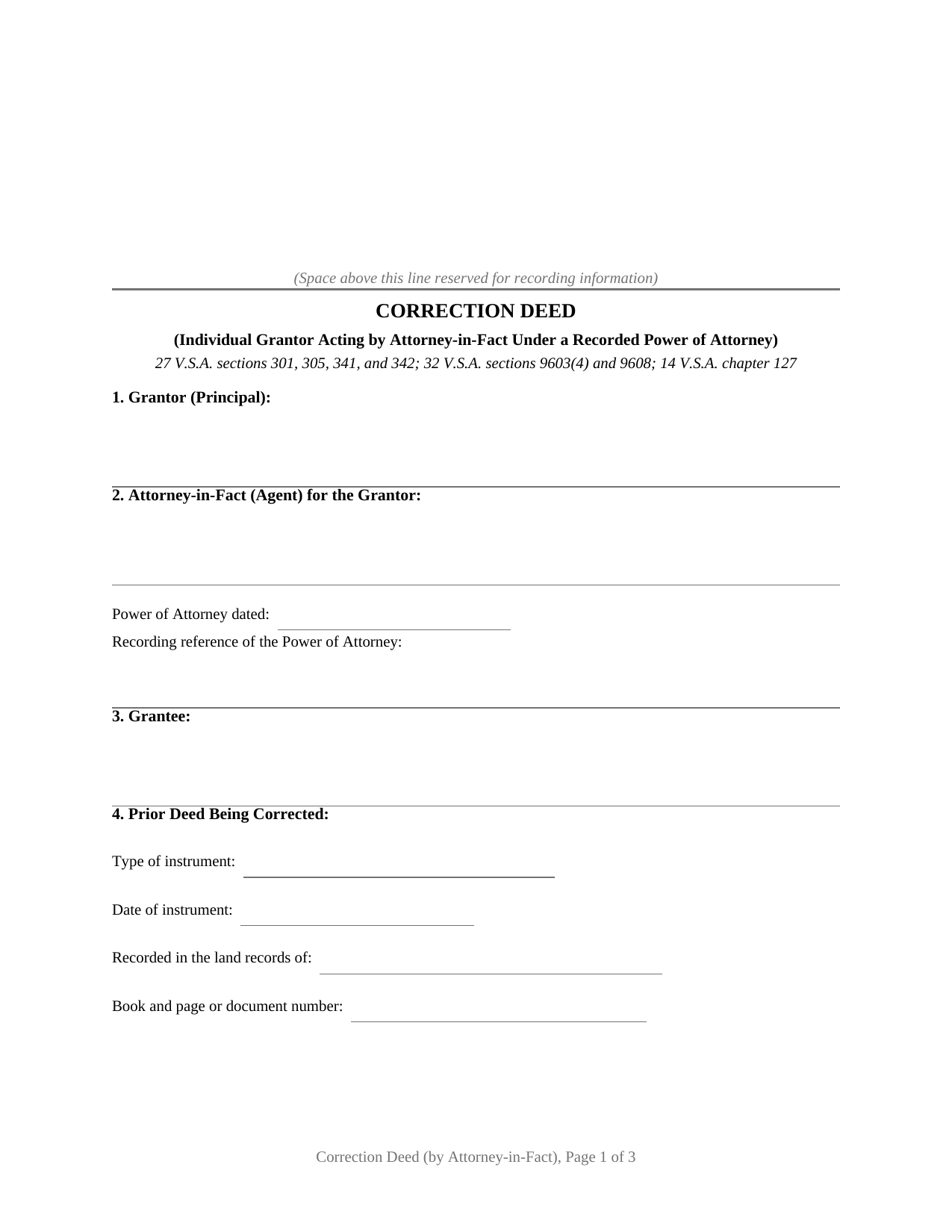
When a recorded Vermont deed carries an error and the owner's signature comes through an agent, the repair arrives as a single instrument: a correction deed executed by an attorney-in-fact under a recorded power of attorney. This fillable form prepares that deed for one individual grantor, re-conveying to the same grantee with the error identified and the corrected matter stated, without a new bargain and without additional consideration.
A deed that repairs the record instead of remaking it
A Vermont correction deed, also searched as a corrective deed or deed of correction, works by re-executing the earlier transaction. The form identifies the prior deed by instrument type, date, and book and page in the municipal land records; states the error as the prior deed carries it, such as a wrong lot number, a misspelled name, or an incomplete legal description; and states the corrected matter alongside a full corrected description. The operative section then gives, grants, conveys, and confirms the property to the grantee the prior deed named, provides that the prior deed otherwise remains as recorded, and adds no covenant or warranty of title of its own.
Because the transfer confirms or corrects a transfer previously recorded, without additional consideration, it sits within the exemption in 32 V.S.A. § 9603(4). Form PTT-172, the Vermont Property Transfer Tax Return, is still filed with the exemption number entered, because 32 V.S.A. § 9608 bars the clerk from recording a deed without a completed return.
The attorney-in-fact signature, and the recorded POA behind it
The defining configuration of this form is its signature architecture: one grantor named as principal, one attorney-in-fact who signs for that grantor, and one acknowledgment certificate completed in representative capacity, identifying the signer as attorney-in-fact for the named principal. Section 2 of the deed names the agent and carries the recording reference of the power of attorney itself, because 27 V.S.A. § 305 places a power of attorney used to convey Vermont land in the same land records office where the deed is recorded.
The agent authority behind the signature is governed by the Vermont Uniform Power of Attorney Act, 14 V.S.A. chapter 127, in effect since July 1, 2023, with a statutory real estate short form. Powers of attorney executed before that date, and powers validly executed in other states, remain usable under the Act's validity rules. A principal wintering out of state, a principal in long-term care, and a closing that went to record under an agent's signature and came back from the clerk with a defect all present the pattern this deed recites: the original conveyance is already on record, and the same agency arrangement now supplies the correcting signature.
What the form is, and is not, set up as
The form recites exactly one individual grantor acting through one attorney-in-fact, one grantee carried over from the prior deed, and a correction made without additional consideration. It is not set up as a deed for a grantor signing personally, for an entity grantor, or for a two-signer correction of a homestead deed that a spouse joined under 27 V.S.A. § 141. It is also not an enhanced life estate deed revision; Vermont's chapter 6 supplies its own recorded revision and revocation instruments for that device, prepared separately and not included in this package. An instrument that changes the parties, adds consideration, or moves beneficial ownership is a new transfer under Vermont's transfer tax chapter rather than a correction.
Recording with the town clerk
Vermont records land instruments by town or city rather than by county, so the deed goes to the clerk of the municipality where the land lies. Recording fees are statewide under 32 V.S.A. § 1671: $15.00 per page, plus $15.00 for the transfer tax return filing. The deed is acknowledged before a notary public under 27 V.S.A. § 341(a), and recording is what makes it effective against persons other than the grantor and the grantor's heirs under 27 V.S.A. § 342. A corrected description that cites a recorded survey plat also cites the map book and page where the plat is recorded, per 27 V.S.A. § 341(b).
The download includes the correction deed as a fillable PDF, a completed example showing the deed filled in for a fictional Montpelier fact pattern, and a plain language guide that walks through each numbered section, the agent signing formalities, and the PTT-172 filing. The materials describe Vermont law in general terms and are not legal advice.
Important: County-Specific Forms
Our correction deed (individual grantor by attorney-in-fact under poa) forms are specifically formatted for each of the 14 counties in Vermont.
After selecting your county, you'll receive forms that meet all local recording requirements, ensuring your documents will be accepted without delays or rejection fees.