Vermont Correction Deed (Married Grantor with Non-Owner Spouse Joinder)
County Specific Legal Forms Validated as recently as September 29, 2026 by our Forms Development Team
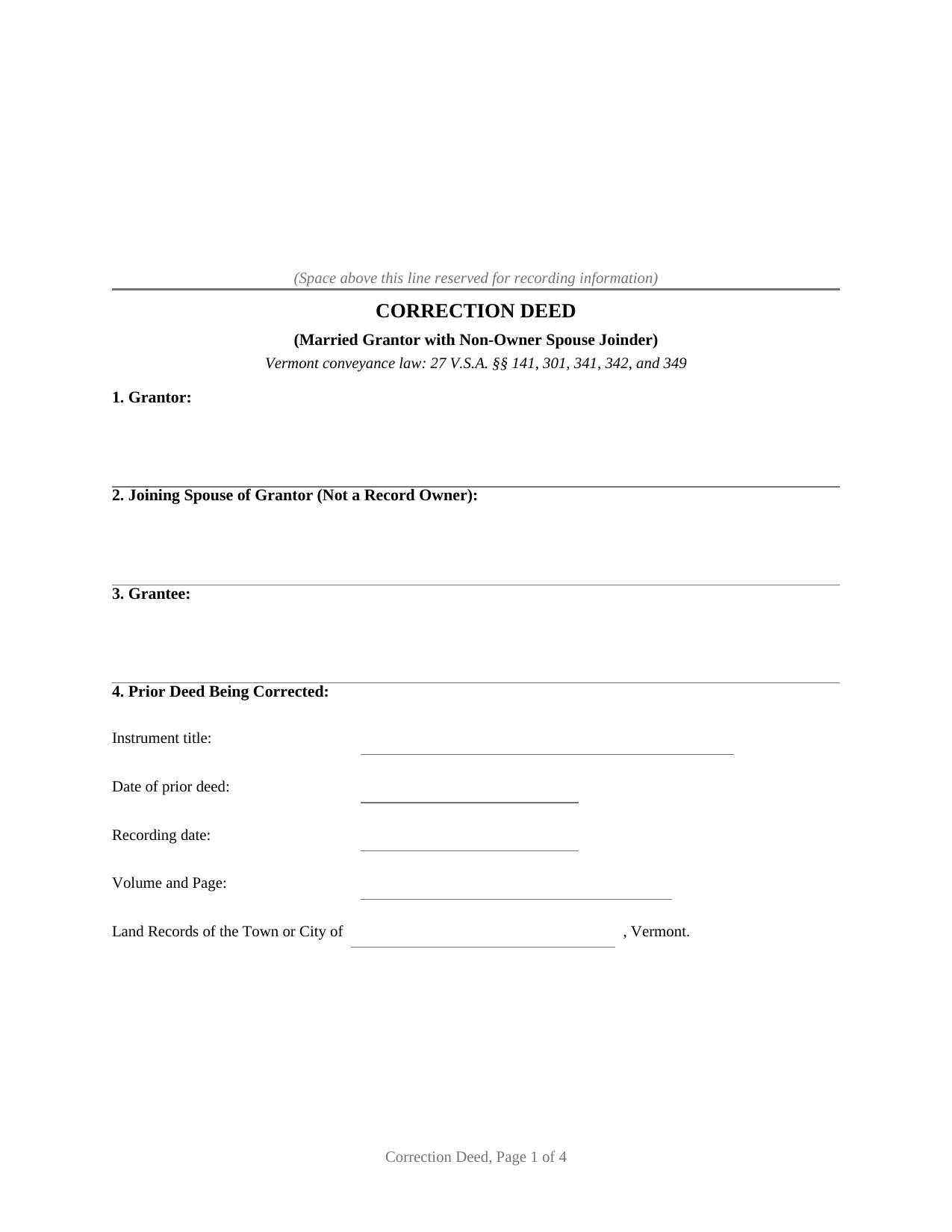
About the Vermont Correction Deed (Married Grantor with Non-Owner Spouse Joinder)
How to Use This Form
- Select your county from the list
- Download the county-specific form
- Fill in the required information
- Have the document notarized if required
- Record with your county recorder's office
What Others Like You Are Saying
"Very informative. It was very helpful."
"The website is easy to navigate. Unfortunately, you were not able to record the deed. However, I app…"
"Easy to follow step by step in completing form. Filing successful on first try. Economical cost. Wou…"
"Excellent work. Berry happy!"
"I loved the easy to understand and use system, very user friendly."
4.8/5 from 4,817 reviews. Read all
On a Vermont correction deed prepared for a married grantor, two signature lines carry the instrument: the grantor who signed the deed being corrected signs again, and the grantor's spouse, who holds no interest of record, signs a labeled joinder block beside it. This form prepares that configuration: a Vermont correction deed, also searched as a corrective deed or deed of correction, set up for one married grantor with joinder by a non-owner spouse.
Why a Spouse Outside the Title Signs
Vermont homestead law is the reason the second line exists. Under 27 V.S.A. 141, a married owner's lifetime conveyance of homestead property is inoperative as to the homestead unless the owner's spouse joins in the execution and acknowledgment of the conveyance, and 27 V.S.A. 349 bars conveying an interest in homestead property to a nonspouse without the spouse's joinder. A correction deed re-executes a conveyance, so the joinder travels with it. The form's joinder section identifies the second signer as the grantor's spouse and a non-owner of record, states the joinder under sections 141 and 349 as to any homestead interest, and adds no covenants from the spouse. Each signer has a separate acknowledgment certificate, so the two can appear before different notaries or on different dates.
A Deed That Repairs the Record, Not a New Transaction
The instrument works by restatement. It identifies the recorded deed containing the error by instrument title, date, volume and page, and the town whose land records hold it; states the specific error, a wrong lot number, a misspelled name, a bad plat citation; and then restates the corrected terms in full, with the grantor giving, granting, conveying, and confirming the property to the grantee. The deed states that it conveys no interest greater than the prior deed conveyed and makes no covenants of title beyond those in the prior deed, so the warranty posture of the original transaction stays where the original deed put it. Vermont has no statute prescribing a correction deed form; the instrument rests on the general conveyance statutes, 27 V.S.A. 301, 341, and 342, and the tax code names the class directly.
The Transfer Tax Exemption for Corrective Transfers
32 V.S.A. 9603(4) exempts from Vermont's property transfer tax those transfers that, without additional consideration, confirm or correct a transfer previously recorded. The deed's consideration section states exactly that pattern on the face of the instrument: given to confirm and correct, no additional consideration paid. The Property Transfer Tax Return, Form PTT-172, still travels with the deed, because 32 V.S.A. 9608 bars a town clerk from recording a deed without a return complete and regular on its face, exempt or not; the return claims the exemption and states its basis. No transfer tax and no clean water surcharge come due on the exempt transfer, and the statewide fees, 15 dollars per recorded page and 15 dollars for the return filing, apply.
Recorded With the Town Clerk, Not a County Office
Vermont land records live with town and city clerks, so the correction deed goes back to the same office that recorded the deed it corrects. Where the corrected legal description refers to a recorded survey or plat prepared or revised after July 1, 1988, 27 V.S.A. 341(b) has the deed cite the volume and page where the survey is recorded or carry the survey with it, a detail correction deeds meet constantly because so many of them exist to repair a description. The guide walks through that citation, the acknowledgment certificates, including the commission number line Vermont's notary statute contemplates, and every numbered section of the form.
The download includes the correction deed as a fillable PDF, a completed example showing the form filled in for a realistic Chittenden County correction, and a plain language guide to every numbered section, the signing formalities, and the recording process. The materials describe Vermont law in general terms and are not legal advice.
Important: County-Specific Forms
Our correction deed (married grantor with non-owner spouse joinder) forms are specifically formatted for each of the 14 counties in Vermont.
After selecting your county, you'll receive forms that meet all local recording requirements, ensuring your documents will be accepted without delays or rejection fees.