Vermont Correction Deed (Trustee Grantee)
County Specific Legal Forms Validated as recently as October 1, 2026 by our Forms Development Team
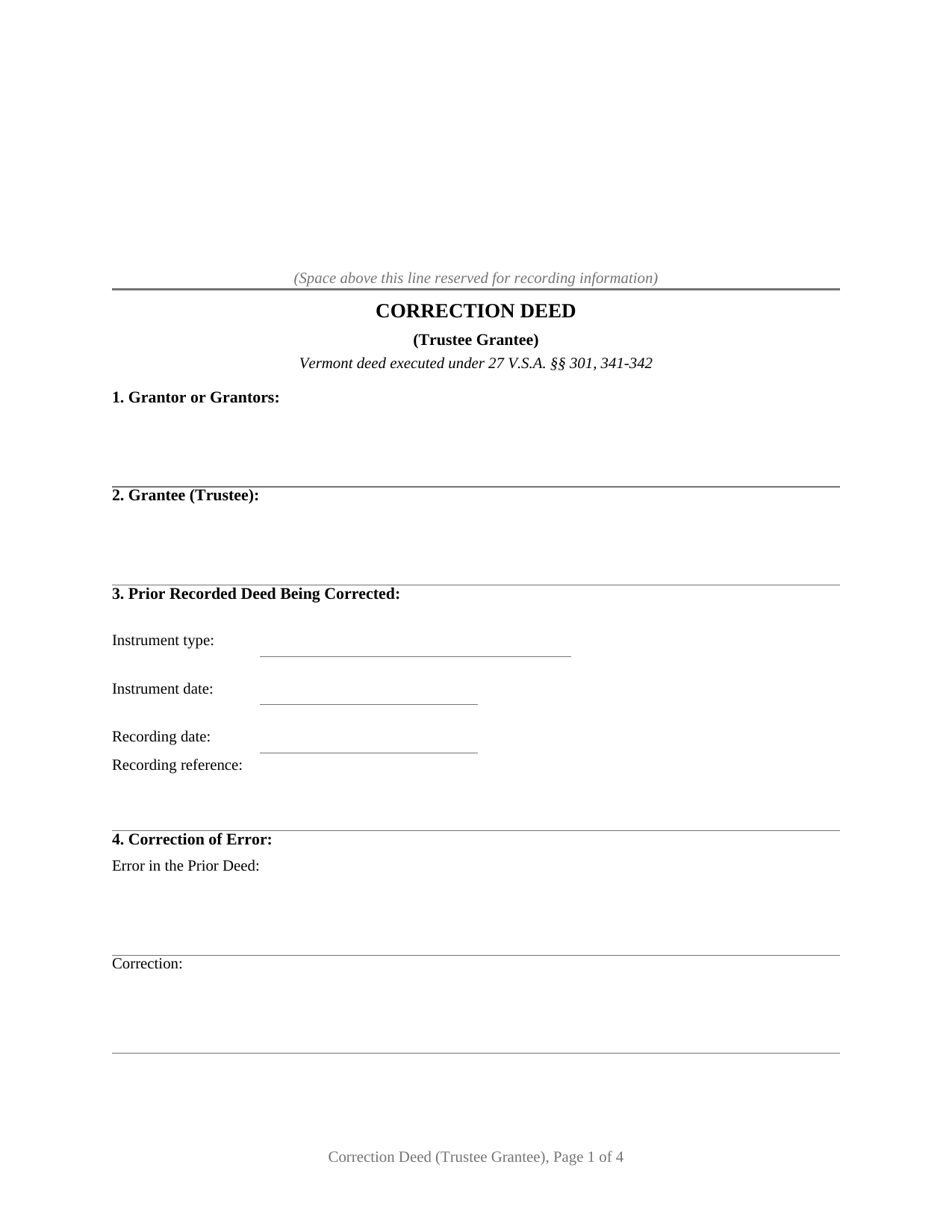
About the Vermont Correction Deed (Trustee Grantee)
How to Use This Form
- Select your county from the list
- Download the county-specific form
- Fill in the required information
- Have the document notarized if required
- Record with your county recorder's office
What Others Like You Are Saying
"This site/service is amazing! The response is almost real-time and the fees are super reasonable. I …"
"THANK YOU. Your materials are excellent and provided the information and guidance requested and need…"
"Amazing! So easy to get all the forms. Very impressive!"
"Great service! Recording was smooth and swiftly performed. Deeds.com is an excellent service."
"Fast, easy download of forms needed. Thank you, Deeds.com"
4.8/5 from 4,817 reviews. Read all
A mistake in a recorded Vermont deed that conveyed property to a trustee does not fix itself, and the town clerk cannot amend a document already in the land records. This Vermont correction deed, also searched as a corrective deed or deed of correction, is built for exactly that configuration: the original grantor re-executes the conveyance to a grantee who holds title as trustee of a trust, identifies the recorded deed being corrected, states the error and the correction, and confirms the transfer as it was meant to read.
A recorded correction for a recorded error
Vermont records deeds town by town, in the clerk's office of the town or city where the land lies, and under 27 V.S.A. 342 an acknowledged, recorded deed is what holds the estate against anyone beyond the grantor and the grantor's heirs. The correction deed works inside that system: it identifies the earlier deed by its date and its volume and page in the town land records, describes the error exactly, states the correction, restates the legal description, and confirms the conveyance except as corrected. The earlier deed stays of record, and the correction deed follows it in the chain of title, so a later examiner reads the two together and the error stops propagating into future abstracts.
The trustee in the grantee clause
The grantee section of this form names the trustee, the trust, and the trust's date, in the style Margaret H. Ellison, Trustee of the Ellison Family Revocable Trust, dated April 12, 2019. Trust details are a common home for small drafting errors: a trust date carried over wrong from an earlier draft, a misspelled trustee name, a trust name that differs between the deed and the trust instrument. Vermont places express trusts of land in a signed writing under 27 V.S.A. 303, so the deed identifies the trust while the trust instrument supplies its terms, and a grantee clause that misidentifies either detail leaves a title examiner matching documents that do not agree. The form is set up as a correction instrument with a trustee grantee, not as a first-time transfer into a trust: its sections assume a deed already of record, and its operative language re-conveys to the same trustee the prior deed named, as corrected.
No new transfer tax on a true correction
A Vermont Property Transfer Tax Return, Form PTT-172, accompanies every deed delivered to a town clerk for recording; under 32 V.S.A. 9608 the clerk cannot record without it. The correction deed has its own place in that system. 32 V.S.A. 9603(4) exempts transfers that, without additional consideration, confirm or correct a transfer previously recorded, and the Department of Taxes' instructions call for the return to be filed even for an exempt transfer, with the exemption number entered on the return itself. The distinction matters: a document that adds land, changes parties, or reflects new consideration is a new transfer rather than a correction, and the exemption does not describe it. The consideration section of this form states the without-additional-consideration character of the transaction in words that track the statute.
Signing and recording in the town, not the county
The grantor of the prior deed signs the correction deed and acknowledges it before a notary public, the execution formality 27 V.S.A. 341 sets for Vermont deeds; no subscribing witnesses appear in the statute, and the acknowledgment is valid without an official stamp affixed to the notary's signature. The form carries two grantor signature blocks, each with its own acknowledgment certificate, so a deed originally given by two grantors, a married couple among the common patterns, re-executes on one instrument, and a single-grantor correction leaves the second block blank. Recording happens where the original recording happened, with the clerk of the town or city where the land lies, at the statewide fee of $15.00 per page plus $15.00 for the transfer tax return.
The download contains the correction deed as a fillable PDF, a completed example showing a realistic Addison County correction from start to finish, and a plain-language guide that walks through every numbered section, the signing formalities, and the recording steps. The materials describe Vermont law in general terms and are not legal advice.
Important: County-Specific Forms
Our correction deed (trustee grantee) forms are specifically formatted for each of the 14 counties in Vermont.
After selecting your county, you'll receive forms that meet all local recording requirements, ensuring your documents will be accepted without delays or rejection fees.