Vermont Correction Deed (Trustee Grantor)
County Specific Legal Forms Validated as recently as October 6, 2026 by our Forms Development Team
About the Vermont Correction Deed (Trustee Grantor)
How to Use This Form
- Select your county from the list
- Download the county-specific form
- Fill in the required information
- Have the document notarized if required
- Record with your county recorder's office
What Others Like You Are Saying
"Excellent and a very fast way to release important documents. Thank you very much."
"Was helpful"
"It was easy to navigate and I found my information without any trouble."
"Great service that satisfied all my needs. Great prices too."
"Fastest online reply of nearly anything on the planet. Very impressed!!"
4.8/5 from 4,815 reviews. Read all
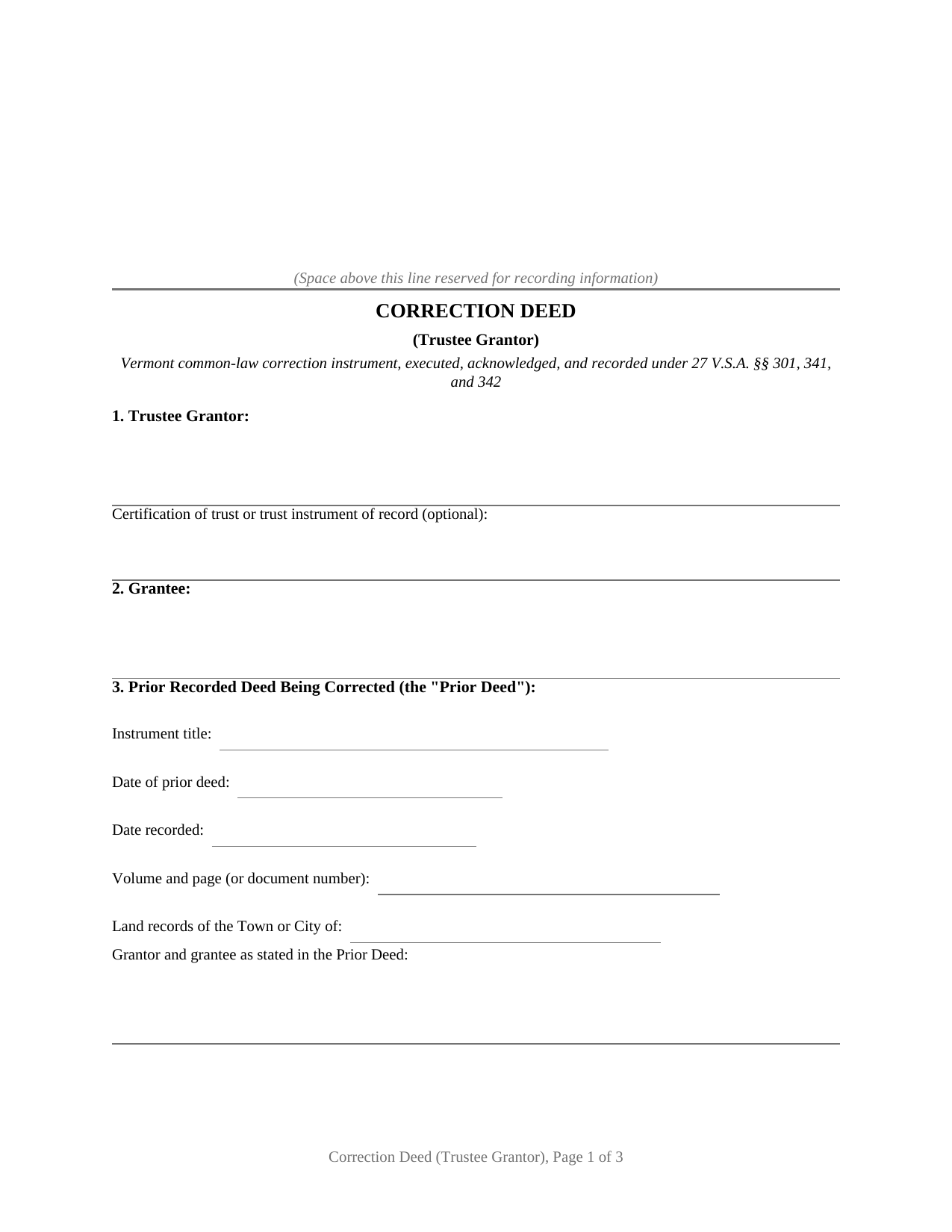
This Vermont correction deed carries a trustee-grantor configuration: a trustee who has already conveyed Vermont real property by a recorded deed, and who now places a correction of that deed on record in the same representative capacity. The form is a Vermont instrument through and through, built around one trustee signature line, one representative-capacity acknowledgment certificate, and the recital pattern a corrective instrument carries in Vermont title practice.
A second deed that fixes the first
A correction deed, also searched as a corrective deed or deed of correction, is a re-execution rather than a fresh bargain. The form identifies the prior recorded deed by its instrument title, its date, and its volume and page in the town land records; states the error the record shows; states the correction; and then confirms, corrects, and conveys the property to the same grantee, as corrected, without additional consideration. Vermont prescribes no statutory correction deed form, so the instrument runs on the general conveyance chapter: signed by the grantor, acknowledged before a notary public, and recorded at length with the clerk of the town where the land lies under 27 V.S.A. 341, with 27 V.S.A. 342 giving the recorded deed its effect against third parties.
The trustee signs again, in the same capacity
The configuration is the variant. The grantor section identifies the trustee and the trust exactly as the prior deed stated them, the operative section recites that the signer acts solely as trustee and not individually, and the single acknowledgment certificate matches the representative-capacity short form in 26 V.S.A. 5368. An optional blank takes the recording reference of a certification of trust already on record, the sworn instrument 14A V.S.A. 1013 makes usable as evidence of a trustee's authority to convey. The fact patterns that present this deed are familiar ones in trust conveyancing: a trustee's deed out of a family revocable trust that recites the wrong lot number, a grantee surname misspelled at the closing table, a trust date carried incorrectly from an older draft. The form recites one trustee grantor acting for one identified trust; a correction of a deed that individual owners signed in their own right follows a different signer pattern and is not what this form recites.
No new transfer tax on a true correction
Vermont taxes transfers by deed under 32 V.S.A. 9602, and the statute answers the correction pattern directly: 32 V.S.A. 9603(4) exempts transfers that, without additional consideration, confirm or correct a transfer previously recorded. The paperwork still travels with the deed. A Vermont Property Transfer Tax Return, Form PTT-172, accompanies every deed delivered for recording, with the corrective exemption entered as number 04 on Line E1, and under 32 V.S.A. 9608 the town clerk cannot record a deed without a return that is complete and regular on its face together with the required Act 250 certificate. The guide included with this form walks through that filing alongside the deed itself.
Recorded with the town clerk, not a county recorder
Vermont land records live at the municipal level, so the corrected deed returns to the same town or city land records that hold the deed it corrects. The statewide recording fee under 32 V.S.A. 1671 is fifteen dollars per page, plus fifteen dollars for filing the transfer tax return. The acknowledgment is valid without an official stamp affixed to the notary's signature, and where the legal description cites a plat or survey recorded after mid-1988, the deed cites the volume and page where that survey is recorded, in the manner the completed example demonstrates.
The download delivers exactly three things: this correction deed as a blank fillable PDF, a completed example showing a corrected lot-number transfer recorded in a Vermont town's land records, and a plain-language guide that walks every section, the trustee's signing formality, and the recording steps. The materials describe Vermont law and the form itself; they are informational and are not legal advice.
Important: County-Specific Forms
Our correction deed (trustee grantor) forms are specifically formatted for each of the 14 counties in Vermont.
After selecting your county, you'll receive forms that meet all local recording requirements, ensuring your documents will be accepted without delays or rejection fees.