Vermont Correction Deed (Married Couple as Grantors)
County Specific Legal Forms Validated as recently as September 8, 2026 by our Forms Development Team
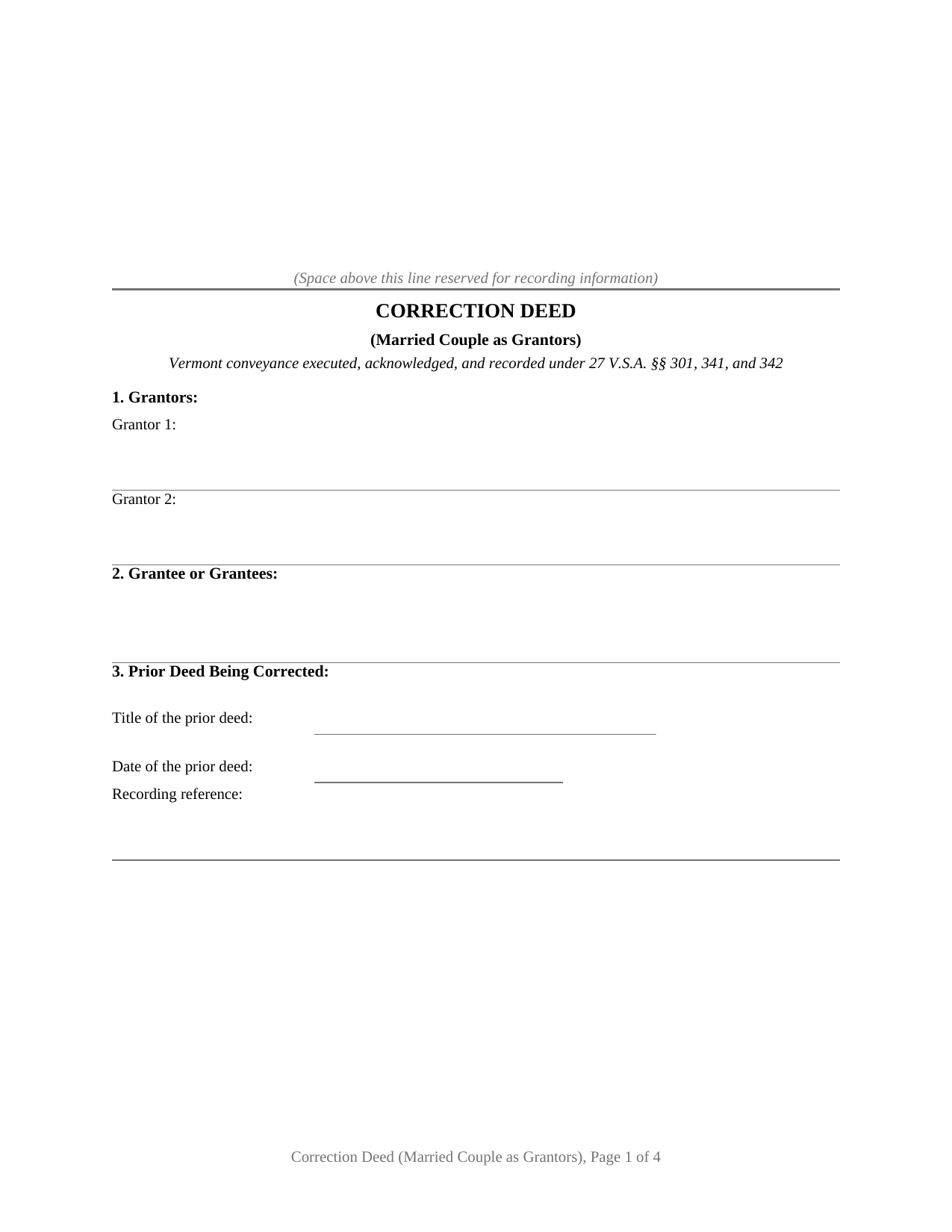
About the Vermont Correction Deed (Married Couple as Grantors)
How to Use This Form
- Select your county from the list
- Download the county-specific form
- Fill in the required information
- Have the document notarized if required
- Record with your county recorder's office
What Others Like You Are Saying
"Excellent service--I got just the information I needed quickly and reasonably priced. I am glad to k…"
"Thank you for making my life easier!!"
"Thank you so much for making it easy and professionally trustworthy. You are the best!!!"
"got what I needed quick and easy thank you!!!"
"Forms were just what I needed. Very well explained and easy to use."
4.8/5 from 4,823 reviews. Read all
This correction deed re-executes a Vermont conveyance that two married grantors signed together, replacing an error discovered after the deed reached the town land records. The form is set up for exactly two grantors who are spouses: both sign again, each signature carries its own acknowledgment certificate, and the completed deed records in the land records office of the Vermont town or city where the property lies.
One recorded error, two signing spouses
The form carries two grantor blocks, two signature lines, and two acknowledgment certificates, so the spouses may acknowledge on different dates, before different notarial officers, or in different states. Spouses who conveyed Vermont property they owned together, and whose recorded deed turned out to carry a transposed lot number, a misspelled name, or a recording reference to the wrong book and page, present the pattern this deed recites. Vermont ties marital joinder to conveyances of homestead and entireties property under 27 V.S.A. 141 and 349(a)(2), and because both spouses appear as grantors and both execute the correction, that joinder appears on the face of the corrective instrument just as it did on the original. The form recites exactly two grantors who are married to each other; a deed with a sole grantor, or with co-grantors who are not spouses, presents a different signature and certificate pattern than this configuration carries.
How a deed of correction reads in the chain of title
Vermont has no statute prescribing a correction deed, sometimes searched as a corrective deed or confirmatory deed; the instrument rests on the ordinary conveyancing statutes in 27 V.S.A. chapter 5. This form identifies the prior deed by title, date, and municipal recording reference, states the error in plain terms, states the corrected information, and then conveys and confirms the property to the same grantee, as corrected and without additional consideration. The operative section provides that the deed creates no covenant or warranty of title beyond those stated in the prior deed and leaves the prior deed otherwise unchanged, so a title examiner reading the chain sees one transaction, corrected, rather than two competing conveyances. The deed is signed by both grantors and acknowledged before a notary public under 27 V.S.A. 341(a), which also makes the acknowledgment valid without an official stamp; the certificate on this form carries the notary's printed name and commission number lines that Vermont's notarial statute describes for tangible records.
Town clerk recording and the transfer tax return
Vermont records deeds municipally: the town or city clerk, not a county recorder, maintains the land records, and the statewide recording fee is $15.00 per page under 32 V.S.A. 1671. A Vermont Property Transfer Tax Return, Form PTT-172, accompanies a deed delivered for recording, and 32 V.S.A. 9608(a) bars the clerk from recording without it. The return is filed even when the transfer is exempt, and a transfer that confirms or corrects a previously recorded transfer without additional consideration is the exemption stated in 32 V.S.A. 9603(4), entered by number on the return. Where the corrected legal description refers to a survey prepared or revised after July 1, 1988, 27 V.S.A. 341(b) calls for the recorded survey to accompany the deed or to be cited by volume and page, a detail the completed example illustrates with a plat citation.
What the download includes
The package contains the fillable correction deed form, a completed example showing a married couple correcting a lot number in a recorded warranty deed, and a guide that walks through each section of the form, the acknowledgment certificates, and the recording package the town clerk expects. The materials describe Vermont law in general terms and are not legal advice.
Important: County-Specific Forms
Our correction deed (married couple as grantors) forms are specifically formatted for each of the 14 counties in Vermont.
After selecting your county, you'll receive forms that meet all local recording requirements, ensuring your documents will be accepted without delays or rejection fees.