Vermont Correction Deed (Entity Grantor)
County Specific Legal Forms Validated as recently as September 25, 2026 by our Forms Development Team
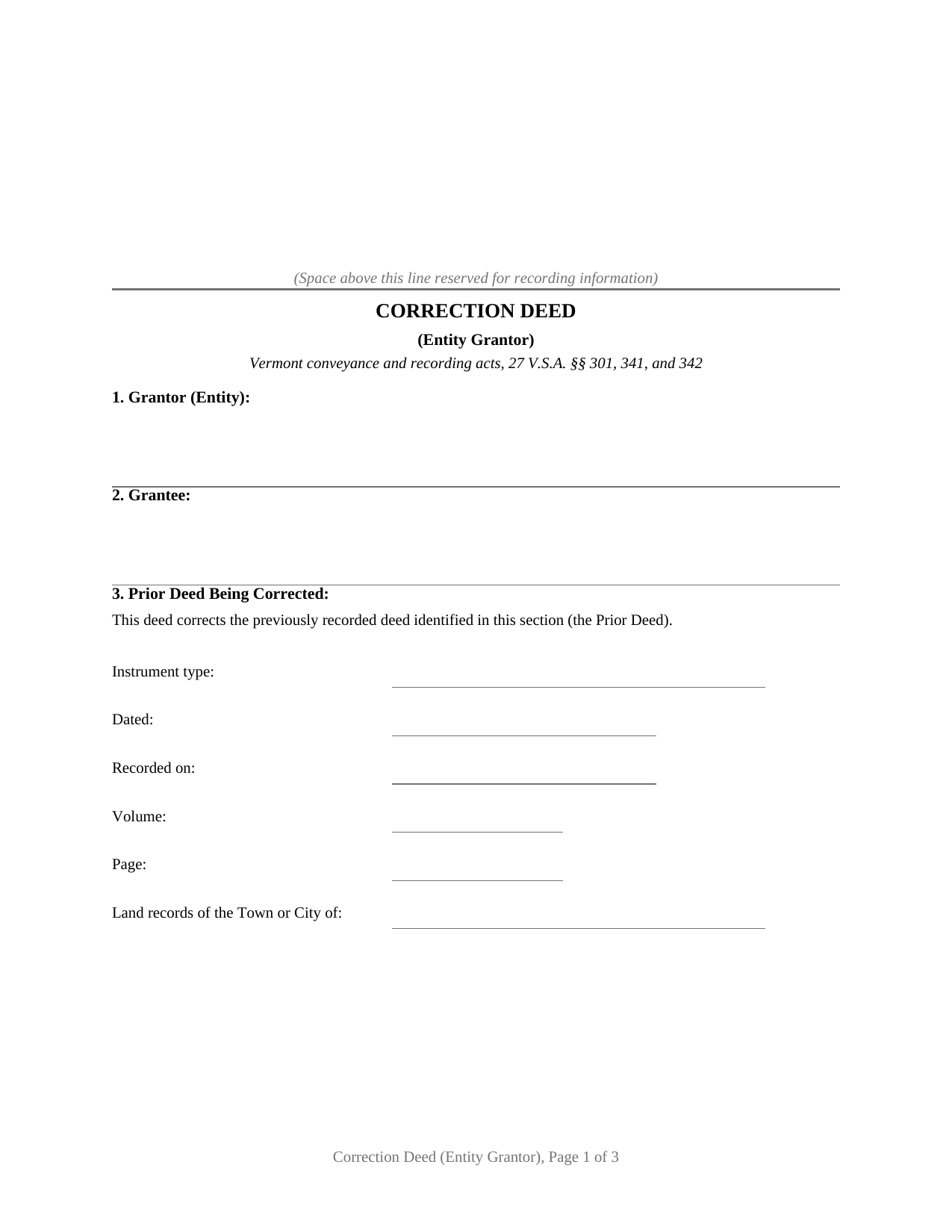
About the Vermont Correction Deed (Entity Grantor)
How to Use This Form
- Select your county from the list
- Download the county-specific form
- Fill in the required information
- Have the document notarized if required
- Record with your county recorder's office
What Others Like You Are Saying
"The web cite is very easy to navigate through making a document process simple to obtain."
"Needed copy of deed in trust. Found info here, paid on line and then printed the docs. Easy to use, …"
"Great Service. Not only the required form, but also the state guidelines. Thank you for making it ea…"
"Easy website to navigate. Found the form I needed within seconds. Thank you"
"Better than in person service, I recommend this service 100%."
4.8/5 from 4,815 reviews. Read all
A recorded deed with a wrong lot number or a misspelled name does not fix itself, and when the grantor is a company, the fix carries its own signing pattern. This Vermont correction deed is set up for an entity grantor: a corporation, limited liability company, partnership, or other organization corrects an error in a deed it previously delivered and recorded, signing through one authorized person whose printed name, title, and representative acknowledgment the form carries.
A recorded fix that leaves the original deed in place
The deed identifies the previously recorded instrument by type, date, and volume and page in the town or city land records, describes the error in plain terms, and states the corrected information. It then confirms the conveyance the earlier deed made, restating that deed only to the extent of the correction. The original deed stays of record, and the two instruments are read together in the chain of title. Typical errors this pattern reaches are drafting mistakes: a legal description that names the wrong lot, a grantee name spelled two different ways, a recording reference that points at the wrong volume or page. The deed also states on its face that it adds no covenant of title, so whatever covenants the original deed carries continue only as stated there.
Signing for the company under Vermont acknowledgment law
Vermont deeds are signed by the party granting and acknowledged before a notary public under 27 V.S.A. 341(a), and a deed holds the estate against persons other than the grantor and the grantor's heirs only when it is acknowledged and recorded, under 27 V.S.A. 342. On this form, one authorized person signs for the organization, a printed name and title line sits under the signature (32 V.S.A. 1405 permits the recording official to require printed names under signatures), and the acknowledgment certificate is completed for a representative signer in the style of Vermont's statutory short form certificates in 26 V.S.A. 5368. The blank following the certificate's operative sentence holds the signer's name and capacity, in the pattern the completed example shows for a manager signing on behalf of a limited liability company.
No new transfer tax for a true correction
Vermont taxes transfers of title by deed and bars the town clerk from recording a deed transferring title unless a complete Property Transfer Tax Return accompanies it, under 32 V.S.A. 9608. A correction sits in its own category: 32 V.S.A. 9603(4) exempts transfers that, without additional consideration, confirm or correct a transfer previously recorded. The return still accompanies the deed at recording, with the exemption entered on it, and the deed's consideration section states the fact supporting the claim, that no additional consideration is paid and the deed is given to confirm and correct a transfer previously recorded. The form is set up for exactly that category. A transaction that moves title to a different grantee, adds or removes land, or exchanges new value describes a new conveyance rather than a correction, with its own tax treatment.
Recorded town by town
Vermont land records are municipal, so a corrective deed is recorded with the clerk of the town or city where the land lies, at the statewide fee of 15 dollars per page, alongside the transfer tax return and its own filing fee. Where a deed refers to a survey prepared or revised after July 1, 1988, Vermont law has the deed accompanied by the survey or citing the volume and page where the survey is recorded, under 27 V.S.A. 341(b), a detail that matters when the correction touches the legal description. The form reserves the top of the first page for the clerk's recording information and keeps every entry inside Vermont's page and legibility standards.
The download includes the correction deed as a fillable PDF, a completed example showing the deed filled in for a realistic Vermont fact pattern, and a plain language guide that walks through each numbered section, the representative acknowledgment, and the recording and transfer tax return steps. The materials describe Vermont law in general terms and are not legal advice.
Important: County-Specific Forms
Our correction deed (entity grantor) forms are specifically formatted for each of the 14 counties in Vermont.
After selecting your county, you'll receive forms that meet all local recording requirements, ensuring your documents will be accepted without delays or rejection fees.