Vermont Warranty Deed (Trustee Grantor)
County Specific Legal Forms Validated as recently as October 21, 2026 by our Forms Development Team
About the Vermont Warranty Deed (Trustee Grantor)
How to Use This Form
- Select your county from the list
- Download the county-specific form
- Fill in the required information
- Have the document notarized if required
- Record with your county recorder's office
What Others Like You Are Saying
"Oh my that was so easy. I love it. Awesome. If someone needs help use the deeds.com"
"easy to use, good experience"
"The form cost was reasonable - it helped me organize my thoughts and write things down to help minim…"
"The deed I needed was available to me easily. I was able to fill it out with the help of the example…"
"TOOK ME SEVERAL DAYS TO FIND A SITE THAT DIDNT CHARGE $100 JUST TO USE ONE FORM. THANKS"
4.8/5 from 4,836 reviews. Read all
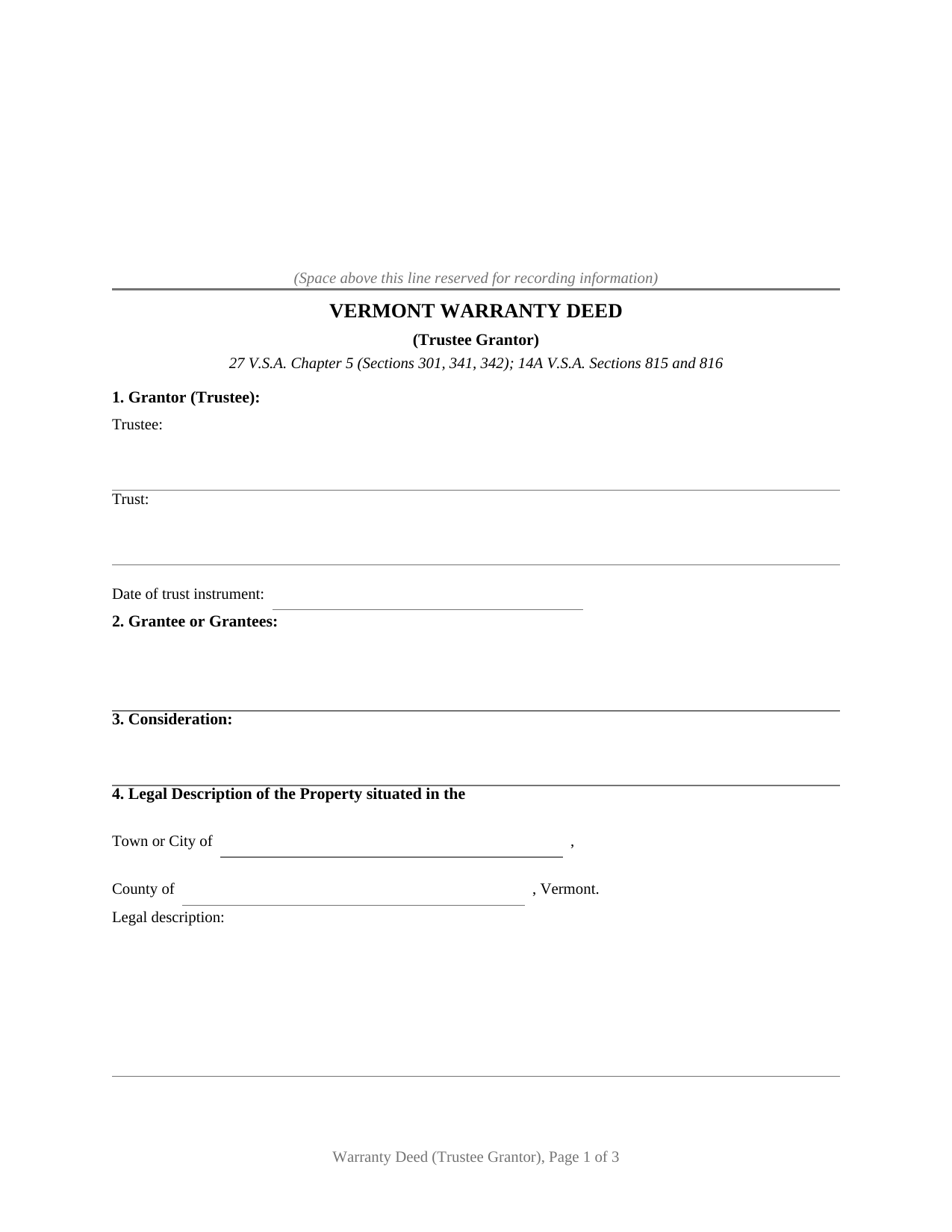
A capacity recital follows the grantor's name on this Vermont warranty deed: the person conveying holds the property as trustee, and the deed says so in its opening section, naming the trustee, the trust, and the date of the trust instrument before any granting word appears. The form prepares a Vermont general warranty deed from one trustee grantor, conveying real property out of a trust to the grantee or grantees it names, with the full common law covenants of title behind the transfer.
Authority the land records can read
A buyer taking a deed from a trustee looks for one thing an individual grantor never has to prove: that the signer may convey at all. Vermont answers from two directions, and the deed recites both. The trust instrument confers whatever powers the settlor wrote into it, and the Vermont Trust Code backstops them; 14A V.S.A. Section 816 lets a trustee sell property for cash or on credit, at public or private sale, and, when the trust winds up, distribute what remains to the persons entitled to it. The operative section of this deed states that the conveyance rests on the trust instrument and on those statutory powers, so the recorded instrument carries its own account of where the authority comes from, while the trust agreement itself stays off the record.
One trustee signs, and the capacity follows every clause
The architecture runs fiduciary from top to bottom: one grantor entry identifying trustee, trust, and trust instrument date; one signature line whose printed name carries the word Trustee; and one acknowledgment certificate worded to the representative capacity short form of 26 V.S.A. Section 5368, in which the notary certifies that the record was acknowledged by the named individual as trustee of the named trust. A settlor serving as her own trustee and selling the home her revocable living trust holds, a successor trustee conveying after the settlor's death, and a trustee deeding property free of trust to a beneficiary as administration closes present the patterns this deed recites. The form recites exactly one trustee and one trust; a conveyance by an owner in that owner's own right, by two co-owners of record, or by co-trustees whose instrument requires joint action, and a deed moving property into a trust rather than out of one, each follows a different recital architecture that this form does not carry.
Covenants made in a fiduciary voice
Vermont statutes imply no covenants of title, so this deed states them: lawful seisin in fee simple, good right and title to convey, freedom from every encumbrance except the matters its exceptions section lists, and warranty and defense against the lawful claims and demands of all persons. What distinguishes the trustee version is who stands behind those promises. The deed makes its covenants in the grantor's capacity as trustee and not individually, and it binds the grantor's successors in trust, so the warranty belongs to the office rather than to the person who happens to hold the office on signing day. The exceptions entry defines the limit of the promise; on a trustee's sale it commonly carries the recorded easements and restrictions the title search returns.
Recorded by the town, taxed by the state
The finished deed is a town filing: Vermont clerks record land instruments by town or city at fifteen dollars a page, and 32 V.S.A. Section 9608 stops a clerk from taking a deed unless a completed Property Transfer Tax Return, Form PTT-172, and the required Act 250 certificate come with it, with the tax itself paid to the Vermont Department of Taxes. How the return comes out depends on what the trustee is doing. A sale to an outside buyer pays the ordinary rates, 1.25 percent of value plus the 0.22 percent clean water surcharge, with a reduced bracket where the buyer takes a principal residence. A distribution conveying property free of trust to the settlor's spouse, child, or grandchild without consideration engages an exemption in 32 V.S.A. Section 9603, claimed on the same return, which is completed and filed with the deed either way.
The download contains three pieces: the blank trustee grantor warranty deed as a fillable PDF, a completed example showing a trustee selling a Lamoille County home held in a revocable living trust, and a plain language guide covering each numbered section, the representative capacity acknowledgment, the grantee vesting options Vermont recognizes, and the recording and transfer tax steps. The materials are informational and are not legal advice.
Important: County-Specific Forms
Our warranty deed (trustee grantor) forms are specifically formatted for each of the 14 counties in Vermont.
After selecting your county, you'll receive forms that meet all local recording requirements, ensuring your documents will be accepted without delays or rejection fees.