Vermont Warranty Deed (Corporation Grantor)
County Specific Legal Forms Validated as recently as September 24, 2026 by our Forms Development Team
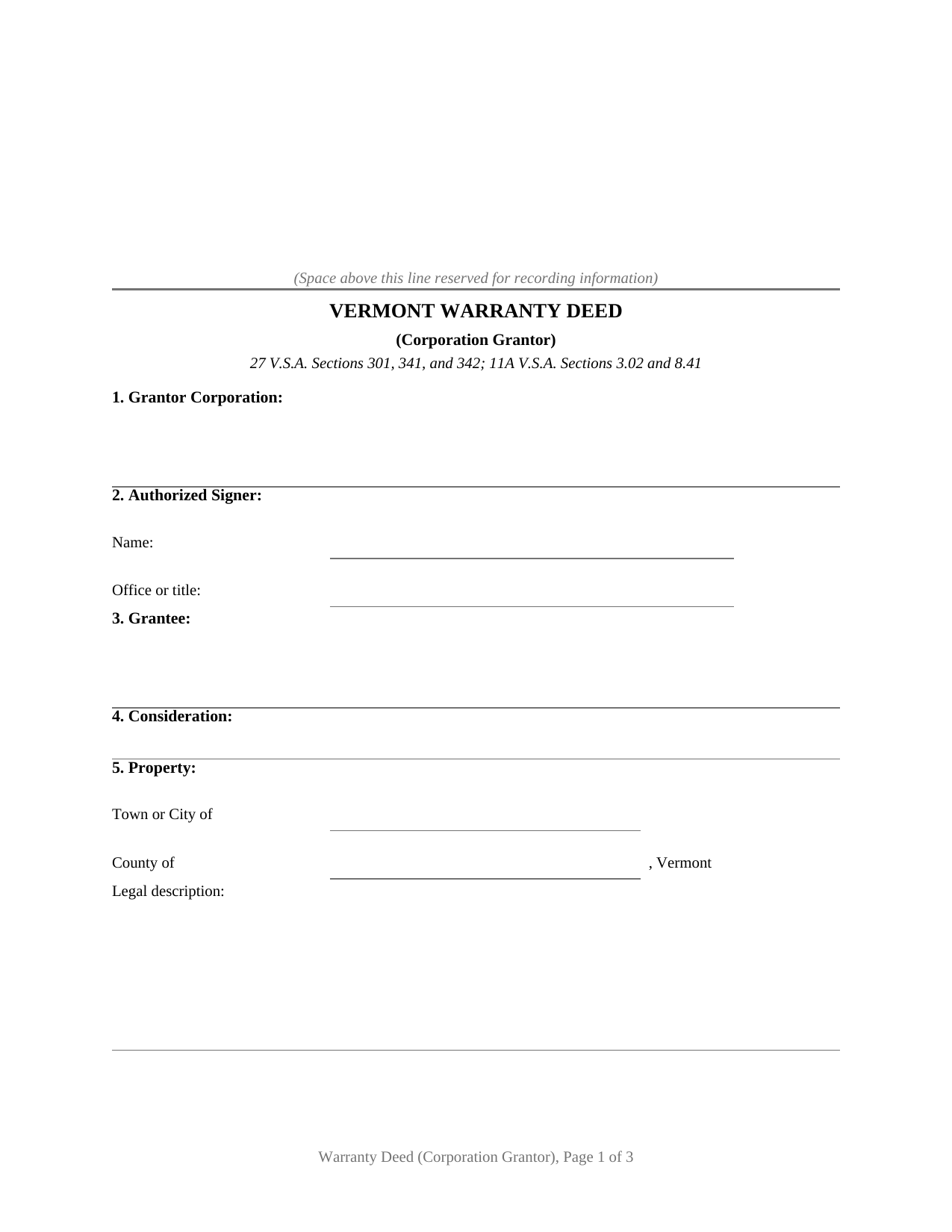
About the Vermont Warranty Deed (Corporation Grantor)
How to Use This Form
- Select your county from the list
- Download the county-specific form
- Fill in the required information
- Have the document notarized if required
- Record with your county recorder's office
What Others Like You Are Saying
"Extremely convenient and easy to execute the document. Instructions and example are very helpful. I …"
"I'm happy to have found your service. Very pleased."
"This process is outstanding, and it saved the hassle of going downtown and dealing with traffic."
"Thank you. Very easy!"
"Received the forms as promised. Very satisfied."
4.8/5 from 4,836 reviews. Read all
The signature line on this Vermont warranty deed starts with the word By, and the office typed beneath it matters as much as the name above it: record title sits in a corporation, the board of directors supplies the authority, and one officer executes the conveyance the company makes. The form prepares a Vermont general warranty deed for one corporation grantor, carrying the full common law covenants of title to the grantee or grantees named in it.
Authority that starts in the boardroom
Vermont's Business Corporation Act writes the chain of command this deed recites. Under 11A V.S.A. Section 3.02, a corporation holds the same power as an individual to own real property and to sell, convey, mortgage, lease, or otherwise dispose of it. Section 8.01 places the exercise of those powers under the authority of the board of directors, and Section 8.41 hands each officer the authority the bylaws set out or the board prescribes, so a president signing a corporate deed acts on documented, delegated power. One vote reaches past the board: under Section 12.02, a disposition that would leave the corporation without a significant continuing business activity requires shareholder approval by a majority of the votes entitled to be cast. The deed's operative section recites the signing authority on its face; the board resolution and any shareholder vote stay in the minute book, where buyers and title insurers look for them.
One corporation of record, one officer at the closing table
The architecture runs corporate throughout: a grantor section reciting the corporation's exact registered name, state of incorporation, and principal office; a signer section naming the individual and the office held; a single By signature line with printed name and title beneath it; and one acknowledgment certificate, worded to Vermont's statutory representative capacity form, in which the notary records that the named officer acknowledged the deed for the named corporation. A manufacturer selling an outgrown warehouse, a corporation turning its last parcel to cash while winding up under 11A V.S.A. Section 14.05, and a family corporation deeding out the land it was formed to hold present the patterns this deed recites. The form recites exactly one corporation as owner of record; a deed from an individual owner, from co-owners, from a limited liability company, or from a trustee follows a different recital and signature architecture than this form carries. Nothing on the form waits for a spouse, because real estate of record in a corporation belongs to no individual's homestead.
A warranty from an entity built to outlast its officers
No Vermont statute reads covenants into a deed, so the promises appear in express text: the corporation is lawfully seised in fee simple, holds good right and title to convey, warrants the property free from every encumbrance apart from the matters its exceptions entry lists, and stands behind the title against all lawful claims and demands. The covenants bind the corporation and its successors and assigns, and the deed states that the signing officer makes no personal covenant. A corporation has perpetual duration unless its articles provide otherwise, so the entity behind the warranty remains answerable long after the signing officer leaves the job; the exceptions entry marks off what the corporation does not warrant, commonly recorded easements, plat conditions, and the current year's municipal taxes.
The town clerk, the tax return, and the corporate seller
Vermont deeds record municipally, in the land records of the town or city where the property lies. At the counter, 32 V.S.A. Section 9608 leaves the clerk no discretion: without a completed Property Transfer Tax Return, Form PTT-172, and the required Act 250 certificate, the deed cannot be received for recording. The transfer tax falls on the buyer and goes to the Vermont Department of Taxes, at a rate that follows the buyer's intended use: reduced for a principal residence, higher for a year round habitable dwelling not taken as one. No corporate seal appears on the deed: 27 V.S.A. Section 341 asks for a signature and an acknowledgment before a notary, and the seal Vermont corporation law permits a company to keep remains optional.
The purchase delivers three items: the blank corporation grantor warranty deed as a fillable PDF, a completed example showing a Vermont corporation's Caledonia County sale filled in section by section, and a plain language guide explaining the numbered sections, the corporate signing rules, the ways grantees may take title, and the recording and transfer tax steps. The materials are informational and are not legal advice.
Important: County-Specific Forms
Our warranty deed (corporation grantor) forms are specifically formatted for each of the 14 counties in Vermont.
After selecting your county, you'll receive forms that meet all local recording requirements, ensuring your documents will be accepted without delays or rejection fees.