Vermont Warranty Deed (Joint Grantors)
County Specific Legal Forms Validated as recently as October 6, 2026 by our Forms Development Team
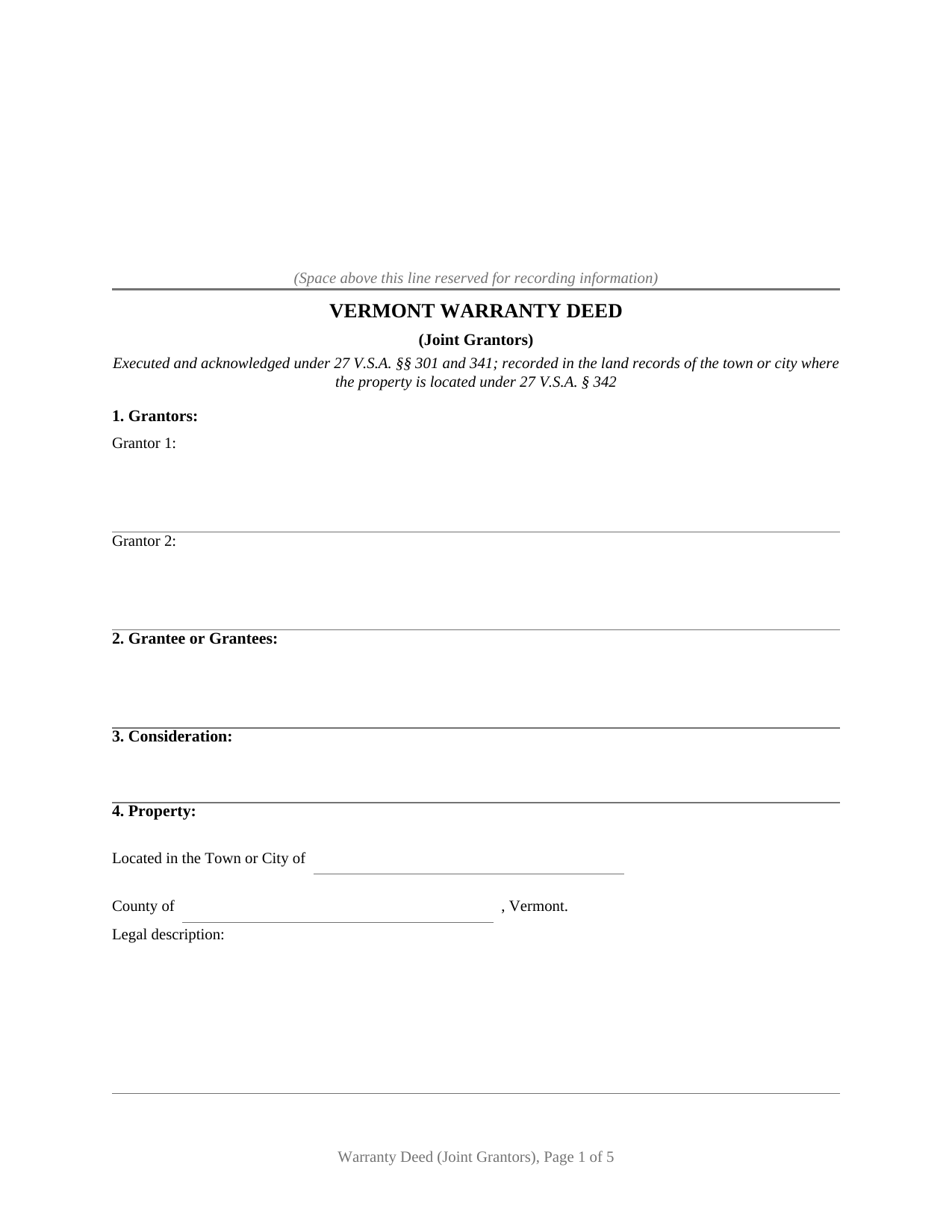
About the Vermont Warranty Deed (Joint Grantors)
How to Use This Form
- Select your county from the list
- Download the county-specific form
- Fill in the required information
- Have the document notarized if required
- Record with your county recorder's office
What Others Like You Are Saying
"HAD WRONG PASSWORD; PROGRAM MADE CHANGE EASY."
"Fast and just as promised"
"Great service! fast turnaround! I’ve used Deeds.com multiple times, and the software interface is ea…"
"I’m in Clearwater, FL and needed to record a something in Palm Beach County. Deeds.com made the enti…"
"I created an account for one particular document. It was very easy to find what I needed for my stat…"
4.8/5 from 4,836 reviews. Read all
Two grantors share this Vermont warranty deed: both co-owners of record are named in it, both sign it, and each acknowledges before a notary on a certificate of that grantor's own. This form prepares a Vermont general warranty deed made by exactly two individual grantors, conveying the property together in one instrument to the grantee or grantees named in it.
Two signatures, two acknowledgment certificates
The grantor section recites two names, and everything downstream comes matched: two signature lines with printed names beneath them, then two independent acknowledgment certificates worded to Vermont's statutory short form. Because the certificates stand apart, the grantors may acknowledge on different days, before different notaries, even in different states, and each notary completes only the certificate for the signer who appeared; the completed example shows the two grantors acknowledging a day apart in different counties. Vermont keeps the notarial mechanics simple in one respect, since 27 V.S.A. Section 341 treats an acknowledgment as valid without an official stamp affixed to the notary's signature, and the certificate carries lines for the notary's printed name and commission number so it stands complete either way. Spouses selling a home they hold as tenants by the entirety, two siblings conveying a farmhouse they inherited together, and unmarried co-owners closing out a shared purchase present the two-grantor pattern this deed recites. The form recites exactly two owners of record; a conveyance from a sole owner, or from three or more co-owners, follows a different recital and signature pattern and is not what this form is set up as.
When the two grantors are married to each other
A married couple holding Vermont land as tenants by the entirety cannot part with the estate one signature at a time: 27 V.S.A. Section 349 keeps an interest in entireties property from passing to anyone outside the marriage unless the other spouse joins. With both spouses named as grantors and both signing, this deed carries that joinder inside its own signature section, and the same two signatures supply the homestead joinder of 27 V.S.A. Section 141 when the property is the couple's homestead. The deed also provides for the opposite arrangement, two grantors who are not married to each other: a labeled joinder section with its own signature line and acknowledgment certificate stands ready for a grantor's spouse who is not an owner of record, and it stays blank when the homestead statute does not reach the transaction.
A joint warranty behind the whole title
The operative section performs the conveyance with the traditional Vermont granting words, give, grant, sell, convey, and confirm, and then states the customary covenants in express text, since no Vermont statute reads them in: sole ownership and lawful seisin in fee simple, good right and title to convey, freedom from every encumbrance except as the deed states, and warranty and defense against the lawful claims and demands of all persons. On this form the covenants run jointly and severally, so each grantor stands behind the entire title conveyed rather than a half interest, and the exceptions entry defines exactly what the pair does not warrant. The grantee entry accepts one buyer or several, and the guide describes each form of co-ownership Vermont recognizes, from tenancy in common through joint tenancy and tenancy by the entirety, with the words 27 V.S.A. Section 2 responds to.
From the closing table to the town clerk
The finished deed is recorded in the land records of the town or city where the property lies, and the Vermont Property Transfer Tax Return, Form PTT-172, travels with it; 32 V.S.A. Section 9608 keeps a town clerk from accepting a deed for recording until the completed return and the required Act 250 certificate are in hand. The transferee bears the transfer tax, and payment goes to the Vermont Department of Taxes rather than to the town.
The download delivers three pieces: the blank two-grantor warranty deed as a fillable PDF, a completed example filled in for a realistic Windsor County transaction, and a plain language guide covering each numbered section, the two-certificate signing pattern, the ways grantees may hold title, and the recording and transfer tax steps at the town clerk's counter. The materials are informational and are not legal advice.
Important: County-Specific Forms
Our warranty deed (joint grantors) forms are specifically formatted for each of the 14 counties in Vermont.
After selecting your county, you'll receive forms that meet all local recording requirements, ensuring your documents will be accepted without delays or rejection fees.