Vermont Warranty Deed (Married Grantor with Spouse Joinder)
County Specific Legal Forms Validated as recently as September 15, 2026 by our Forms Development Team
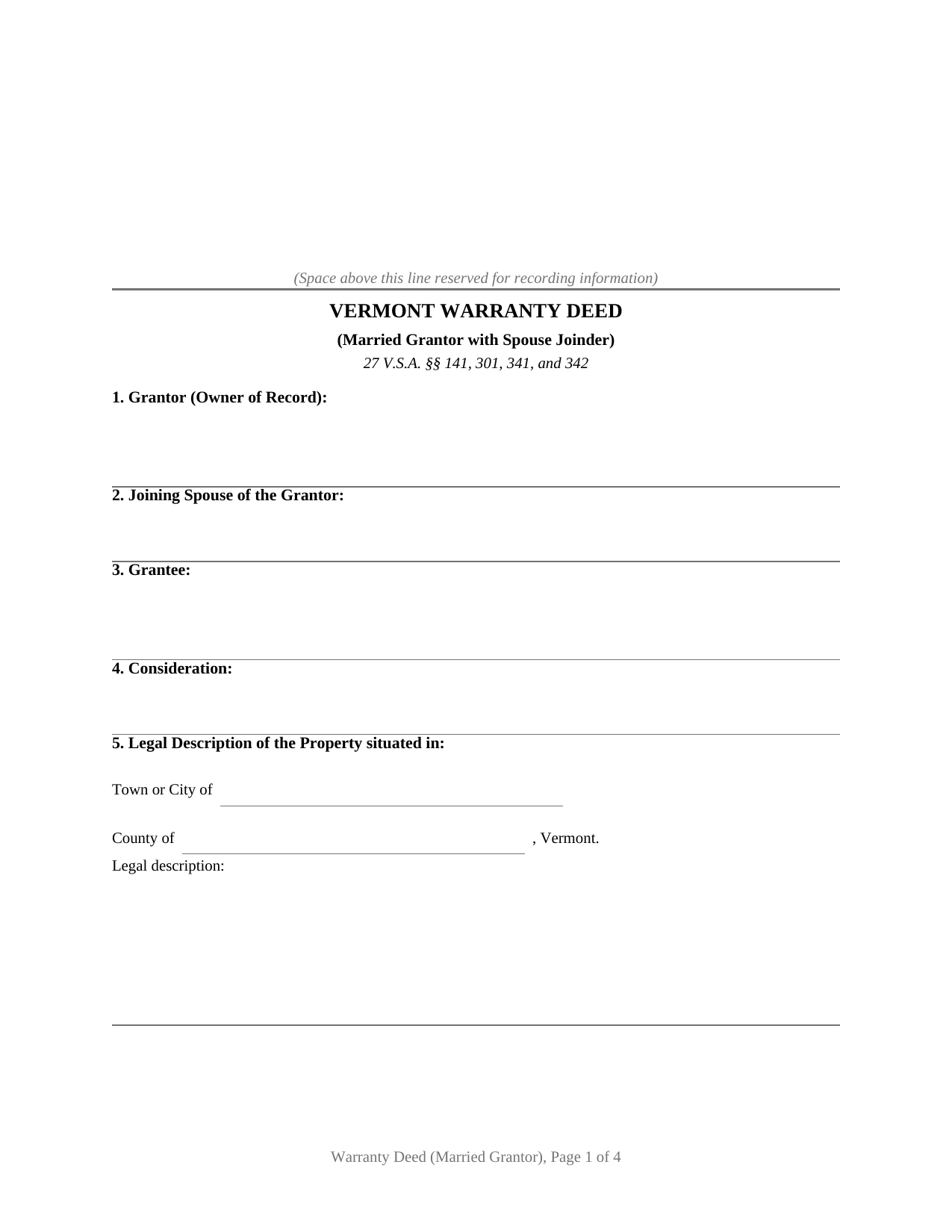
About the Vermont Warranty Deed (Married Grantor with Spouse Joinder)
How to Use This Form
- Select your county from the list
- Download the county-specific form
- Fill in the required information
- Have the document notarized if required
- Record with your county recorder's office
What Others Like You Are Saying
"GOT WHAT I NEEDED FORMS WORKED FINE."
"Amazing service from competent individuals that really go above and beyond to get you documents proc…"
"This company is a super time saver for our firm and our client! Their website was easy to use and th…"
"The forms were easy to acquire and easy to use"
"Perfection. The filled-out form was especially helpful and I appreciate not having to share personal…"
4.8/5 from 4,836 reviews. Read all
The second signature on this Vermont warranty deed belongs to someone who owns no part of the record title. One married grantor holds the property alone and conveys it with full warranty covenants; the grantor's spouse, named in the deed's own joinder section, signs and acknowledges beside the owner to satisfy 27 V.S.A. Section 141, the statute that makes a married owner's homestead conveyance inoperative without the spouse. The form prepares a Vermont general warranty deed built around exactly that pairing: one owner of record, one joining spouse, and a single instrument that carries them both.
The statute behind the second signature
Vermont protects the homestead, the home the family occupies up to $125,000 in value under 27 V.S.A. Section 101, with a signing rule rather than a lien. Under Section 141, a homestead or an interest in one is not conveyed by a married owner unless the wife or husband joins in both the execution and the acknowledgment of the conveyance, and a deed made without that joinder is inoperative so far as the homestead reaches. A companion provision, 27 V.S.A. Section 349, holds homestead property back from any grantee outside the marriage unless the spouse joins. Both halves of the rule matter: the spouse signs the deed, and the spouse also acknowledges it before a notary, which is why this form carries a second acknowledgment certificate and not merely a second signature line.
Joinder as architecture, not an afterthought
On this deed the joinder is a numbered operative section, not a blank held in reserve. The section names the joining spouse, recites the joinder under Section 141, and conveys and releases to the grantee all homestead rights and any other interest of the spouse in the property, so the face of the record shows the statute satisfied. The release travels one way: the joining spouse becomes no grantor of record and takes on no covenant, and the deed says so, leaving the warranty obligations, sole ownership, good right and title to convey, freedom from every encumbrance except those the deed lists, and defense against all lawful claims, resting on the grantor alone. Title standing in one name while a marriage stands behind it is the pattern this deed recites: a house bought before the wedding and never retitled, land inherited by one spouse while the couple lives on it, a home deeded into a single name during a long-ago refinance and now heading to closing. The form recites exactly one owner of record plus that owner's spouse; a conveyance from an unmarried owner, or from a couple who both hold record title, belongs to a different signing architecture that this form does not recite.
Two certificates, one notary visit or two
Each signer acknowledges on a certificate of that signer's own, worded to the individual short form of 26 V.S.A. Section 5368: the record was acknowledged before me on a stated date by the named signer. The certificates stand independent, so the grantor and the joining spouse may appear together at one closing table, as the completed example shows, or before different notaries on different days. Lines for the notary's printed name and commission number complete each certificate the way 26 V.S.A. Section 5367 describes for a paper record.
Into the town land records
The finished deed goes to the clerk of the Vermont town or city where the land lies, since Vermont keeps land records municipally, and under 27 V.S.A. Section 342 the recording is what makes the conveyance good against anyone beyond the grantor and the grantor's heirs. Form PTT-172, the Vermont Property Transfer Tax Return, travels to the counter with the deed, because 32 V.S.A. Section 9608 bars a clerk from receiving a deed without the completed return and its Act 250 certificate.
The download holds three pieces: the blank deed as a fillable PDF, a completed example showing a married grantor and joining spouse conveying a Washington County home from start to finish, and a plain language guide to every numbered section, the two-certificate signing pattern, the grantee vesting choices Vermont recognizes, and the recording and transfer tax steps. The materials are informational and are not legal advice.
Important: County-Specific Forms
Our warranty deed (married grantor with spouse joinder) forms are specifically formatted for each of the 14 counties in Vermont.
After selecting your county, you'll receive forms that meet all local recording requirements, ensuring your documents will be accepted without delays or rejection fees.