Vermont Warranty Deed (Individual Grantor)
County Specific Legal Forms Validated as recently as October 6, 2026 by our Forms Development Team
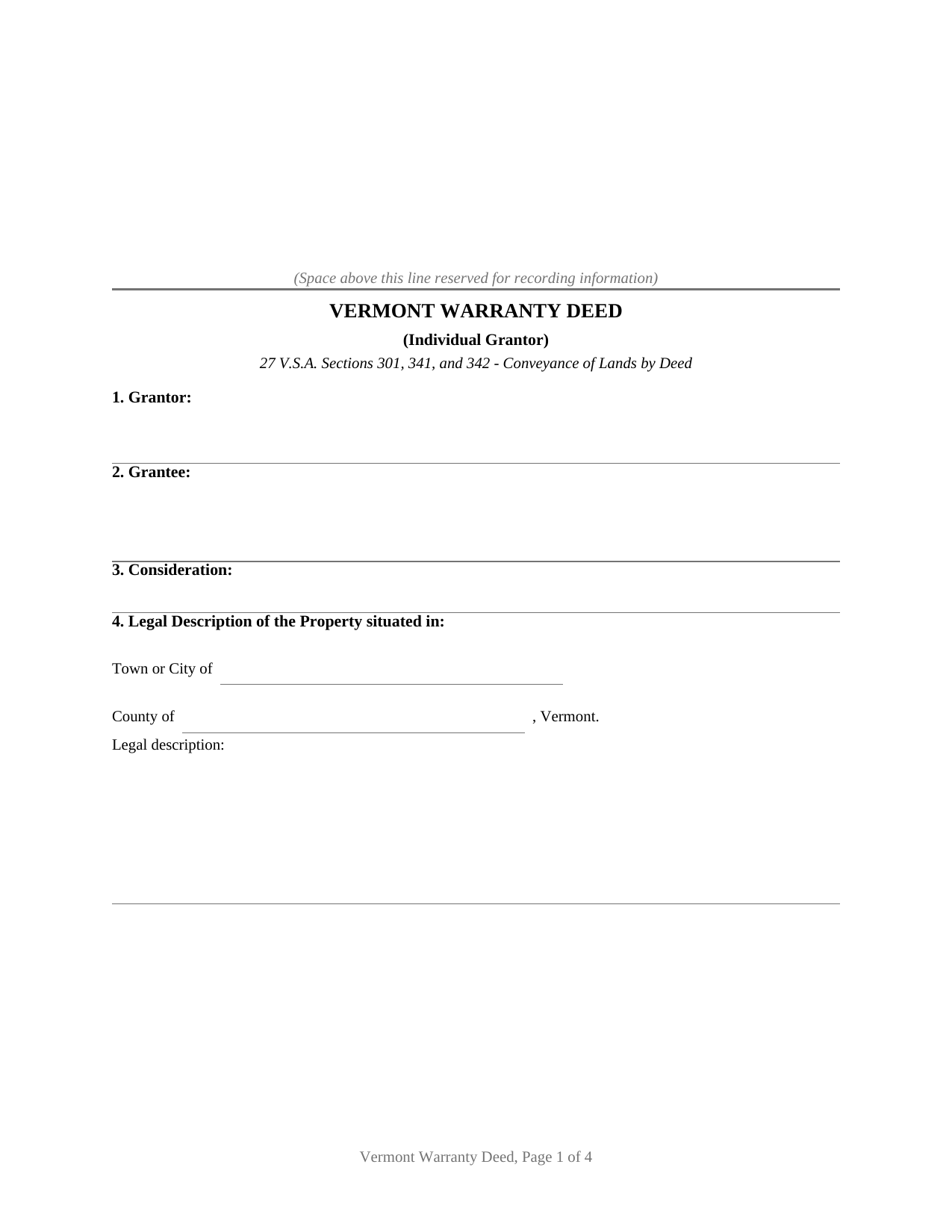
About the Vermont Warranty Deed (Individual Grantor)
How to Use This Form
- Select your county from the list
- Download the county-specific form
- Fill in the required information
- Have the document notarized if required
- Record with your county recorder's office
What Others Like You Are Saying
"I downloaded the wrong form, how do I change this, or can I?"
"Form was the one I needed and the instructions along with a sample form was all I needed."
"Very helpful Got information and form I wanted."
"Service was fantastic. So helpful and they promptly get back with you. No reason to drive if you are…"
"I was very impressed with the speed at which information was retrieved on my very first search. Unfo…"
4.8/5 from 4,817 reviews. Read all
One record owner signs this Vermont warranty deed, acknowledges it on a single notary certificate, and conveys with the full common law title covenants; a second, conditional signature block waits below for the one signer Vermont law sometimes adds, a spouse joining a homestead conveyance under 27 V.S.A. Section 141. The form prepares a general warranty deed for one individual grantor conveying Vermont real property to the grantee or grantees named in it.
Covenants stated in full, because Vermont implies none
Vermont has no statutory warranty deed form and no statute that reads covenants into a deed from a single operative word, so a Vermont warranty deed makes its promises out loud. This form carries the customary covenant chain in express text: the grantor is the sole owner of the property, has good right and title to convey it, the property is free from every encumbrance except as stated in the deed, and the grantor will warrant and defend it against all lawful claims and demands. Those covenants reach the whole history of the title, not just the grantor's period of ownership, which is what separates a warranty deed from the limited and no-covenant instruments Vermont practice also uses. The encumbrances section does real work here: every recorded easement, restriction, or surviving lien listed there sits outside the warranty, so that entry draws the exact boundary of what the grantor stands behind.
One grantor signs, and sometimes a spouse joins
The form recites exactly one grantor: one name in the grantor section, one signature line, one acknowledgment certificate worded to Vermont's statutory short form. A sole owner selling a house, a single person conveying inherited land, and an unmarried owner deeding a parcel to family present the single-grantor pattern this deed recites; deeds from two co-owners, from spouses conveying together, or from a trustee follow different recital and signature patterns and are not what this form is set up as. Vermont adds one conditional signer. Under 27 V.S.A. Section 141, a married owner's conveyance of the homestead is inoperative as to the homestead unless the spouse joins in the execution and acknowledgment, so the deed carries a labeled joinder section with its own signature line and notary certificate; where the grantor is unmarried or the property is outside the homestead rules, that section stays blank. On the receiving side, the grantee entry accepts any form of ownership Vermont recognizes, from a single grantee through tenants in common, joint tenants, spouses as tenants by the entirety, or a trustee, and the guide describes the words 27 V.S.A. Section 2 gives effect to for each.
Recorded with a town clerk, with the tax return alongside
Vermont records deeds town by town, not county by county: the deed goes to the clerk of the town or city where the land lies, and under 27 V.S.A. Section 342 an unrecorded deed holds the property only against the grantor and the grantor's heirs. The deed does not travel alone. A completed Vermont Property Transfer Tax Return, Form PTT-172, accompanies it, and 32 V.S.A. Section 9608 bars the clerk from recording without that return and the required Act 250 certificate. The general transfer tax rate is 1.25 percent of value plus the 0.22 percent clean water surcharge, with a reduced bracket for a principal residence, and the recording fee is fifteen dollars per page statewide. The form reserves space at the top of the first page for the clerk's recording information and keeps every entry inside Vermont's recordable page dimensions.
What arrives in the download
The package contains the blank warranty deed as a fillable PDF, a completed example showing every section filled in for a realistic Chittenden County fact pattern, and a plain language guide that walks through each numbered section, the signing and notarization rules, the vesting choices open to grantees, and the recording and transfer tax process. The materials are informational and are not legal advice.
Important: County-Specific Forms
Our warranty deed (individual grantor) forms are specifically formatted for each of the 14 counties in Vermont.
After selecting your county, you'll receive forms that meet all local recording requirements, ensuring your documents will be accepted without delays or rejection fees.