Virginia Quitclaim Deed
County or Independent City Specific Legal Forms Validated as recently as September 3, 2026 by our Forms Development Team
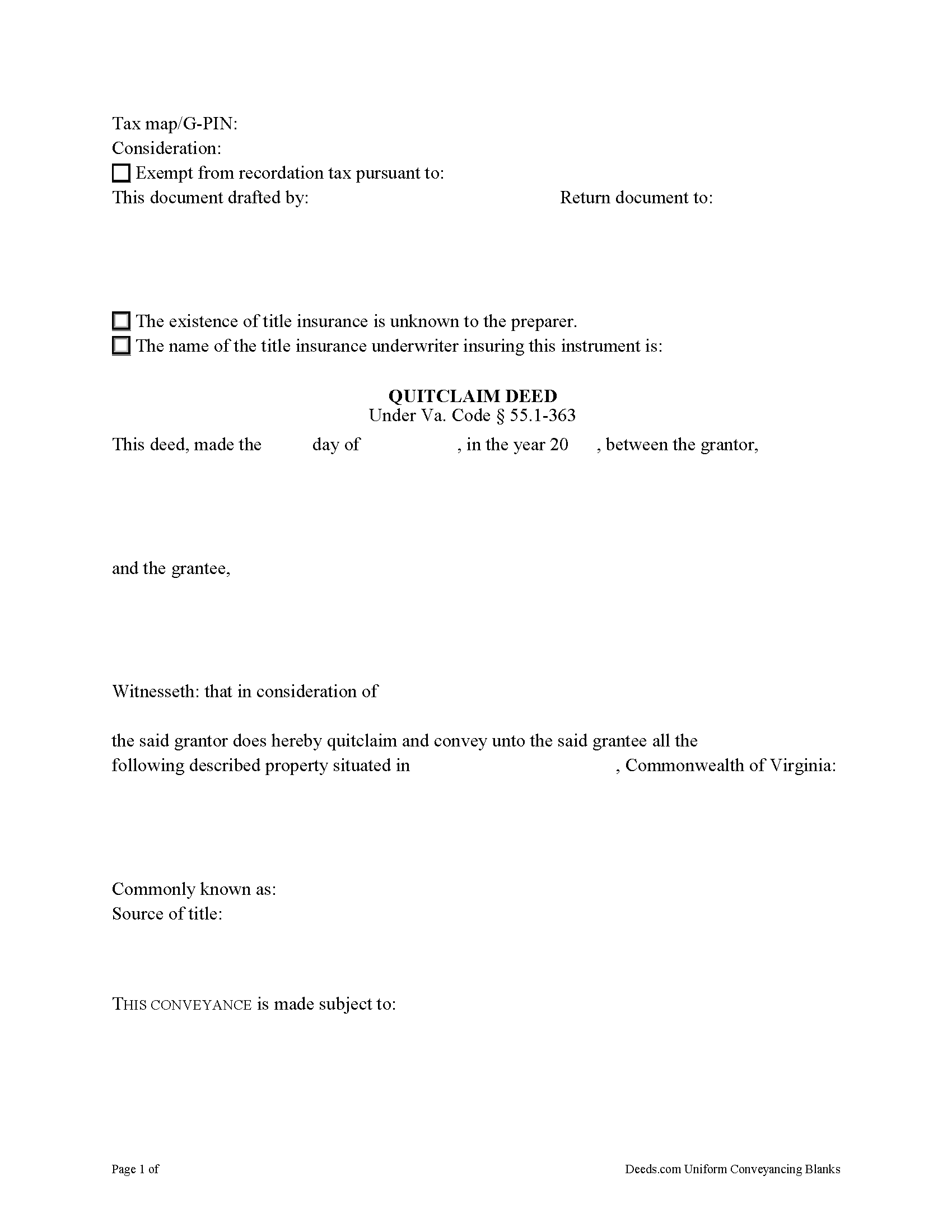
About the Virginia Quitclaim Deed
How to Use This Form
- Select your county or independent city from the list
- Download the county or independent city-specific form
- Fill in the required information
- Have the document notarized if required
- Record with your county or independent city recorder's office
What Others Like You Are Saying
"It would be helpful to have a joint tenant example."
"Appreciated the prompt answers to my inquiries…"
"Very easy to download and appreciated the other information and affidavits."
"it worked. fantastic. thanks!"
"The process was easy going. The process is one thing, the results another. I have attempting to reso…"
4.8/5 from 4,787 reviews. Read all
Virginia never wrote a quitclaim deed form. What the Code of Virginia wrote instead is a pair of rules about words: Section 55.1-363 fixes what a release of all claims upon the land means, and Sections 55.1-354 through 55.1-362 fix what a warranty phrase means. A quitclaim deed speaks the first set and stays silent on the second, and this package prepares that deed for one or two individual owners releasing an interest in Virginia land.
A release the Code construes for itself
Section 55.1-363 supplies the meaning no caption can. Where a deed uses words releasing to the grantee all claims upon the lands, the statute reads it as though the grantor has remised, released, and forever quitted claim to all right, title, and interest whatsoever, at law and in equity, so that neither the grantor nor the grantor's heirs or assigns may afterward have, claim, challenge, or demand the lands. Section 10 of the form speaks in those words, and Section 55.1-301 sets their reach: unless a deed provides otherwise it passes the whole of the grantor's estate, which on a release is whatever is genuinely there the day it is delivered.
The covenants that go unspoken
Warranty here is a matter of covenant phrases, never of a heading. Section 55.1-354 turns a promise to warrant generally into a defense against the claims of all persons, and Section 55.1-355 narrows the special warranty version to claims by, through, or under the grantor. This deed contains neither, and Section 10 says so in capital letters, listing what is withheld: seisin, the right to convey, quiet possession, freedom from encumbrances, and further assurances. A judgment or a gap two owners back rides straight through. Recording keeps its own footing under Section 55.1-407, which names the quitclaim form in the recording act and leaves a grantee taking by one eligible to be a purchaser for valuable consideration without notice.
One or two names a side, and nothing preprinted
The grantor block is four open lines and no more. It receives one or two people signing in their own names, with whatever status words the filler adds, and the grantee block is built the same way, with room for a vesting designation behind the names. Nothing about marriage, capacity, or tenancy is printed in advance, so a sole owner releasing to one grantee or to two, and a couple releasing to either, all sit on the same page. Two signature blocks and two certificates follow, the second of each left empty on a one-grantor fill, which also lets two grantors appear before different notaries. The form is not set up for an entity grantor, for a trustee, executor, or agent signing in a representative capacity, or for three or more owners a side.
The sentence that changed on July 1, 2026
Money, or the absence of it, decides what the counter collects. Section 58.1-801 charges 25 cents on every $100 or fraction of the consideration or the actual value, whichever is greater, and pins that value to the most recent assessment. Where nothing passes, Section 58.1-811(D) exempts a quitclaim deed without consideration, but only where the deed states that classification about itself, a reach the subsection gained on July 1, 2026 when 2026 Acts of Assembly Chapter 966 carried it past the deed of gift. Section 2 takes the price, the value, the Code section relied on, and that sentence.
What page one has to carry
Section 17.1-223(A) is the list a Virginia clerk reads. Absent a cover sheet, a clerk may reject a writing unless each individual party's surname is capitalized or underscored in the first clause naming the parties, the pages are numbered in order, consideration and actual value appear on page one, and the law behind any exemption is clear on the face. Subsection B adds the title insurance underwriter and a preparer statement on a residential deed of four dwelling units or fewer, and Section 17.1-252 adds the parcel number where a locality runs a unique parcel system. Section 1 gathers all of it above the deed's own text.
Buyers find this instrument under three names Virginia treats as one: quitclaim deed, quit claim deed, and release deed. The download holds the blank deed as a fillable PDF, a completed example worked through an Albemarle County transfer, and a plain-language guide covering every blank, the ways a Virginia grantee may hold title, notarization, and the charges collected at recording. The materials are informational and are not legal advice.
Important: County or Independent City-Specific Forms
Our quitclaim deed forms are specifically formatted for each of the 132 county or independent cities in Virginia.
After selecting your county or independent city, you'll receive forms that meet all local recording requirements, ensuring your documents will be accepted without delays or rejection fees.