Washington Deed of Trust and Promissory Note
County Specific Legal Forms Validated as recently as October 5, 2026 by our Forms Development Team
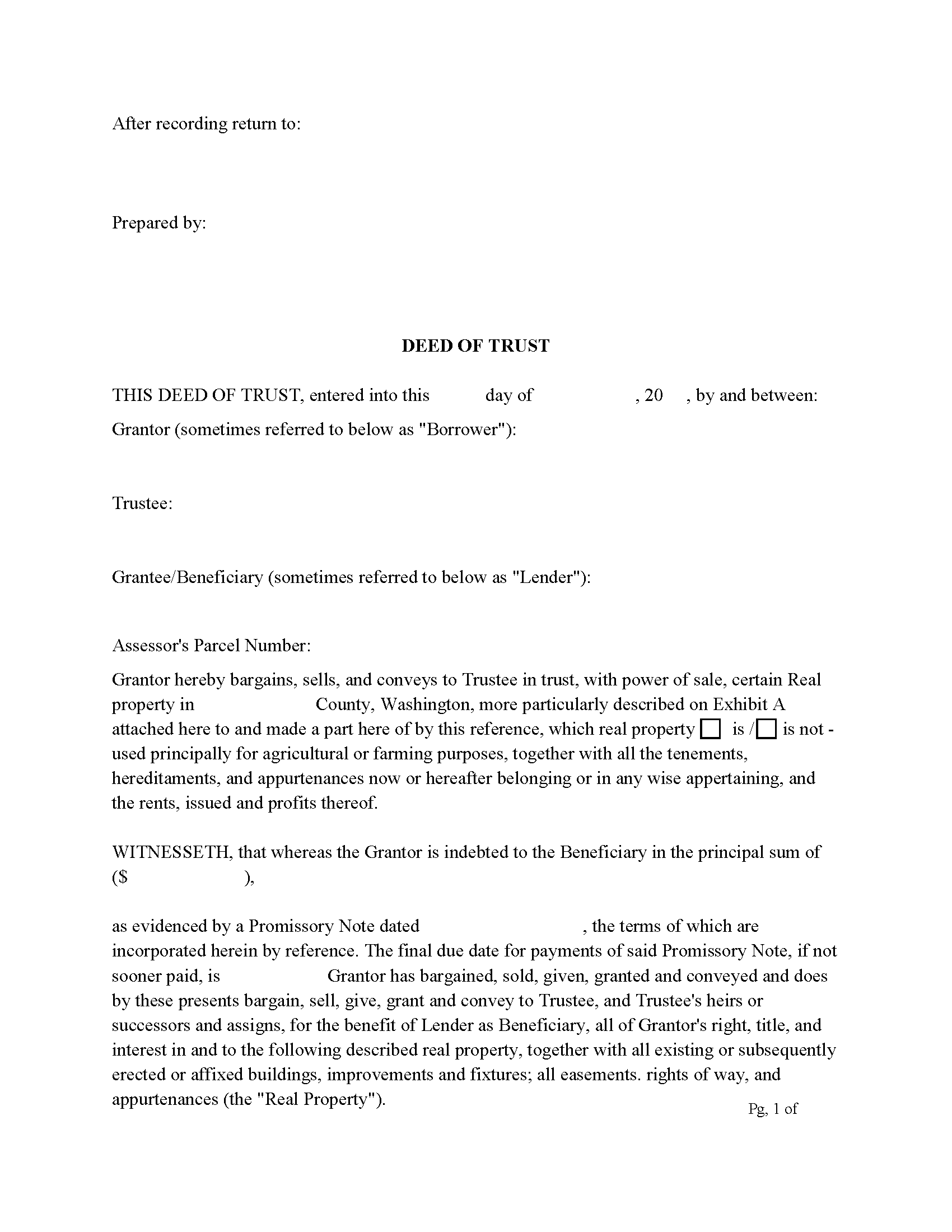
About the Washington Deed of Trust and Promissory Note
How to Use This Form
- Select your county from the list
- Download the county-specific form
- Fill in the required information
- Have the document notarized if required
- Record with your county recorder's office
What Others Like You Are Saying
"I loved using this process to record my deeds. it was fast and everytime I sent a message I received…"
"great forms, nice that they are fillable pdfs, easy to use, no issues. thanks."
"Thank You, Job well done. So nice not to have to leave house and drive all over to record these docu…"
"The service was great. Thank you."
"Your service is a life saver! I'm a paralegal and new to lien releases especially in Platte Co., MO.…"
4.8/5 from 4,828 reviews. Read all
A deed of trust (DOT), is a document that conveys title to real property to a trustee as security for a loan until the grantor (borrower) repays the lender according to terms defined in an attached promissory note. It's similar to a mortgage but differs in that mortgages only include two parties (borrower and lender).
In Washington, a Deed of Trust is the most commonly used instrument to secure a loan. Foreclosure can be done non-judicially, saving time and expense. This process is called a Trustee Sale.
There are three parties in this Deed of Trust:
1- The Grantor (Borrower)
2- Beneficiary (Lender) and a
3- Trustee (Neutral Third Party) (Our guidelines will show how to choose a Trustee at little to no cost)
Basic Concept. The Trustor (Borrower) conveys property title to a Trustee (Neutral Party). A Trustee or beneficiary/Lender can take an action against any person for damages.
These forms are flexible, they can be used for financing residential property, agricultural property, rental property, condominiums, and or small office buildings, with or without existing liens and encumbrances.
A "Special Provisions" section is included for any information specific to your transaction.
The Promissory Note offers options of financing, conventional installments, or installments combined with a balloon payment, common with Owner Financing transactions. Late Charges and Default rates are set within. In addition to any other remedies available to Lender if this Note is not paid in full at the Maturity Date, Borrowers shall pay to Lender an Overdue Loan Fee, which fee shall be due at the time this Note is otherwise paid in full. The "Overdue Loan Fee" shall be determined based upon the outstanding principal balance of this Note as of the Maturity Date and shall be:
(a) one percent (1.0%) Of such principal balance if the Note is paid in full on or after thirty (30) days after the Maturity Date but less than sixty (60) days after the Maturity Date, or
(b) two percent (2.0%) of such principal balance if the Note is paid in full on or after sixty (60) days after the Maturity Date.
A Deed of Trust secured by a Promissory Note that includes stringent default terms, can be advantageous to the Lender and favorable to Owner Financing.
RCW 61.24.020- Deeds subject to all mortgage laws---Foreclosure---Recording and indexing---Trustee and beneficiary, separate entities, exception.
Except as provided in this chapter, a deed of trust is subject to all laws relating to mortgages on real property. A deed conveying real property to a trustee in trust to secure the performance of an obligation of the grantor or another to the beneficiary may be foreclosed by trustee's sale. The county auditor shall record the deed as a mortgage and shall index the name of the grantor as mortgagor and the names of the trustee and beneficiary as mortgagee. No person, corporation or association may be both trustee and beneficiary under the same deed of trust: PROVIDED, That any agency of the United States government may be both trustee and beneficiary under the same deed of trust. A deed of trust conveying real property that is used principally for agricultural purposes may be foreclosed as a mortgage. Pursuant to *RCW 62A.9-501(4), when a deed of trust encumbers both real and personal property, the trustee is authorized to sell all or any portion of the grantor's interest in that real and personal property at a trustee's sale.
For us in Washington Only, formatted for county recording requirements. (Washington DOT Package includes forms, guidelines, and completed examples)
Important: County-Specific Forms
Our deed of trust and promissory note forms are specifically formatted for each of the 39 counties in Washington.
After selecting your county, you'll receive forms that meet all local recording requirements, ensuring your documents will be accepted without delays or rejection fees.