Arizona Beneficiary Deed (Married Owner, Sole and Separate Property)
County Specific Legal Forms Validated as recently as October 13, 2026 by our Forms Development Team
About the Arizona Beneficiary Deed (Married Owner, Sole and Separate Property)
How to Use This Form
- Select your county from the list
- Download the county-specific form
- Fill in the required information
- Have the document notarized if required
- Record with your county recorder's office
What Others Like You Are Saying
"Excellent documentation. Thank you."
"Great service!"
"Found what I needed, thanks."
"So far this looks like exactly what I need and at a reasonable price. Glad it was so easy to find on…"
"After receiving the forms online and reviewing them, it was very easy to fill this out and the addit…"
4.8/5 from 4,836 reviews. Read all
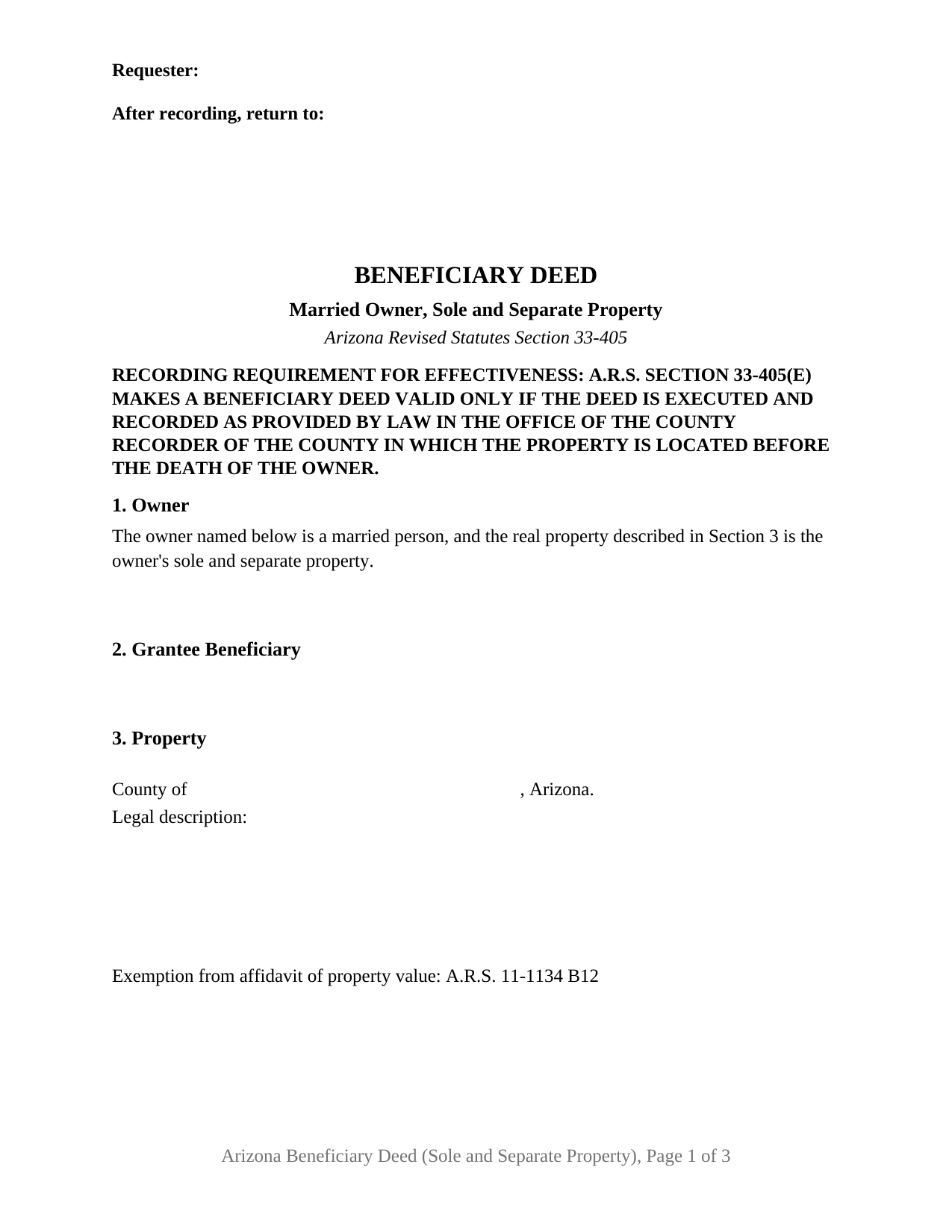
Arizona presumes that what a spouse acquires during marriage belongs to the marital community, which is why a married owner's death-transfer deed raises a signature question before anything else. This form settles it in the deed text: one owner of record, a printed recital that the owner is a married person and that the described land is that owner's sole and separate property, and a single signature block where a community property conveyance would carry two. It is an Arizona beneficiary deed under A.R.S. Section 33-405 for property outside the community.
Why one spouse signs this deed alone
Two short statutes carry the configuration. A.R.S. Section 33-451 provides that married persons of the age of eighteen years or more may convey their separate property without being joined by the spouse in the conveyance. A.R.S. Section 33-453 requires a spouse's consent to convey or encumber the homestead of a family, and then adds a sentence reaching this exact configuration: that consent is not required where the homestead property is conveyed or encumbered by an owner spouse who holds title as sole and separate property. Community real property runs instead through A.R.S. Section 33-452 and A.R.S. Section 25-214(C)(1), which take both spouses. Whether particular land is separate or community is settled by Sections 25-211 and 25-213 and by the record of acquisition; the deed recites the owner's assertion and leaves that determination where the statutes put it.
Nothing moves until the owner dies
Section 33-405(A) is the engine. A deed conveying an interest to a designated grantee beneficiary and expressly stating that it is effective on the death of the owner transfers that interest at death, subject to the mortgages, deeds of trust, liens, contracts, and other encumbrances the owner made or was subject to in life. Meanwhile the owner sells, refinances, and leases without asking anyone: subsection I provides that a grantee beneficiary's signature, consent, agreement, or notice is not required for any purpose while the owner lives. Subsection G makes the last beneficiary deed recorded before death the operative one, and subsection J keeps a will from revoking one. Revocation runs through subsection F and the form in subsection L, a separate instrument recorded before death and not included here.
The one choice the statute puts on the page
Inside the statutory form at subsection K the legislature supplied two results for a grantee beneficiary who dies first: that the conveyance to that beneficiary become null and void, or that it become part of that beneficiary's estate. Both appear in the statute's own words, each with its own box, neither marked on the blank form. Where no named beneficiary outlives the owner at all, subsection C supplies a separate rule of its own.
What this configuration recites
The deed carries one owner block, one signature block, and one acknowledgment certificate holding the A.R.S. Section 41-265(1) short form sentence together with the record description A.R.S. Section 41-264(F) calls for. Its status and ownership recital is fixed deed text rather than a blank or a box, and its conveyance sentence runs against the death of the owner, singular. Title taken before the marriage, an inheritance, and a gift made to one spouse alone are the acquisition histories that produce this pattern in the record. The form is not set up for community property, for land held with a right of survivorship, where Section 33-405(D) measures the transfer against the death of the last surviving owner, or for a trustee or company whose authority to sign comes from outside the deed.
Recorded before death, with the notation the recorder expects
Subsection E makes recording a condition of validity: the deed operates only if executed and recorded with the recorder of the Arizona county holding the land before the owner dies. An Arizona deed ordinarily arrives with an Affidavit of Property Value, but Section 11-1134(B)(12) exempts a beneficiary deed transfer with only nominal consideration, and the Department of Revenue puts the claim beneath the legal description as A.R.S. 11-1134 B12. The form prints it there, and its format follows Section 11-480: caption at the top, the reserved two inch band, and type above the statutory minimum.
Arizona owners also search this instrument as a transfer on death deed or TOD deed. The package holds three things: the fillable beneficiary deed, a completed example built on an Arizona fact pattern, and a guide covering the numbered sections, the signing formalities, and recording. These materials describe Arizona law and this form; they are not legal advice.
Important: County-Specific Forms
Our beneficiary deed (married owner, sole and separate property) forms are specifically formatted for each of the 15 counties in Arizona.
After selecting your county, you'll receive forms that meet all local recording requirements, ensuring your documents will be accepted without delays or rejection fees.