Arizona Beneficiary Deed (Individual Joint Tenant, Conditional on Being the Last Survivor)
County Specific Legal Forms Validated as recently as October 16, 2026 by our Forms Development Team
About the Arizona Beneficiary Deed (Individual Joint Tenant, Conditional on Being the Last Survivor)
How to Use This Form
- Select your county from the list
- Download the county-specific form
- Fill in the required information
- Have the document notarized if required
- Record with your county recorder's office
What Others Like You Are Saying
"Excellent site! Very informative and easy to navigate. I would highly recommend to anyone requiring …"
"Outstanding. I will definitely recommend your company."
"Very easy to use. Time will tell if I have any issues getting it recorded. Beats using an attorney w…"
"Thank you So far everything worked great. Got my downloads so I'm off and running. I hope the rest o…"
"Easy to use and fast"
4.8/5 from 4,836 reviews. Read all
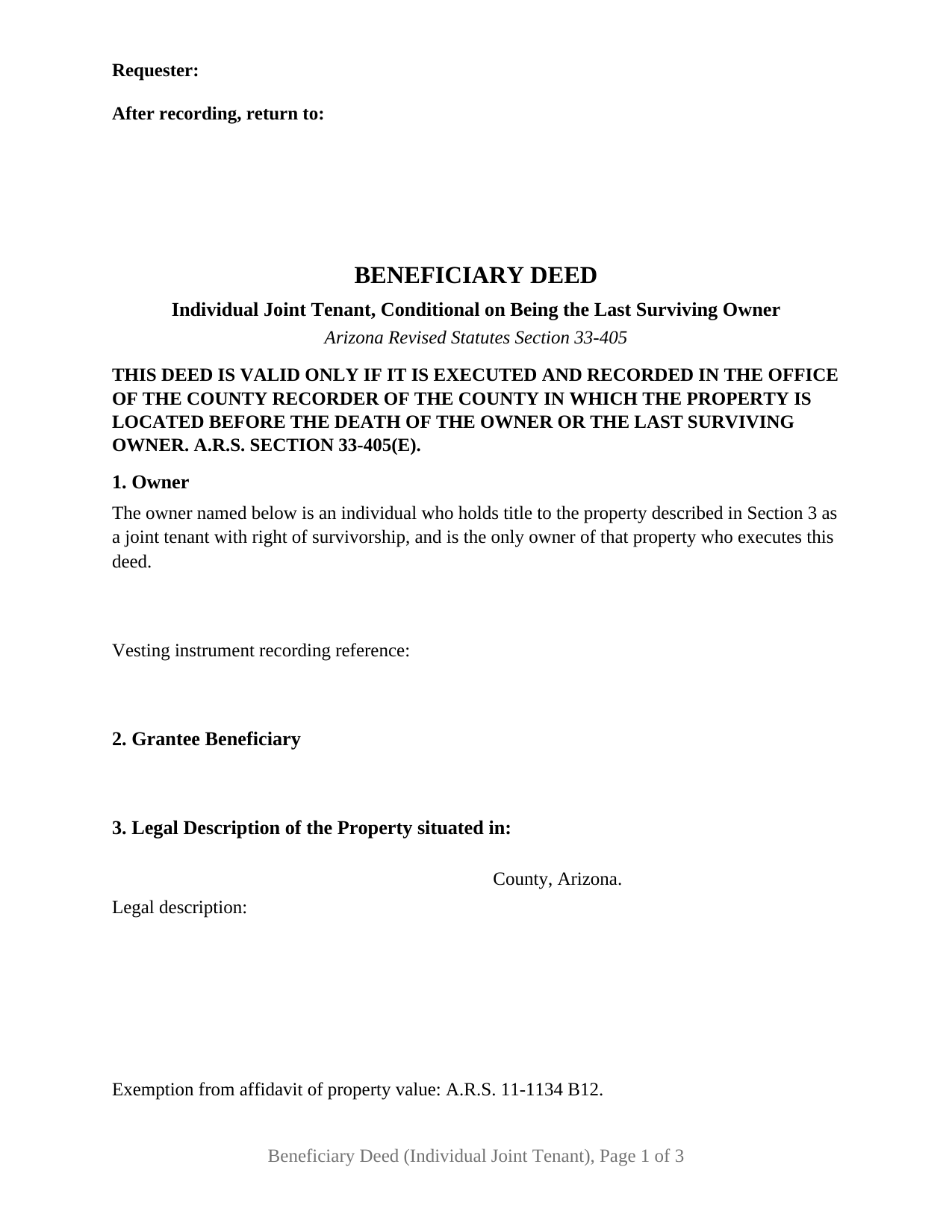
A joint tenancy with right of survivorship already answers who takes at the first death, so a beneficiary deed signed by one joint tenant is a deed about the second one. This Arizona form carries that configuration: one owner of record whose title runs with a right of survivorship, signing without the other owners, naming a grantee beneficiary who takes at that owner's death and only if that owner is the last of them living. A.R.S. Section 33-405(D) both permits the deed and attaches the condition.
A deed that waits to find out whether it operates
Subsection D speaks to property owned as joint tenants with survivorship. Where all then surviving owners join, the transfer runs from the death of the last surviving owner. Where fewer than all of them sign, the statute keeps the deed alive on a condition: it is valid if the last surviving owner is one of the persons who executes it, and if the last surviving owner did not execute it, the transfer lapses and the deed is void. Such a deed is not defective, it is contingent, and the contingency resolves in the order of the deaths. Section 4 prints that condition in the deed instead of leaving it in the statute book.
Survivorship still outranks the beneficiary
The same subsection protects the co-owners who did not sign. An estate in joint tenancy with right of survivorship is not affected by a beneficiary deed executed by fewer than all of the owners, and a surviving joint tenant's rights prevail over the grantee beneficiary the deed names. Nothing is severed, and no signature is asked of the others. Subsection A hands the beneficiary an interest subject to each mortgage, deed of trust, lien and contract the owner is subject to in life, and subsection I dispenses with the beneficiary's consent and notice while the owner lives.
One owner block, one certificate, one condition
Section 1 recites the configuration instead of offering it as a choice: the owner named below is an individual who holds title as a joint tenant with right of survivorship, and is the only owner of that property who signs it. A labeled blank takes the recording reference of the instrument that vested title. One signature block follows, then one acknowledgment certificate carrying the short form sentence of A.R.S. Section 41-265(1) and the four record items A.R.S. Section 41-264(F) lists. Two buyers who took title with the express survivorship declaration A.R.S. Section 33-431(B) calls for, one of them later naming a recipient against the chance of outliving the other, produce this pattern in the record. Title standing in one name alone, or held as a tenancy in common, recites something different, as does a deed signed by a trustee, a company, or an attorney-in-fact.
The choice the legislature left on the page
The sufficient form at subsection K contains one election, for a grantee beneficiary who dies before the owner: the conveyance to that beneficiary is to become null and void, or to become part of the estate of the grantee beneficiary. Both alternatives print in the statute's own wording, each with a box of its own, and neither is marked on the blank. Subsection C supplies the rule for when no named beneficiary outlives the owner, and the guide states it with its citation.
Recorded during life, in the county holding the land
Subsection E makes recording a condition of validity rather than a question of notice: the deed operates only when it is recorded with the recorder of the Arizona county where the property lies, before the death of the owner or the last surviving owner. Subsection G gives effect to the last beneficiary deed of record before that death, and subsection J keeps a will from revoking one. A.R.S. Section 11-1134(B)(12) exempts a beneficiary deed transfer made for nominal actual consideration from the affidavit of property value, and the form carries the notation A.R.S. 11-1134 B12 beneath the legal description.
Owners hunting for a transfer on death deed or a TOD deed in Arizona are looking at this instrument. An instrument of revocation under A.R.S. Section 33-405(L), and the documents that put the owner's death on the record, are prepared and recorded separately and are not included. Three files arrive with the purchase: the fillable beneficiary deed, a completed example on an Arizona fact pattern, and a guide covering the numbered sections, execution, and recording. These materials describe Arizona law and this form; they are not legal advice.
Important: County-Specific Forms
Our beneficiary deed (individual joint tenant, conditional on being the last survivor) forms are specifically formatted for each of the 15 counties in Arizona.
After selecting your county, you'll receive forms that meet all local recording requirements, ensuring your documents will be accepted without delays or rejection fees.