Arizona Beneficiary Deed (Individual Tenant in Common)
County Specific Legal Forms Validated as recently as October 20, 2026 by our Forms Development Team
About the Arizona Beneficiary Deed (Individual Tenant in Common)
How to Use This Form
- Select your county from the list
- Download the county-specific form
- Fill in the required information
- Have the document notarized if required
- Record with your county recorder's office
What Others Like You Are Saying
"Deeds.com made it easy to obtain and download the deed form I needed - I will keep this account acti…"
"Documents available immediately as advertised. Was easy to understand the guide and complete the dee…"
"it was convenient to have a starting place, however, though the property is in Colorado, the probate…"
"Really great experience. Thanks!"
"Excellent Service! Please note that form Realty Transfer Tax Statement of Value does not print compl…"
4.8/5 from 4,832 reviews. Read all
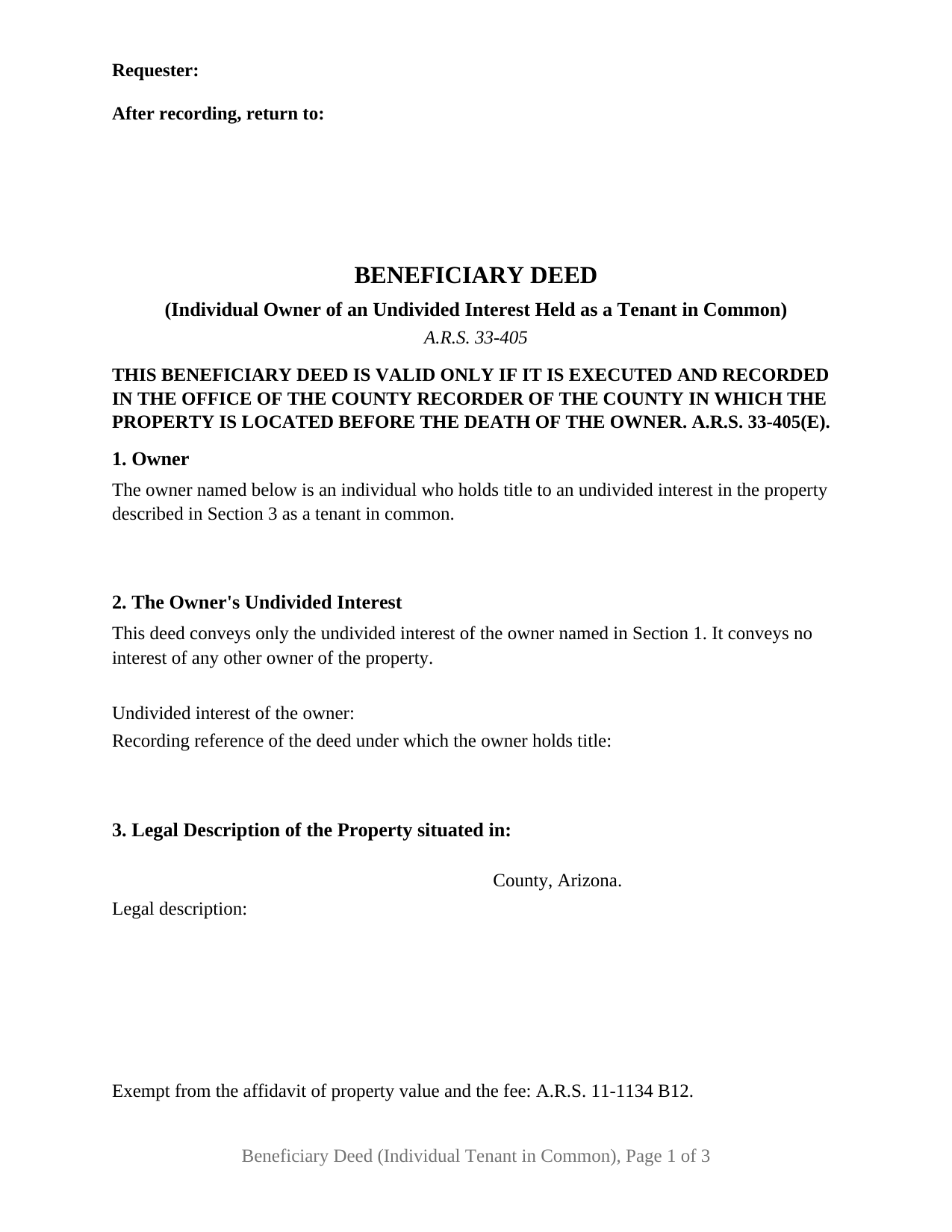
An undivided interest held as a tenant in common answers to a single life, and not the last life on the title. When one Arizona cotenant dies, that share leaves through the cotenant's own estate instead of passing to the others, and a beneficiary deed redirects it to a named person outside probate. This form carries that configuration: one individual owner of record, the fractional interest that owner holds, and a conveyance effective at that owner's death that reaches nothing else on the parcel.
Why a cotenant's share can travel alone
A.R.S. Section 33-431(A) makes an estate in common the result when a grant runs to two or more persons and expressly declares nothing else. No survivorship attaches, so what the other owners do with their shares decides nothing about this one. That is why A.R.S. Section 33-405, the Arizona beneficiary deed statute that owners also search for as a transfer on death deed or TOD deed, can work here on one signature. Subsection A moves the designated interest at the death of the owner who signed, and moves it as the owner left it: mortgages, deeds of trust, liens, and lifetime conveyances ride along to the grantee beneficiary.
The share itself is on the page
Section 2 prints a fixed statement that the deed conveys only the undivided interest of the owner named in Section 1 and no interest of any other owner. Two blanks follow, both answered from the vesting deed: the fraction the owner holds, and the recording reference of the instrument that vested it. The completed example fills them with an undivided one-third interest and a special warranty deed recorded in Pima County. County, legal description, street address, and parcel number finish the property description.
If a beneficiary dies first
Subsection K prints a sufficient form, and inside that form sits one election: a conveyance to a grantee beneficiary who predeceases the owner shall either become null and void, or become part of the estate of that grantee beneficiary. This deed reproduces both alternatives in the statute's wording with a square beside each, and marks neither on the blank, so the selection stays with the person completing it. Subsection C states what governs when nothing is marked and no named beneficiary survives, and the guide gives that rule with its citation. A change of mind later is made through an instrument of revocation under subsection L, recorded during the owner's life as its own document and not included here.
One cotenant signs, and only that cotenant
Section 1 recites the configuration as deed text rather than leaving it to a blank: the owner named below is an individual who holds title to an undivided interest in the described property as a tenant in common, leaving the name and mailing address as the entries. One signature block follows, then a single acknowledgment certificate carrying the short form sentence of A.R.S. Section 41-265(1) and the record identification A.R.S. Section 41-264(F) describes. The trigger sentence names the death of the owner, singular. Siblings who took equal shares by inheritance, an investor holding a fraction beside unrelated cotenants, and a parent who deeded part of a property away and kept the balance all show up in the record as tenants in common. Title carrying a right of survivorship is a different pattern: A.R.S. Section 33-405(D) measures that transfer against the death of the last surviving owner and voids a deed the last survivor did not execute. So is a deed signed by a trustee, an entity, or an attorney-in-fact, whose authority to sign is established outside the deed.
Recorded in the owner's lifetime
Subsection E ties validity to recording with the recorder of the county where the property sits, before the owner's death. Subsection G gives operative effect to the last beneficiary deed recorded before that death, and subsection J states that a will does not revoke one. A deed ordinarily reaches the counter with an affidavit of property value, and A.R.S. Section 11-1134(B)(12) exempts a transfer under a beneficiary deed with only nominal actual consideration; the notation naming that exemption prints beneath the legal description, in the pattern the Department of Revenue's affidavit instructions use.
Three items come with this purchase: the fillable deed, a completed example built on an Arizona fact pattern, and a guide covering each numbered section, the execution and certificate requirements in A.R.S. Sections 33-401 and 41-264, and what the recorder expects. This description addresses Arizona law and this form; it is not legal advice.
Important: County-Specific Forms
Our beneficiary deed (individual tenant in common) forms are specifically formatted for each of the 15 counties in Arizona.
After selecting your county, you'll receive forms that meet all local recording requirements, ensuring your documents will be accepted without delays or rejection fees.