Arizona Beneficiary Deed (Two Owners, Joint Tenants with Right of Survivorship)
County Specific Legal Forms Validated as recently as October 8, 2026 by our Forms Development Team
About the Arizona Beneficiary Deed (Two Owners, Joint Tenants with Right of Survivorship)
How to Use This Form
- Select your county from the list
- Download the county-specific form
- Fill in the required information
- Have the document notarized if required
- Record with your county recorder's office
What Others Like You Are Saying
"I thought the service was good"
"So far it seems easy and hopefully be acceptable to Hillsborough Co"
"I found the site to be easy to use and the information very helpful."
"Within 10 minutes I had my Deed!!! Fantastic!!!!"
"Exactly what I needed, at a reasonable cost."
4.8/5 from 4,819 reviews. Read all
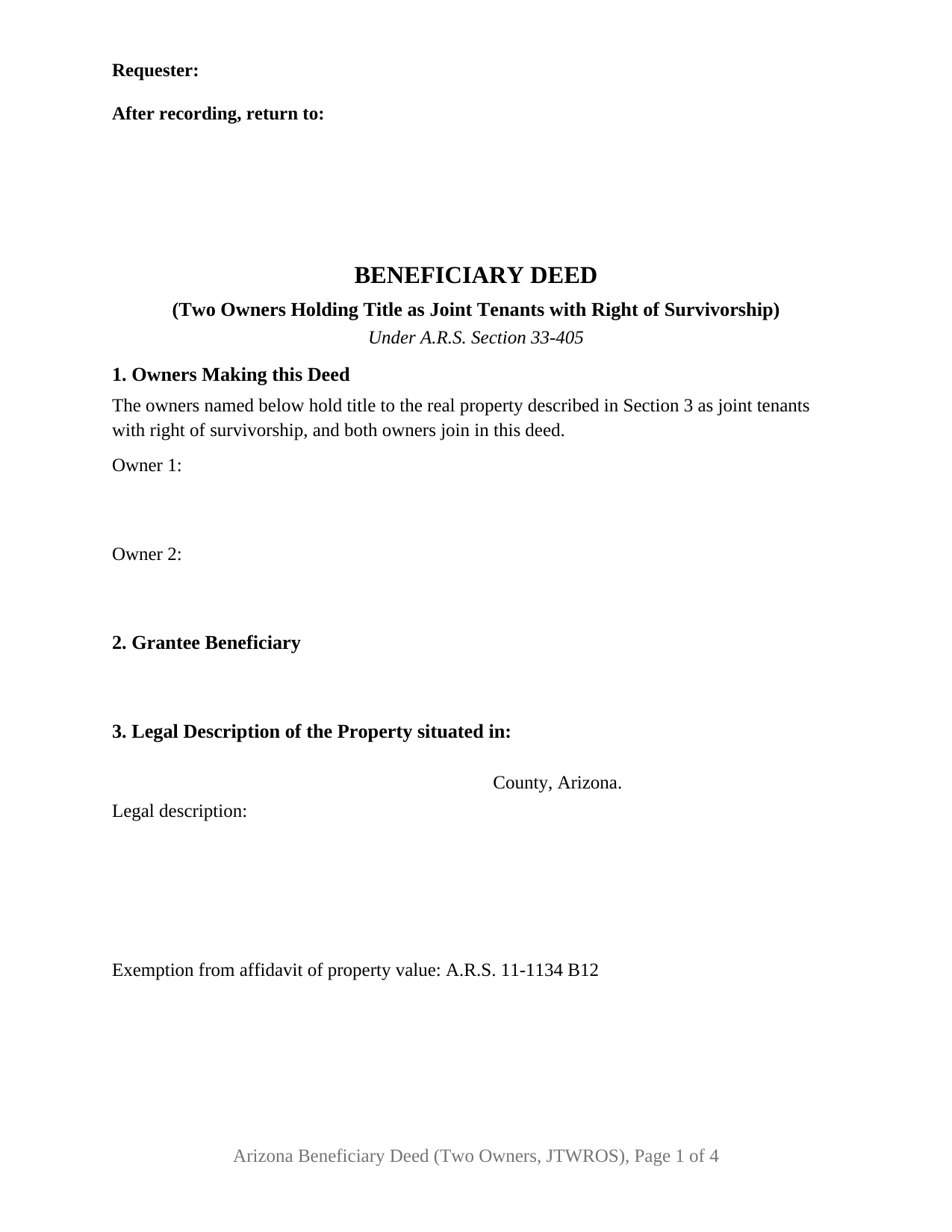
Two Arizona owners who hold one property as joint tenants with right of survivorship can decide together where it goes once both of them are gone, and this is the deed that records the decision. Both owners sign the same instrument, each acknowledges it before an officer of that owner's own choosing, and the conveyance then waits for the second death. While either owner lives, the survivorship between them, not the beneficiary designation, controls the property.
Two lives, one instrument, one moment of transfer
Arizona's name for this instrument is the beneficiary deed, authorized by A.R.S. Section 33-405, and owners searching for an Arizona transfer on death deed or TOD deed are looking at this document. Subsection D is the provision this configuration rests on. Where property is owned as joint tenants with the right of survivorship, a deed conveying to a grantee beneficiary designated by all of the then surviving owners, and expressly effective on the death of the last surviving owner, transfers the interest at that second death. Subsection D is also blunt about signatures: a deed executed by fewer than all owners is valid only if the last surviving owner happens to be among the signers, and if that owner did not sign, the transfer lapses and the deed is void. A deed both owners sign leaves none of that to chance.
What this form fixes, and what it is not set up for
Section 1 prints the ownership recital as deed text instead of leaving it to a blank: the owners named below hold title as joint tenants with right of survivorship, and both join in the deed. Two party blocks, two signature blocks, and two acknowledgment certificates follow, so the owners may acknowledge on different days, before different notaries, in Arizona or elsewhere. Section 4 conveys effective on the death of the last surviving owner. Co-owning siblings who took title with survivorship wording, an unmarried couple whose vesting deed named them both with a right of survivorship, and spouses who hold as joint tenants rather than as community property all present the pattern this deed recites. It is not set up for a lone owner, for three or more owners, for community property with right of survivorship, which A.R.S. Section 33-431(C) creates by its own express declaration, or for title held by a trustee or a business entity.
The choice the statute puts on the page
Subsection K supplies a statutory form carrying one election, and this deed prints it whole. If a grantee beneficiary dies first, the conveyance to that beneficiary shall either become null and void or become part of the estate of the grantee beneficiary. Both results appear in the statute's own words, each with a box beside it, and nothing is marked on the blank form. Subsection C runs alongside that choice: unless the deed provides otherwise, a deed that no named grantee beneficiary survives is void. Revocation is its own recorded act under subsections F and L, prepared and recorded separately from this deed and not included here, and it carries a last-surviving-owner rule of its own when fewer than all owners sign it.
Recording, and the paperwork the recorder looks for
Recording is a validity condition rather than a notice formality. Subsection E makes the deed valid only if it is executed and recorded with the county recorder where the property sits before the death of the last surviving owner, so a signed deed that never reaches the counter accomplishes nothing. A.R.S. Section 11-480 governs the page itself: a caption naming the instrument, original signatures, ten point print or larger, paper no larger than 8.5 by 14 inches, and two inches of clear space at the top of page one, whose left three and one half inches may carry the requester and return entries this form prints there. Because a beneficiary deed for nominal consideration is exempt from the affidavit of property value, the deed shows the exemption code A.R.S. 11-1134 B12 under the legal description. Each certificate also opens with the record description A.R.S. Section 41-264(F) calls for, and on a two owner deed the additional signer named in one certificate is simply the other owner.
Three files come in the package: the fillable two owner beneficiary deed, a completed example carrying a Pima County fact pattern, and a guide covering the numbered sections, the signing and acknowledgment formalities, and recording. The materials describe Arizona law and this form; they are not legal advice.
Important: County-Specific Forms
Our beneficiary deed (two owners, joint tenants with right of survivorship) forms are specifically formatted for each of the 15 counties in Arizona.
After selecting your county, you'll receive forms that meet all local recording requirements, ensuring your documents will be accepted without delays or rejection fees.