Arizona Beneficiary Deed (Unmarried Sole Owner)
County Specific Legal Forms Validated as recently as October 21, 2026 by our Forms Development Team
About the Arizona Beneficiary Deed (Unmarried Sole Owner)
How to Use This Form
- Select your county from the list
- Download the county-specific form
- Fill in the required information
- Have the document notarized if required
- Record with your county recorder's office
What Others Like You Are Saying
"Very easy to use. Got the emailed documents within minutes."
"Your forms, guides, sample deeds and submission process were accessible, easy to understand and simp…"
"Everything I needed to complete my release of lien was easy to obtain from Deed.com - and the exampl…"
"They respond fast, the process is simple, and it's obviously convenient. I'm not sure what else ther…"
"The release of mortgage form was OK, and accepted at the recorder's office, but there were some prob…"
4.8/5 from 4,829 reviews. Read all
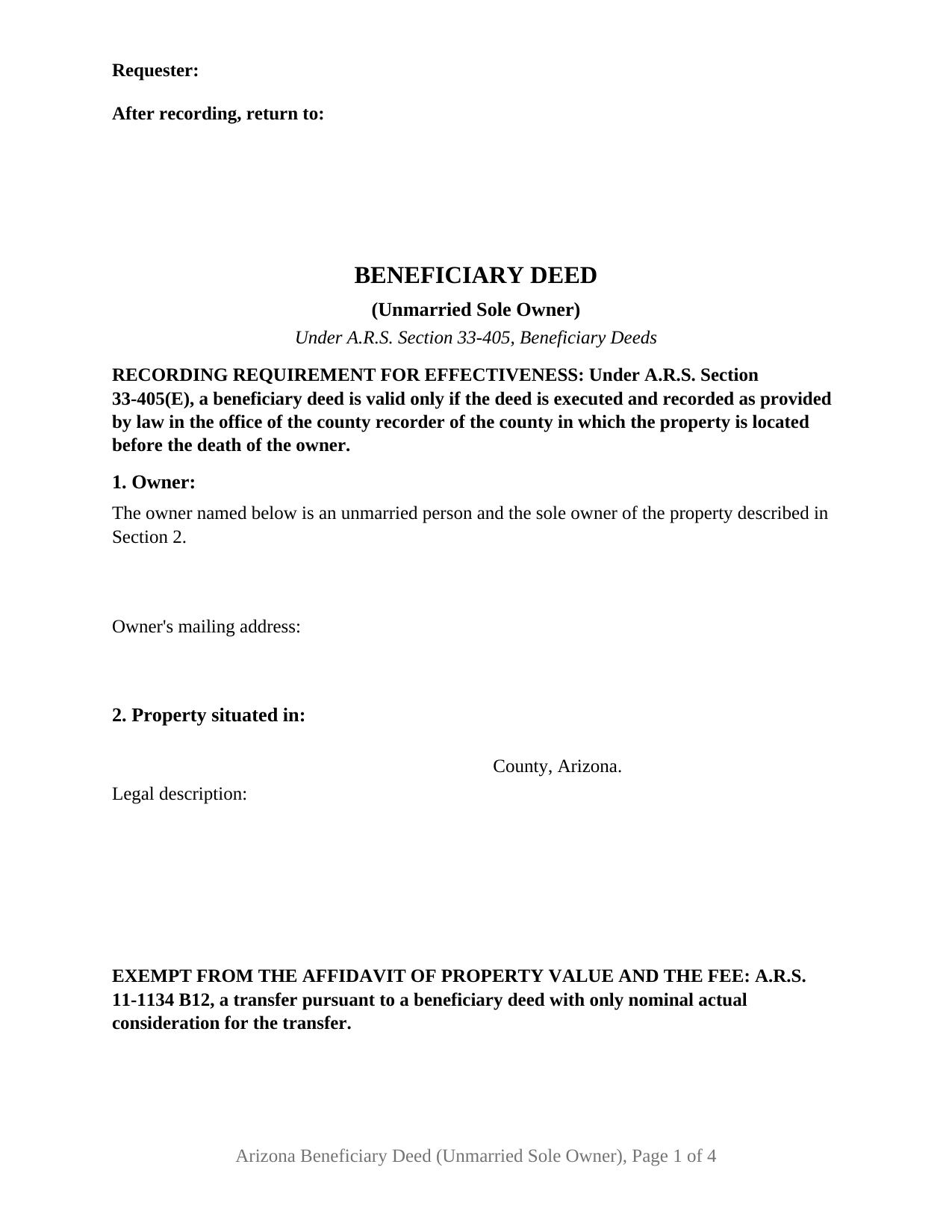
A beneficiary deed made by an unmarried Arizona owner who holds title alone runs against a single life. One person signs, one acknowledgment certificate follows the signature, and the property moves at one death, the owner's, with no surviving co-owner in the way and no second signature to gather. This form carries that configuration for Arizona real property: an owner of record who is unmarried, a grantee beneficiary or several, and an operative sentence that conveys effective on the death of the owner.
A deed measured against one life
Arizona calls the instrument a beneficiary deed, and A.R.S. Section 33-405 is the single section that governs it. Arizona owners searching for a transfer on death deed or a TOD deed are looking at this instrument. Its defining feature sits in subsection A: a deed that conveys an interest in real property to a grantee beneficiary and that expressly states that it is effective on the death of the owner transfers that interest at death, subject to every conveyance, contract, mortgage, deed of trust, lien, and other encumbrance the owner made or was subject to during life. Nothing moves while the owner lives. The owner can still sell, refinance, or record a later beneficiary deed, and under subsection G the last deed recorded before death is the one that operates.
What the statute leaves to the deed
Section 33-405 leaves several terms to the deed itself. Subsection B recognizes that a deed naming more than one grantee beneficiary may state how they take title, in any tenancy valid in Arizona, and makes each beneficiary's interest separate property unless the deed provides otherwise. Subsection K's statutory form puts one choice on the page, and this form prints it: a box beside each of the two results that subsection supplies for a grantee beneficiary who predeceases the owner, that the conveyance become null and void, or that it become part of that beneficiary's estate. Both appear in the statute's own words, unmarked on the blank. Where no named beneficiary survives the owner, subsection C makes the deed void unless it provides otherwise, and shuts off the antilapse rule of Section 14-2603.
One owner, one signature, one certificate
Section 1 recites the configuration as deed text rather than in a blank: it prints that the owner named below is an unmarried person and the sole owner of the property described in the deed, and leaves the name and mailing address as entries. One party block, one signature block, and one acknowledgment certificate follow, the certificate carrying the A.R.S. Section 41-265(1) short form sentence with the record description A.R.S. Section 41-264(F) calls for. Its operative sentence conveys effective on the death of the owner, singular, rather than on the death of a last surviving owner, and it carries no spousal signature line, no joinder recital, no tenancy designation for concurrent beneficiaries, and no successor beneficiary designation. Sole owners who never married, owners whose marriage ended before title was taken, and owners holding separate property under A.R.S. Section 25-213 present this pattern. The form is not set up for property held with a right of survivorship, which Section 33-405(D) measures against the death of the last surviving owner, nor for a trustee, corporation, or limited liability company, whose signing authority comes from outside the deed.
Recorded before death, or not at all
Recording is not merely notice here. Under subsection E a beneficiary deed is valid only if executed and recorded in the office of the county recorder of the county where the property sits before the owner's death, which is why a signed deed left in a drawer accomplishes nothing. Recording also brings a small Arizona wrinkle the form handles on its face: a deed ordinarily arrives with an affidavit of property value, and a beneficiary deed made for nominal consideration is exempt under A.R.S. Section 11-1134(B)(12). The Department of Revenue puts that notation beneath the legal description in the pattern A.R.S. 11-1134 B12, and the form prints it in exactly that position, so the recorder finds the exemption where the state says to look.
The package holds three things: the fillable beneficiary deed form, a completed example carrying an Arizona fact pattern, and a guide covering the numbered sections, the signing formalities under A.R.S. Sections 33-401 and 41-264, and recording. An instrument of revocation under Section 33-405(L) is a separately recorded document and is not part of this package. These materials describe Arizona law and this form; they are not legal advice.
Important: County-Specific Forms
Our beneficiary deed (unmarried sole owner) forms are specifically formatted for each of the 15 counties in Arizona.
After selecting your county, you'll receive forms that meet all local recording requirements, ensuring your documents will be accepted without delays or rejection fees.