Arizona Beneficiary Deed (Spouses, Community Property Without Right of Survivorship)
County Specific Legal Forms Validated as recently as October 16, 2026 by our Forms Development Team
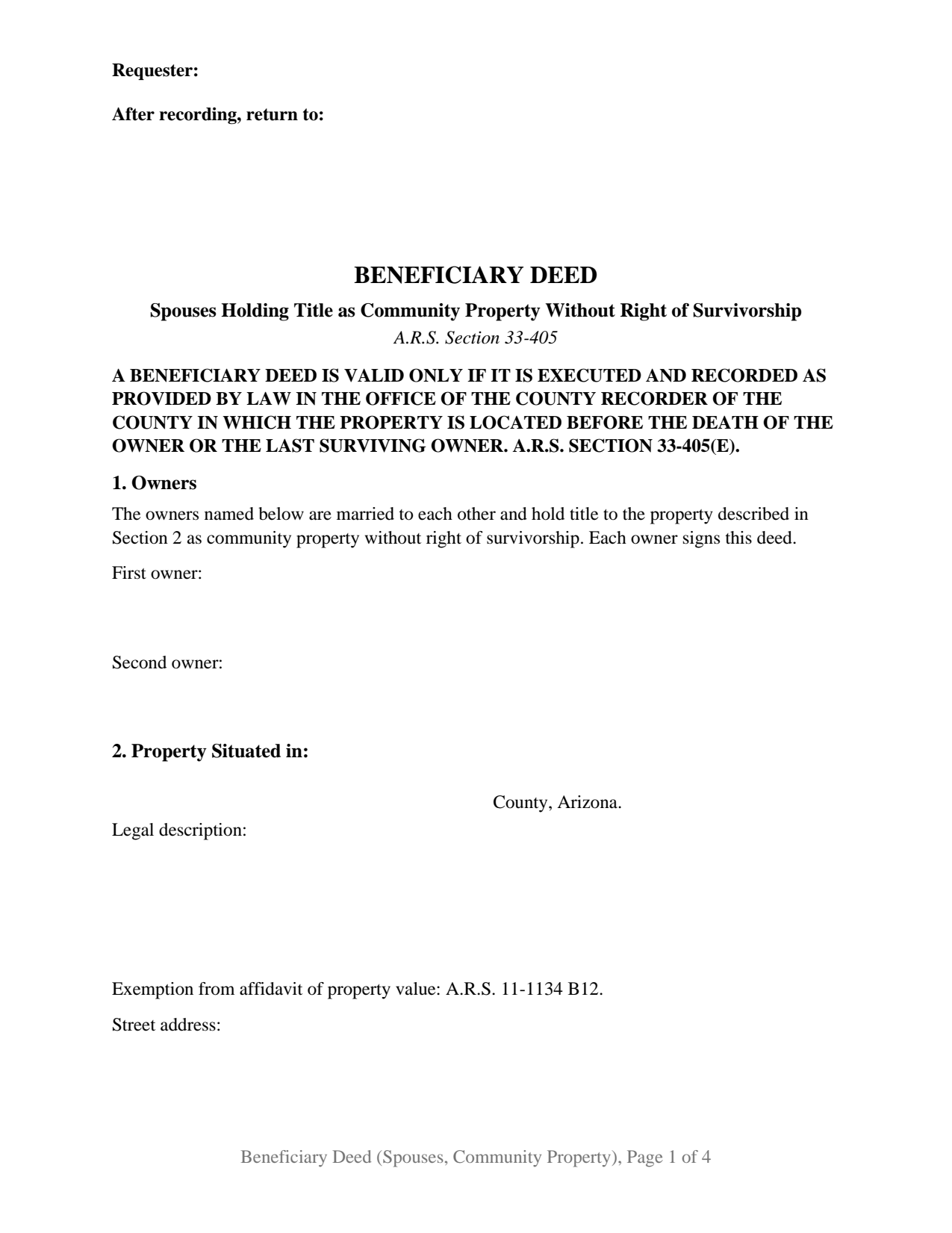
About the Arizona Beneficiary Deed (Spouses, Community Property Without Right of Survivorship)
How to Use This Form
- Select your county from the list
- Download the county-specific form
- Fill in the required information
- Have the document notarized if required
- Record with your county recorder's office
What Others Like You Are Saying
"With a little assist from the customer service department-- who was extremely nice and professional-…"
"I was unable to finish what I started due to computer crash. I'll get back soon. I paid off my mortg…"
"They offer a great service. Also they have been responsive and professional."
"Easy to use."
"Awesome Job! thank you"
4.8/5 from 4,833 reviews. Read all
Two spouses, one deed, two deaths. That is the arithmetic of an Arizona beneficiary deed on community property with no survivorship: each half of the community answers to the life of the spouse who owns it, so one recorded instrument operates twice, moving the deceased spouse's interest at the first death and the survivor's at the second. Both spouses are named as owners here, both sign, and the grantee beneficiary takes outside probate.
Where survivorship title and plain community property part company
A.R.S. Section 33-431(C) creates community property with right of survivorship only where the grant, transfer, or devise expressly declares that estate. A vesting instrument that put the parcel in both spouses and said nothing further left them holding community property with no survivorship, and that difference decides which part of the beneficiary deed statute runs. Subsection D of A.R.S. Section 33-405 speaks to joint tenancy with right of survivorship and to community property with right of survivorship, measuring those transfers against the death of the last surviving owner. Title without survivorship sits outside it, so subsection A governs, tying the transfer to the death of the owner who made it. Arizona owners also search this instrument as a transfer on death deed or TOD deed.
What the first death does
The interest of the spouse who dies first goes to the grantee beneficiary, the survivor keeps the survivor's own interest, and the two hold the parcel together until the second death carries the rest across. The survivor's choices stay open: subsection I keeps a grantee beneficiary's signature, consent, and notice out of the picture while an owner lives, subsection G makes the last beneficiary deed recorded before a death the one that operates at it, and subsection F allows an instrument of revocation, recorded during life as its own document and not part of this package.
The configuration this form recites
Section 1 states the arrangement as deed text rather than a blank or a checkbox: the owners named below are married to each other, hold title to the described property as community property without right of survivorship, and each signs. Two owner entries follow, then two signature blocks and two acknowledgment certificates, one per signer, each carrying the short form sentence of A.R.S. Section 41-265(1) with the record description A.R.S. Section 41-264(F) sets out, whose additional signers line names the other spouse. Section 4 conveys against the death of each owner as to that owner's interest, never against a last surviving owner, and each interest arrives carrying the mortgages, liens, and other encumbrances subsection A preserves. A residence bought during the marriage on a deed running to both spouses produces this pattern in the Arizona record. The form is not set up for survivorship title, for one owner signing alone, or for a trustee, company, or attorney in fact.
The single choice the statute puts on the page
The sufficient form at subsection K carries one election, and this deed prints it: two results for a grantee beneficiary who dies before an owner, the conveyance to that beneficiary becomes null and void, or it becomes part of the estate of the grantee beneficiary. Each appears in the legislature's own words with a square beside it, neither marked on the blank form. Subsection C states what governs when no named beneficiary outlives an owner, and the guide gives that rule with its citation.
Recorded before the first death, not merely the last
Subsection E ties validity to recording with the recorder of the Arizona county where the land sits, ahead of death; here the deadline arrives early, because the first death is already operative as to half the parcel. The deed answers the affidavit question on its face: paragraph B12 of A.R.S. Section 11-1134 exempts a transfer pursuant to a beneficiary deed with only nominal actual consideration, and the notation A.R.S. 11-1134 B12 prints under the legal description, where the Department of Revenue's affidavit instructions place it. Page format follows A.R.S. Section 11-480, source of the caption and the reserved band across the top of page one.
The purchase delivers three files: the fillable deed, a completed example set in Yavapai County, and a guide to the numbered sections, execution, and recording. This description addresses Arizona law and this form, and is not legal advice.
Important: County-Specific Forms
Our beneficiary deed (spouses, community property without right of survivorship) forms are specifically formatted for each of the 15 counties in Arizona.
After selecting your county, you'll receive forms that meet all local recording requirements, ensuring your documents will be accepted without delays or rejection fees.