Arizona Beneficiary Deed (Spouses, Community Property With Right of Survivorship)
County Specific Legal Forms Validated as recently as October 6, 2026 by our Forms Development Team
About the Arizona Beneficiary Deed (Spouses, Community Property With Right of Survivorship)
How to Use This Form
- Select your county from the list
- Download the county-specific form
- Fill in the required information
- Have the document notarized if required
- Record with your county recorder's office
What Others Like You Are Saying
"Prompt, accurate and professional response. Thank you. Kelin F."
"I wish you could send copy in mail"
"It was easy to download, received it quickly, the sample really helped. I would like if some of the …"
"Excellent Service! Quick and easy! Will definitely be using again!"
"The site is fine with one exception. About half the pdf files I downloaded were corrupted. I could n…"
4.8/5 from 4,819 reviews. Read all
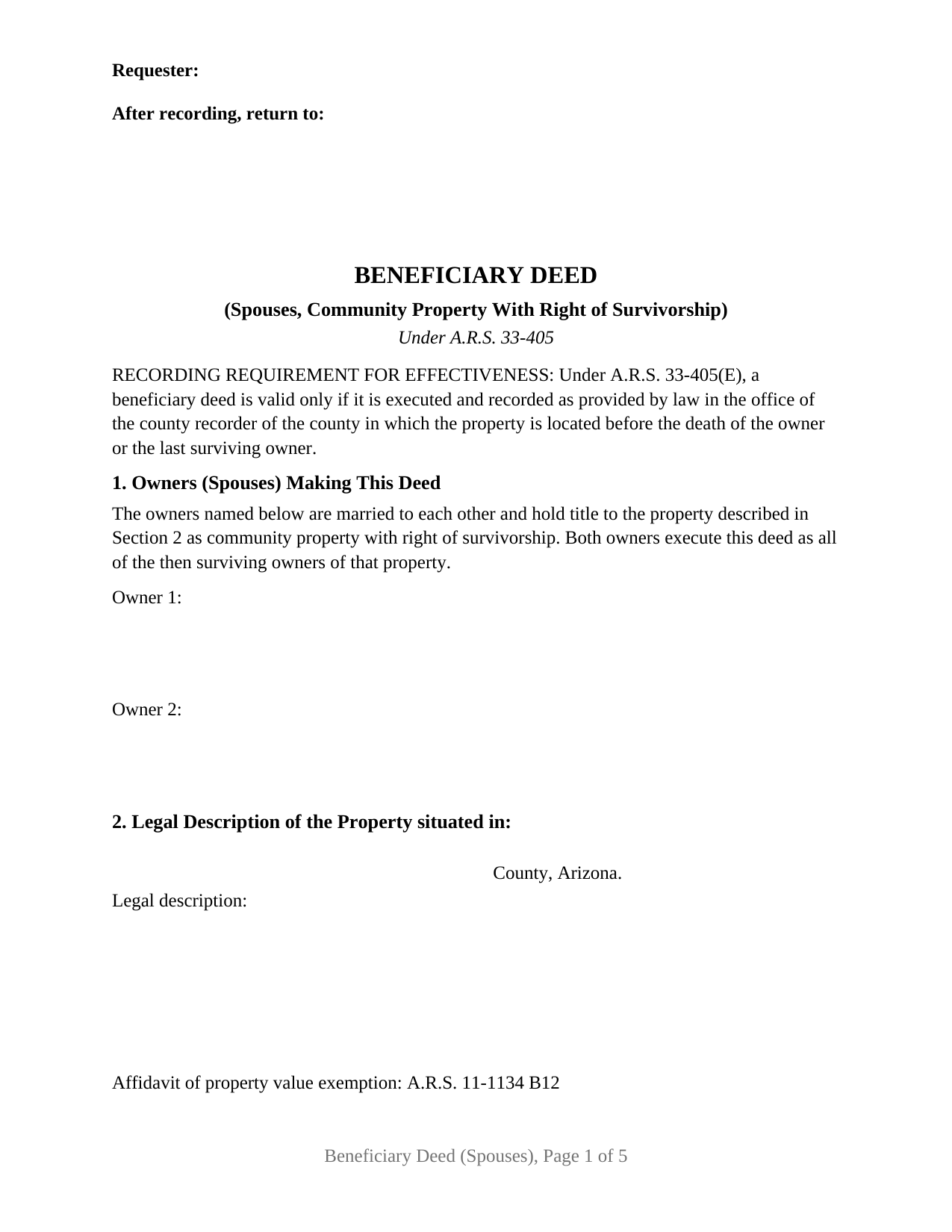
Two married Arizona owners who hold their property as community property with right of survivorship can sign a single beneficiary deed, and that deed waits for the second death to do anything at all. This form carries that arrangement: both spouses named as owners, a recital of the marriage and of the survivorship vesting, two signature lines, two acknowledgment certificates, and a conveyance measured against the death of the last surviving owner rather than the first.
A deed that waits for the second death
A.R.S. 33-405(D) is the subsection that makes this shape work. Where Arizona real property is held as joint tenants with right of survivorship or as community property with right of survivorship, a deed designated by all of the then surviving owners, expressly stating that it is effective on the death of the last surviving owner, transfers the interest at that death. Nothing happens at the first death: the survivorship vesting itself carries the deceased spouse's interest to the surviving spouse, and the same subsection states that a surviving spouse's rights in survivorship community property prevail over a grantee beneficiary named in a beneficiary deed. The subsection also treats a deed signed by fewer than all owners as valid where the last surviving owner is one of the signers, and void where that owner never signed.
Two owners, two certificates
A.R.S. 25-214(C)(1) requires both spouses to join in a transaction for the disposition or encumbrance of an interest in community real property, and A.R.S. 33-405(D) speaks of designation by all of the then surviving owners. The deed accordingly draws one signature block for each spouse and one acknowledgment certificate for each signature, so the two owners may acknowledge on separate dates, before separate officers, in separate states. Each certificate uses the operative sentence of the A.R.S. 41-265(1) short form and identifies the record it belongs to under A.R.S. 41-264(F). No grantee beneficiary signs, and neither spouse gives up any lifetime power over the property.
Recorded during life, or void
Recording this instrument is not about priority against later buyers. A.R.S. 33-405(E) makes recording in the county where the property sits, completed before the death of the owner or the last surviving owner, a condition of validity, unlike the notice provisions that govern ordinary Arizona conveyances. Where more than one beneficiary deed is recorded on the same parcel, A.R.S. 33-405(G) gives effect to the last one recorded before death, and A.R.S. 33-405(J) keeps a will from revoking a recorded deed made under the section. Revocation runs through its own recorded instrument under A.R.S. 33-405(F), prepared and recorded separately and not included in this package. The form also prints the affidavit of property value exemption notation, A.R.S. 11-1134 B12, in the position the Department of Revenue describes, beneath the legal description.
The one choice the statutory form prints
A.R.S. 33-405(K) supplies an Arizona pattern for this instrument, and it puts one question to the owners: if a grantee beneficiary predeceases the owner, the conveyance to that beneficiary shall either become null and void, or become part of the estate of that grantee beneficiary. Both alternatives appear on the form in the statute's words, each with a box, and neither is marked on the blank. A.R.S. 33-405(C) supplies the consequence where no named beneficiary survives.
What this configuration recites
The deed recites exactly two record owners, married to each other, holding one described parcel as community property with right of survivorship, and it fixes the transfer trigger at the death of the last surviving owner. Spouses who took title with survivorship wording in the vesting deed, and couples who later moved a community property vesting into survivorship community property under A.R.S. 33-431(C), present the pattern this form recites. The form is not set up for a single owner, for co-owners holding as tenants in common, for a trustee or a company, or for a designation signed by one spouse alone. It prints no tenancy designation for concurrent grantee beneficiaries and no successor grantee beneficiary designation, both of which A.R.S. 33-405(B) and (C) leave to a deed that states them.
The package holds three files: the fillable beneficiary deed form, a completed example built on an Arizona fact pattern, and a guide covering the numbered sections, the signing formalities, and recording. Arizona owners searching for a transfer on death deed or TOD deed are looking at this instrument under its Arizona name. These materials describe Arizona law and this form; they are not legal advice.
Important: County-Specific Forms
Our beneficiary deed (spouses, community property with right of survivorship) forms are specifically formatted for each of the 15 counties in Arizona.
After selecting your county, you'll receive forms that meet all local recording requirements, ensuring your documents will be accepted without delays or rejection fees.