Pinal County Deed of Release and Reconveyance Form
Last validated October 7, 2026 by our Forms Development TeamFormatted for recording in Pinal County, for property anywhere in the county: rural and unincorporated areas as well as Apache Junction, Arizona City, Bapchule, Casa Grande, Coolidge, Eloy, Florence, Kearny and 11 more.
- 3 documents included
- Immediate PDF download
- Formatting guarantee
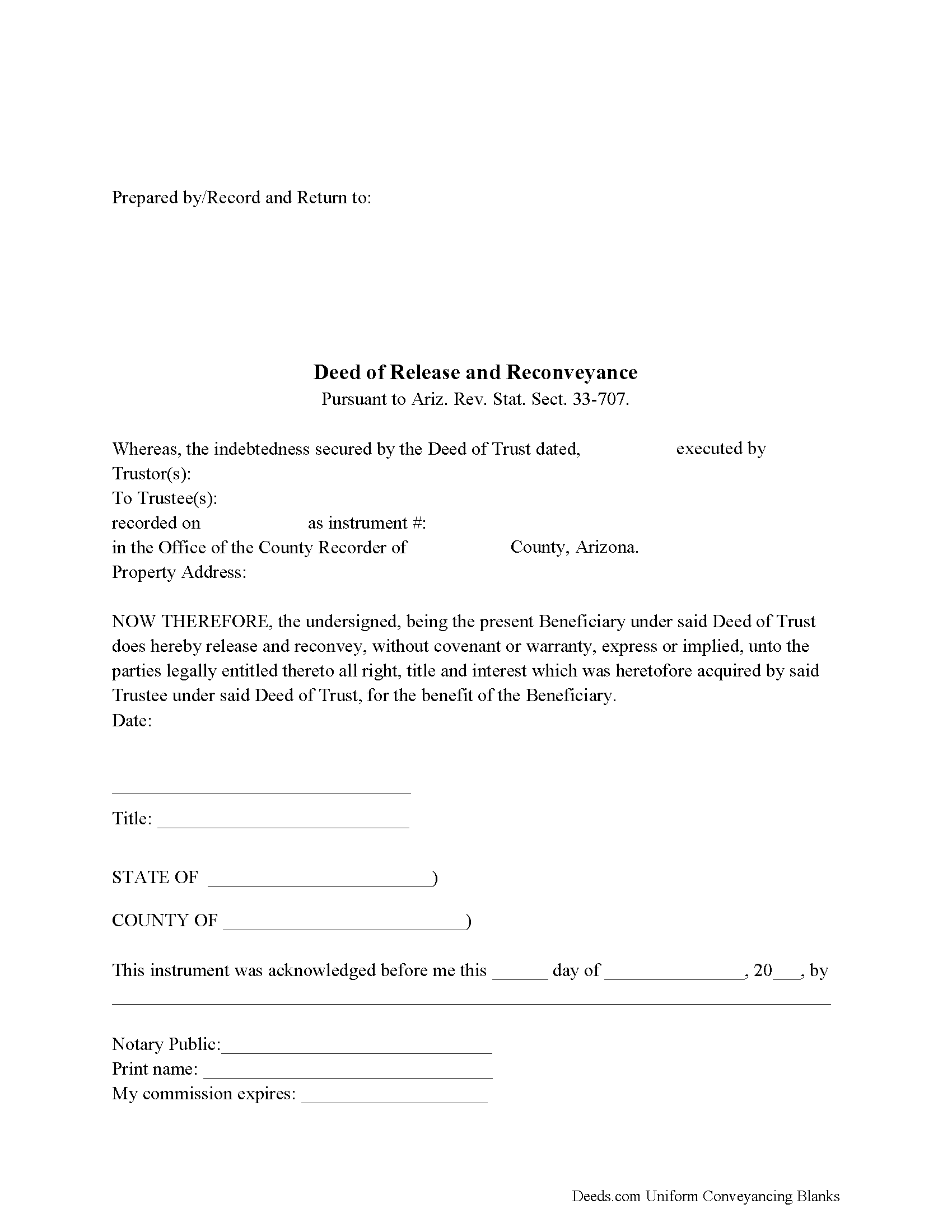
Pinal County Deed of Release and Reconveyance
Fill in the blank form formatted to comply with all recording and content requirements.
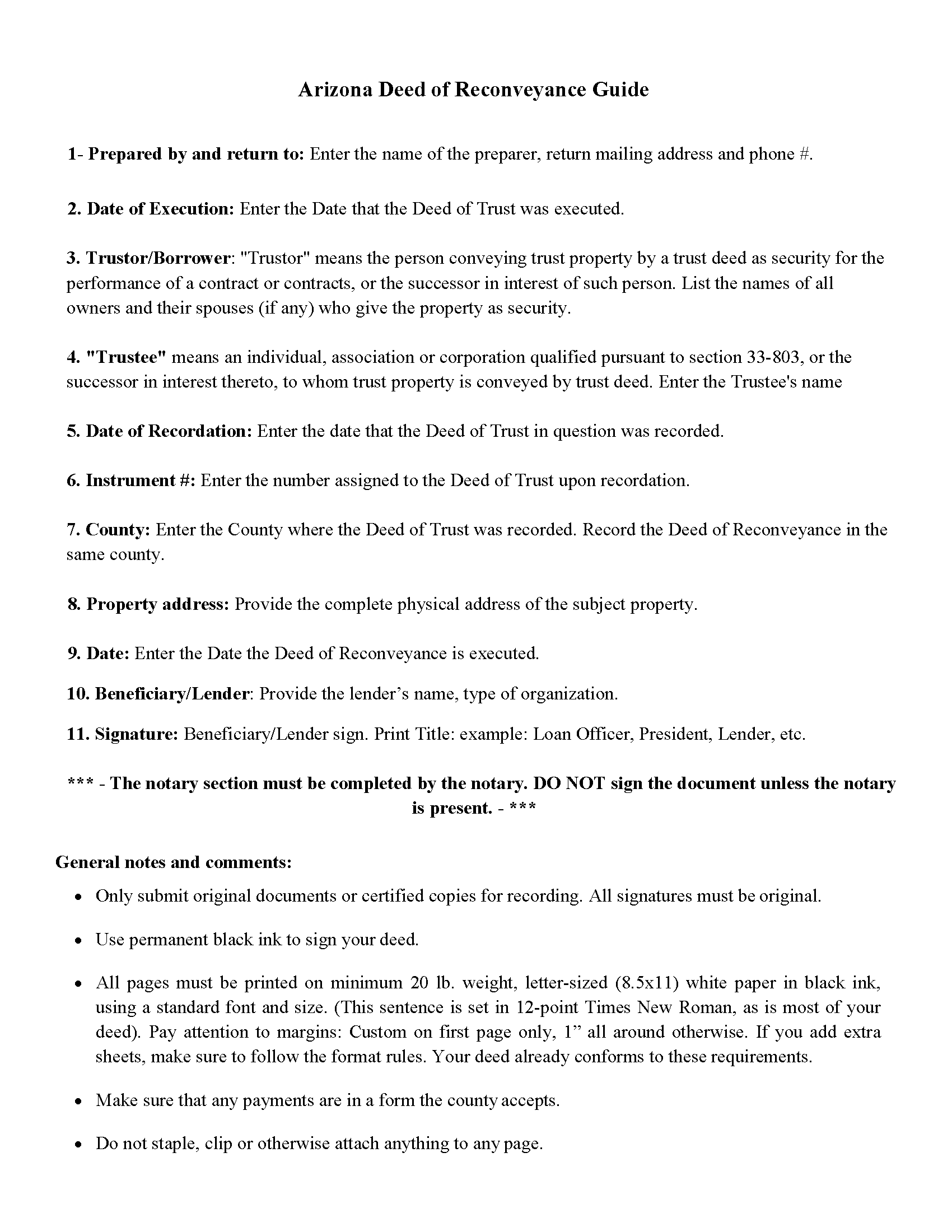
Pinal County Deed of Release and Reconveyance Guidelines
Line by line guide explaining every blank on the form.
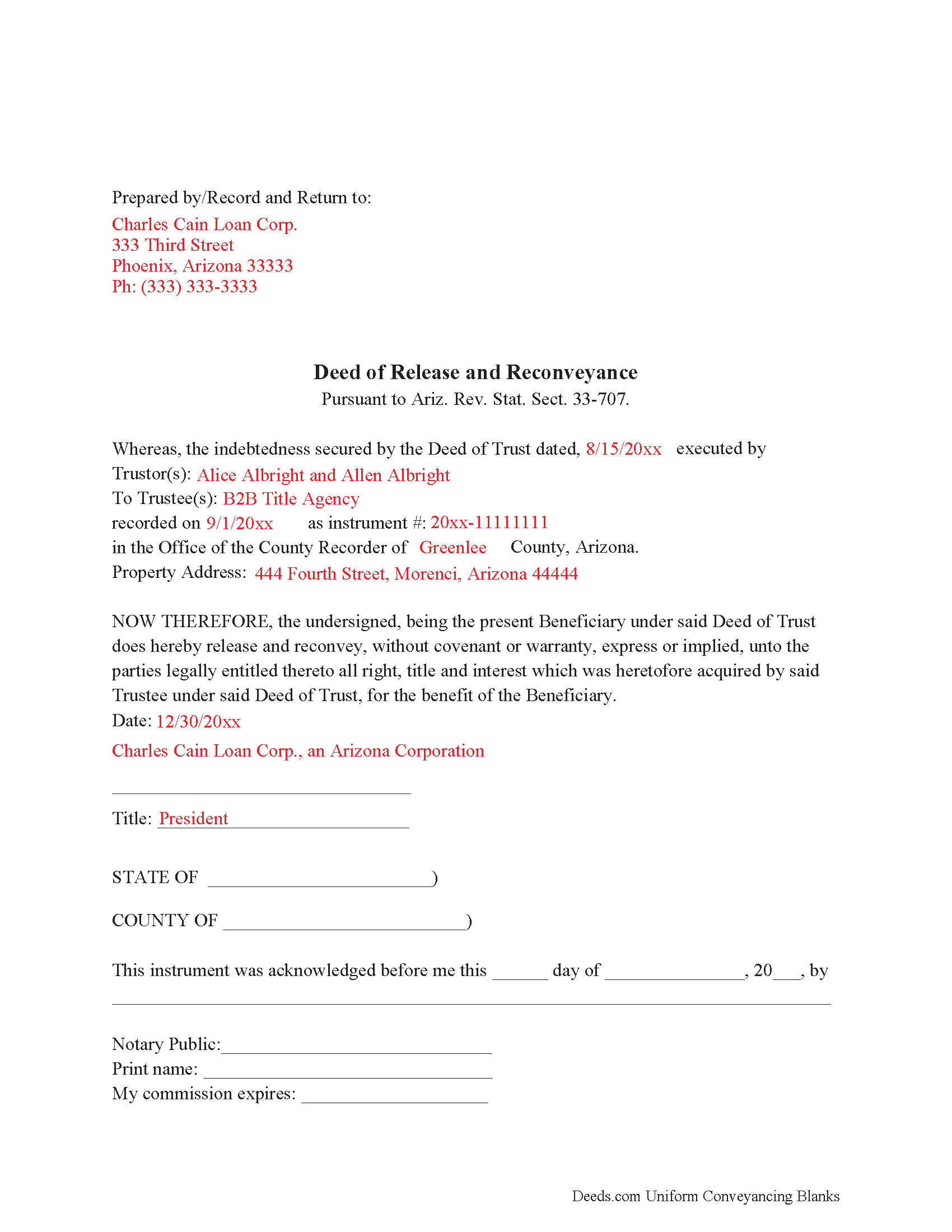
Pinal County Completed Example of the Deed of Release and Reconveyance
Example of a properly completed form for reference.
All 3 documents above included • One-time purchase • No recurring fees
Immediate Download • Secure Checkout
Additional Arizona and Pinal County documents included at no extra charge:
Where to Record Your Documents
County Recorder: Main Office
Florence, Arizona 85132
Hours: 8:00am to 5:00pm Monday - Friday
Phone: 520-866-6830
Apache Junction Office
Apache Junction, Arizona 85119
Hours: 8:00am to 4:30pm M-F
Phone: (520) 866-6830
Casa Grande Office
Casa Grande, Arizona 85122
Hours: 8:30am - 4:30pm M-F
Phone: (520) 866-6830
Recording Tips for Pinal County:
- Bring your driver's license or state-issued photo ID
- Ensure all signatures are in blue or black ink
- Make copies of your documents before recording - keep originals safe
- Recorded documents become public record - avoid including SSNs
- Recording fees may differ from what's posted online - verify current rates
Cities and Jurisdictions in Pinal County
Properties in any of these areas use Pinal County forms:
- Apache Junction
- Arizona City
- Bapchule
- Casa Grande
- Coolidge
- Eloy
- Florence
- Kearny
- Mammoth
- Maricopa
- Oracle
- Picacho
- Queen Creek
- Red Rock
- Sacaton
- San Manuel
- Stanfield
- Superior
- Valley Farms
Hours, fees, requirements, and more for Pinal County
How do I get my forms?
Forms are available for immediate download after payment. The Pinal County forms will be in your account ready to download to your computer. An account is created for you during checkout if you don't have one. Forms are NOT emailed.
Are these forms guaranteed to be recordable in Pinal County?
Yes. Our form blanks are guaranteed to meet or exceed the applicable formatting requirements used for recording in Pinal County, including margin requirements, font requirements, and other layout standards. This guarantee applies to formatting, not to the legal sufficiency of information entered by the user or the suitability of a form for a particular transaction.
Can I reuse these forms?
Yes. You can reuse the forms for your personal use. For example, if you have multiple properties in Pinal County you only need to order once.
What do I need to use these forms?
The forms are PDFs that you fill out on your computer. The free Adobe Acrobat Reader is recommended, and most PDF apps also work. You do NOT enter your property information online - you download the blank forms and complete them privately on your own computer.
Are there any recurring fees?
No. This is a one-time purchase. Nothing to cancel, no memberships, no recurring fees.
How much does it cost to record in Pinal County?
Recording fees in Pinal County vary. Contact the recorder's office at 520-866-6830 for current fees.
Questions answered? Let's get started!
The Arizona Deed of Release and Reconveyance is the recorded instrument that clears a paid-off deed of trust from the property's chain of title and reconveys the bare legal title that the trustee held back to the property owner. Arizona law at ARS 33-707 gives this instrument a specific, consequential status: the recorded release constitutes conclusive evidence of full release of the deed of trust in favor of purchasers and encumbrancers for value and without actual notice. That conclusive-evidence status is what makes the recorded release worth the effort — it ends the inquiry for any future party looking at the title and prevents the long-satisfied loan from continuing to cloud subsequent transactions.
When the Arizona Deed of Release and Reconveyance Is Used
This form is used to clear a deed of trust from the record once the secured debt has been fully paid or otherwise satisfied. Typical triggers include payment in full at the natural maturity of a mortgage loan, refinance of the existing loan by a new lender (where the proceeds of the new loan pay off the old one and the old deed of trust is released as part of the closing), a sale of the property where the sale proceeds pay off the existing loan and clear the record for the buyer, and payoff of a seller-financed note where the seller as beneficiary signs the release once the final installment has been received. The form is also used for smaller secured obligations — home equity lines of credit that have been closed, second deeds of trust, investor-held notes — and for the discharge of deeds of trust securing matured obligations where no further payments are due.
Arizona's Specific Rule Under ARS 33-707
Under ARS 33-707, the trustee or person entitled to payment is required to acknowledge satisfaction of a deed of trust by recording a release and reconveyance upon receipt of full satisfaction. The statute contains two features that set Arizona practice apart from some other states. First, it is not necessary for the trustee to join in the acknowledgment or execution of the release — the beneficiary (the party to whom the debt was owed) can execute the release alone, and the recorded instrument is fully effective. Second, once recorded, the release constitutes "conclusive evidence" of full release in favor of later purchasers and encumbrancers for value and without actual notice. That conclusive-evidence status means a later title examiner or lender finding the recorded release does not need to look behind it for confirmation — the record speaks for itself, and the paid-off loan is definitively off the property.
The conclusive-evidence rule is a consumer-friendly feature that reduces title work for future transactions and protects good-faith buyers and lenders from being drawn into disputes between the original borrower and beneficiary. It is also a protection for the beneficiary: once the release is properly recorded, later claims that the loan was not actually satisfied generally cannot be raised against third parties who relied on the record. The rule's effect on the parties themselves is more nuanced — a beneficiary who released in error (for example, on the basis of a check that later bounced) may have recourse against the trustor personally under separate legal theories, but the release, once recorded, has cleared the record.
What the Release Reconveys
A deed of trust operates by conveying bare legal title to a neutral trustee to hold as security for the debt. While the loan is in effect, the trustor remains the owner in every practical sense — occupying, using, renting, and improving the property — but the trustee technically holds legal title on behalf of the beneficiary. When the debt is paid, that bare legal title needs to come back to the trustor (or to whoever is now the owner of the property, if the property has been sold while the deed of trust remained in place). The release accomplishes two things in one document: it releases the beneficiary's claim against the property, and it reconveys the bare legal title that the trustee held back to the current owner. The "and Reconveyance" part of the instrument's title captures this dual function, which is why Arizona's form is typically labeled more completely than similar instruments in states where the mortgage structure makes the reconveyance function less prominent.
Who Signs the Release
The party entitled to payment signs the release — that is, the beneficiary who was owed the debt at the time of satisfaction. For institutional loans, this is the current holder of the note and deed of trust, which may not be the original lender if the loan has been assigned. In practice, a lender other than the originator can execute a valid release only if it can demonstrate that it is the current beneficiary, and the recorded chain of assignments should support the authority. When the chain is clear, the release recites the current beneficiary's status and proceeds. When there is a gap in the recorded assignment chain, the assignee may need to record the missing assignments before the release will be accepted or before a title insurer will rely on it.
For seller-financed notes, the original seller is typically still the beneficiary unless the note has been sold to an investor. The seller (or the seller's estate, or the assignee) signs the release on payment in full. When the original beneficiary has died, the personal representative of the estate signs, with authority documented by letters of appointment. When the beneficiary is a business entity, the signatory's representative capacity appears in the signature block. The statute's provision that the trustee need not join is practically significant for seller-financed and private-investor transactions, where the named trustee on the original deed of trust may be difficult to locate years later — the beneficiary can execute the release without needing to track down the trustee.
Reference to the Original Deed of Trust
The release must tie itself to the specific deed of trust being cleared. The instrument should identify the original deed of trust by its recording date, recording reference (docket and page or instrument number), county of recording, and the names of the original trustor, trustee, and beneficiary. The legal description of the property should match the original deed of trust. When the deed of trust has been assigned one or more times since recording, the recording information of the assignments should also be referenced, to show the chain from the original beneficiary to the current beneficiary executing the release. A release that fails to reference the original with specificity may not be indexed properly by the county recorder, and a later title examiner may not see the connection between the release and the obligation it clears.
Timing — Statutory Obligation to Release
Beneficiaries are not free to delay the release indefinitely after payoff. Arizona law imposes obligations to deliver or record a release within a reasonable time after satisfaction, and specific statutory remedies exist when the beneficiary unreasonably delays. A trustor or current owner who has paid off the loan and has not received or seen recording of the release after a reasonable period can pursue the beneficiary for damages and, in some circumstances, for statutory penalties. Institutional lenders operate under strict servicing requirements that typically move releases into the recording pipeline quickly; private beneficiaries and smaller investors sometimes do not, and the resulting delays create problems when the former borrower tries to sell or refinance. The best practice is to have the release pre-executed and held by an escrow agent or title company so that delivery and recording happen automatically at payoff, rather than depending on the beneficiary to act separately after the fact.
Partial Release Versus Full Release
A full release clears the entire deed of trust against all the property described in the original instrument. A partial release clears only a portion of the property — for example, releasing one lot out of a larger tract from a blanket deed of trust while leaving the deed of trust in place as to the balance. The two serve different functions and are drafted differently. This form is the full release and reconveyance: it clears the deed of trust in its entirety. When the parties want to release only part of the property, a partial release or a formal partial reconveyance is the correct vehicle, and using a full release in that situation inadvertently terminates the security entirely — a potentially catastrophic error when the beneficiary's intent was only to free a portion.
Execution and Acknowledgment
Under ARS 33-401 and 33-707, the release must be in writing, subscribed by the beneficiary, and acknowledged before a notary public or other officer authorized to take acknowledgments. Arizona does not require subscribing witnesses. Acknowledgments taken outside Arizona must comply with ARS 33-501, which recognizes notaries, judges and clerks of courts of record, and other officers authorized to perform notarial acts in the jurisdiction where the acknowledgment is taken. Institutional releases are frequently signed in other states — servicing operations and assignee lenders are commonly headquartered outside Arizona — and the acknowledgment must satisfy Arizona's foreign-acknowledgment rules to be recordable.
Affidavit of Property Value Exemption
Arizona requires an Affidavit of Property Value to accompany most instruments affecting interests in real property (ARS 11-1133), but a release of deed of trust is exempt under ARS 11-1134 because no property is being transferred — the instrument is clearing a security interest rather than conveying the fee. The exemption should be claimed on the face of the release with a statement that the transfer is exempt and a citation to the specific exemption subsection, placed below the legal description. Releases that omit the exemption recital are routinely rejected at the recorder's window even when the transaction plainly qualifies.
Formatting and Recording
ARS 11-480 sets the formatting requirements for every recordable instrument: legible type of at least ten points, white paper no larger than 8.5 by 14 inches, a caption identifying the document (for example, "Deed of Release and Reconveyance"), a top margin of at least two inches on the first page reserved for the recorder's stamp, and minimum half-inch margins elsewhere. Record the release in the same county where the original deed of trust was recorded — in each county, if the property spans more than one. Confirm current recording fees and accepted forms of payment with the county recorder's office in advance, and verify that the release has actually been indexed rather than relying on a drop-off or mailing receipt. The conclusive-evidence protection of ARS 33-707 attaches only when the release is actually recorded and indexed against the property.
What's Included in the Download Package
The Arizona Deed of Release and Reconveyance package includes the release form drafted around ARS 33-707 with the beneficiary as the sole required signer and the statutory language that delivers conclusive-evidence status on recording, detailed guidelines covering the Arizona-specific drafting and recording requirements, and a completed example showing how the form should look for a typical payoff. All files are available for instant download after purchase.
Important: Your property must be located in Pinal County to use these forms. Documents should be recorded at the county recording office listed above.
This Deed of Release and Reconveyance meets all recording requirements specific to Pinal County.
Our Promise
The documents you receive here are guaranteed to meet or exceed the applicable Pinal County recording format requirements. If there is a rejection caused by our formatting, we will correct the issue or refund your payment. This guarantee applies to document formatting only and does not extend to information entered by the user, the selection of the form, or the legal effect of the completed document.
Save Time and Money
Get your Pinal County Deed of Release and Reconveyance form done right the first time with Deeds.com Uniform Conveyancing Blanks. At Deeds.com, we understand that your time and money are valuable resources, and we don't want you to face a penalty fee or rejection imposed by a county recorder for submitting nonstandard documents. We constantly review and update our forms to meet rapidly changing state and county recording requirements for roughly 3,500 counties and local jurisdictions.
4.8 out of 5 - ( 4,825 Reviews )
Mark B. 3 out of 5 stars
I had to download forms one by one: would be more convenient to have a single download for all.
Thank you for your feedback. We really appreciate it. Have a great day!
Lee J. 5 out of 5 stars
Very good so far -- downloading all the forms. So many forms -- I had no idea ....
Thank you for your feedback. We really appreciate it. Have a great day!
Sharon C. 5 out of 5 stars
Easy process considering not too technical savvy!
We appreciate your business and value your feedback. Thank you. Have a wonderful day!
David H. 5 out of 5 stars
It was great
Thank you!
STANLEY F. 5 out of 5 stars
Forms were spot on and able to save over $100 by not going to an attorney to complete the same documents. There were templates on how forms are supposed to be completed. You just need a notary to sign.
Thank you Stanley, we really appreciate your feedback.
Geraldine B. 5 out of 5 stars
Top notch real estate forms. Easy to use, printed out nice, and the guide and example are priceless. You're not going to find anything better anywhere.
Thank you for the kind words Geraldine! Have an incredible day!
harry S. 4 out of 5 stars
Just created account. Very easily done. have not recorded anything yet. Hope to do so soon.
Thank you for your feedback. We really appreciate it. Have a great day!
Wendy S. 5 out of 5 stars
Very easy and affordable.
We appreciate your business and value your feedback. Thank you. Have a wonderful day!
Angela B. 5 out of 5 stars
The site made everything very easy to understand and access. I was able to get everything I needed and the cost was reasonable.
We appreciate your business and value your feedback. Thank you. Have a wonderful day!
Cynthia M. 5 out of 5 stars
I wanted the Lady Bird Deed for my estate, and it was very easy to download, fill out and file. My county records department accepted it with no issue. Thank you Deeds.com! You saved me over $500.00!
We appreciate your business and value your feedback. Thank you. Have a wonderful day!
Margaret S. 5 out of 5 stars
Your service is second to none. Your website is user-friendly, easy to navigate and within minutes I had the forms I needed. Keep up the good work!
We appreciate your business and value your feedback. Thank you. Have a wonderful day!
David M. 5 out of 5 stars
Outstanding products and interface. DCM, IL Attorney
We appreciate your business and value your feedback. Thank you. Have a wonderful day!
Valerie W. 5 out of 5 stars
I haven't gotten around to filling out the forms yet, but they look fine to me on the surface. looking forward to getting to them as soon as I can!
Thank you, Valerie. When you’re ready, everything will be available in your account.
William M. 5 out of 5 stars
I found your service for deeds easy to use and I was able to quickly get the information (forms, example of forms filled out, and guide for filling out the form) down downloaded. I wish all government services and information was as easy to use as your's was. Thank you!
We appreciate your business and value your feedback. Thank you. Have a wonderful day!
Carmen R. 5 out of 5 stars
I was able to get the form I needed but it would not adjust properly on the page.
Thank you!