Pinal County Revocation of Power of Attorney Form
Last validated October 7, 2026 by our Forms Development TeamFormatted for recording in Pinal County, for property anywhere in the county: rural and unincorporated areas as well as Apache Junction, Arizona City, Bapchule, Casa Grande, Coolidge, Eloy, Florence, Kearny and 11 more.
- 3 documents included
- Immediate PDF download
- Formatting guarantee
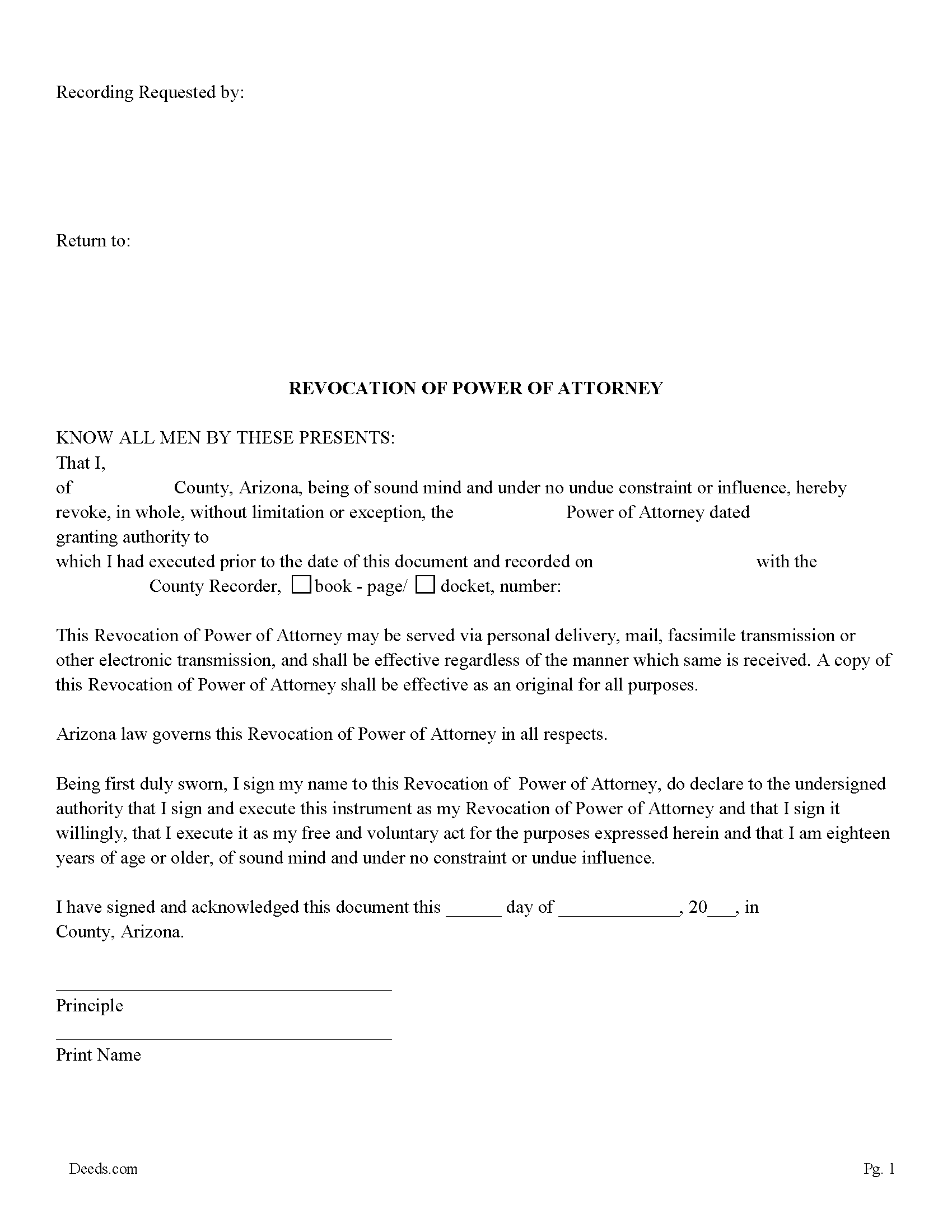
Pinal County Revocation of Power of Attorney Form
Fill in the blank form formatted to comply with all recording and content requirements.
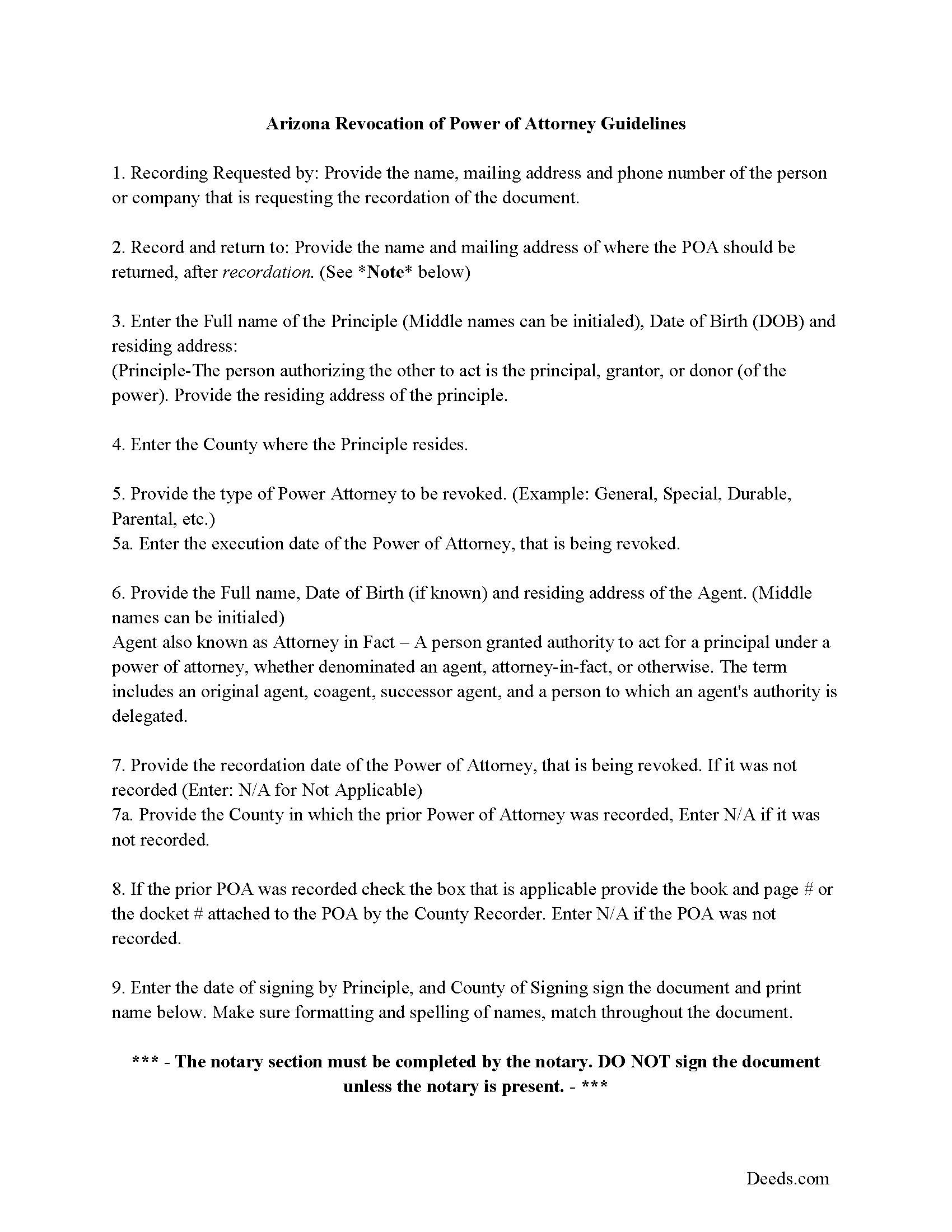
Pinal County Guidelines for Revocation Notice
Line by line guide explaining every blank on the form.
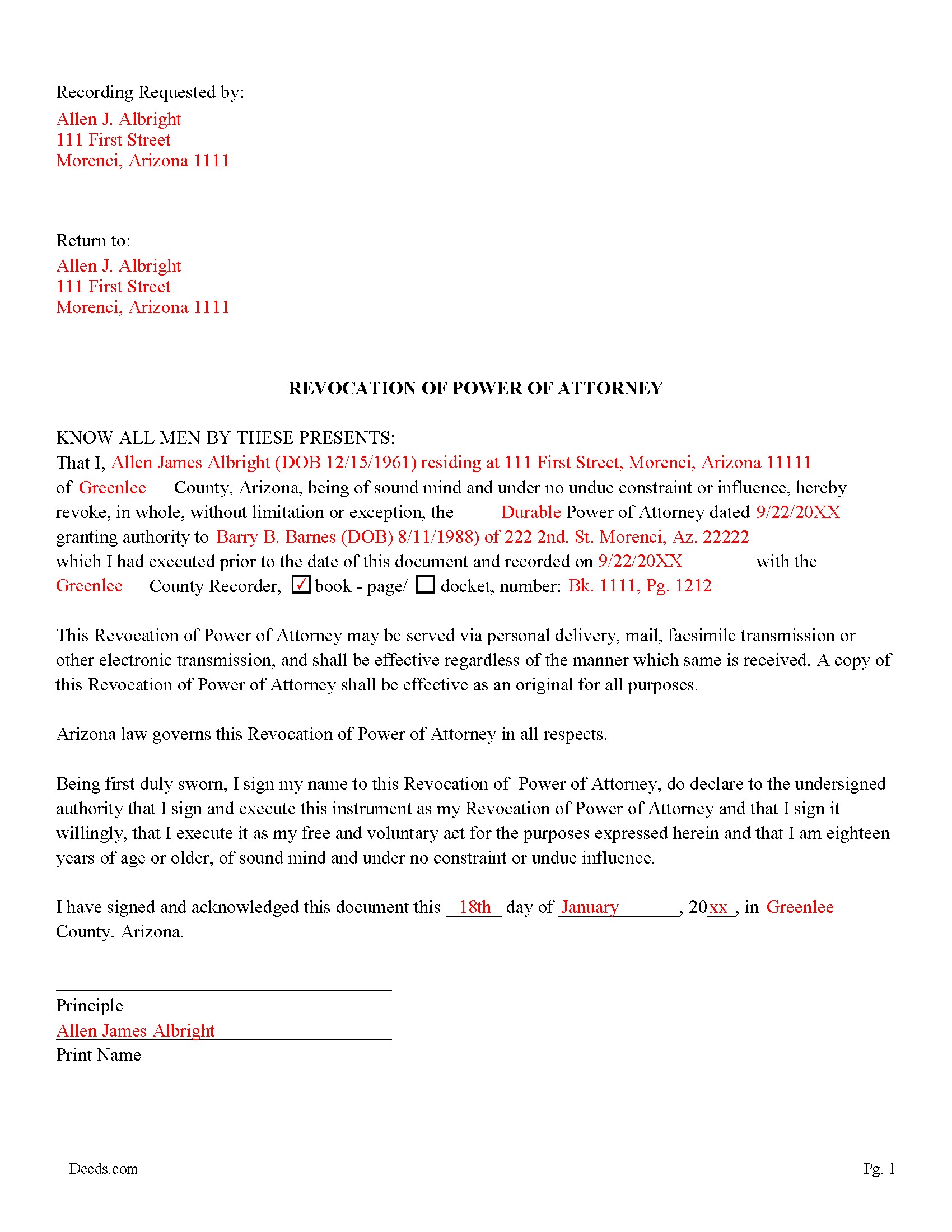
Pinal County Completed Example of Revocation Notice
Example of a properly completed form for reference.
All 3 documents above included • One-time purchase • No recurring fees
Immediate Download • Secure Checkout
Additional Arizona and Pinal County documents included at no extra charge:
Where to Record Your Documents
County Recorder: Main Office
Florence, Arizona 85132
Hours: 8:00am to 5:00pm Monday - Friday
Phone: 520-866-6830
Apache Junction Office
Apache Junction, Arizona 85119
Hours: 8:00am to 4:30pm M-F
Phone: (520) 866-6830
Casa Grande Office
Casa Grande, Arizona 85122
Hours: 8:30am - 4:30pm M-F
Phone: (520) 866-6830
Recording Tips for Pinal County:
- Bring your driver's license or state-issued photo ID
- Ensure all signatures are in blue or black ink
- Check that your notary's commission hasn't expired
- Documents must be on 8.5 x 11 inch white paper
- Double-check legal descriptions match your existing deed
Cities and Jurisdictions in Pinal County
Properties in any of these areas use Pinal County forms:
- Apache Junction
- Arizona City
- Bapchule
- Casa Grande
- Coolidge
- Eloy
- Florence
- Kearny
- Mammoth
- Maricopa
- Oracle
- Picacho
- Queen Creek
- Red Rock
- Sacaton
- San Manuel
- Stanfield
- Superior
- Valley Farms
Hours, fees, requirements, and more for Pinal County
How do I get my forms?
Forms are available for immediate download after payment. The Pinal County forms will be in your account ready to download to your computer. An account is created for you during checkout if you don't have one. Forms are NOT emailed.
Are these forms guaranteed to be recordable in Pinal County?
Yes. Our form blanks are guaranteed to meet or exceed the applicable formatting requirements used for recording in Pinal County, including margin requirements, font requirements, and other layout standards. This guarantee applies to formatting, not to the legal sufficiency of information entered by the user or the suitability of a form for a particular transaction.
Can I reuse these forms?
Yes. You can reuse the forms for your personal use. For example, if you have multiple properties in Pinal County you only need to order once.
What do I need to use these forms?
The forms are PDFs that you fill out on your computer. The free Adobe Acrobat Reader is recommended, and most PDF apps also work. You do NOT enter your property information online - you download the blank forms and complete them privately on your own computer.
Are there any recurring fees?
No. This is a one-time purchase. Nothing to cancel, no memberships, no recurring fees.
How much does it cost to record in Pinal County?
Recording fees in Pinal County vary. Contact the recorder's office at 520-866-6830 for current fees.
Questions answered? Let's get started!
The Arizona Revocation of Power of Attorney is the instrument used to terminate a previously executed power of attorney and put the world on notice that the agent's authority has ended. Arizona's rule, traceable to the recording statutes at ARS 33-411.01 and ARS 33-412, cuts in a specific direction: when the original power of attorney was recorded — which is required any time the agent is acting on matters involving a transfer of real estate or any legal or equitable interest in real property other than a lease — the revocation must also be recorded to be effective against third parties. A written revocation that sits in a drawer while the recorded POA continues to appear in the county records is a recipe for problems, because title companies, recorders, banks, and other parties will continue to rely on the POA they can see until something new is on the record.
When the Arizona Revocation of Power of Attorney Is Used
This form is used whenever the principal wants to end an agent's authority under any previously executed Arizona power of attorney. The form works regardless of the type of POA being revoked: general durable, special durable (tied to a specific property), parental (delegating caregiver authority over a minor child under ARS 14-5104), healthcare, or narrowly drafted transactional powers of attorney. Common triggers for revocation include a falling-out with the named agent, the agent's death or incapacity (which technically ends the agent's authority by operation of law but should still be reflected on the record), completion of the transaction for which a special POA was granted, the principal's decision to appoint a different agent, divorce from an agent-spouse (which automatically revokes that spouse's authority under Arizona law but still leaves the original document on the record), and any other circumstance in which the principal has concluded that the agent should no longer act.
The Recording Rule
Arizona's recording statutes attach significant consequences to whether an instrument affecting real property is on the record. If the POA being revoked was recorded — typically because the agent used it to execute a deed, mortgage, easement, or other instrument affecting real estate — the revocation has to be recorded in the same county where the original POA was recorded. Without that recording, the revocation may be effective between the principal and the agent personally, but it is not effective against subsequent third parties who rely on the recorded POA in good faith. The policy behind this rule is straightforward: the public records are what third parties check, and a revocation that is not in the records cannot cut off reliance on what is.
For powers of attorney that were never recorded — typically general financial POAs used only to deal with banks and brokerages — recording the revocation is not strictly required, but it is often still the better practice. Recording establishes a public date of revocation that cannot be disputed later and creates a document that can be provided to any institution that needs it. For POAs that straddle the line — a general POA that was used for one real estate transaction but is otherwise used for banking — the safer approach is to treat the revocation as requiring recording.
Reference to the Original POA
A revocation must tie itself to the specific power of attorney being terminated. The instrument should identify the original POA by the date of execution, the identity of the principal and the named agent (and any successor agent), and, when the original was recorded, the recording date and recording reference in the county where it was filed. When the original was not recorded, the revocation should describe the document by its date and the type of POA (general durable, special durable tied to a described property, and so on), so there is no ambiguity about which document the revocation is canceling. A principal who has executed several powers of attorney over time — as many people do, particularly for estate planning — should make sure the revocation clearly identifies the instrument being revoked rather than leaving the field open to interpretation.
Notice to the Agent and to Third Parties
Recording the revocation puts the world on constructive notice, but it does not directly notify anyone. The principal should also deliver actual notice of the revocation — a copy of the recorded (or executed) revocation — to the agent personally and to each third party that has been relying on the POA. For a general financial POA, that typically means the principal's banks, brokerages, credit card companies, insurance carriers, and any other institutions where the agent has been transacting. For a special POA tied to real estate, it means any title company holding the POA in an open file and any lender on the property. For a parental POA, it means the child's school, doctors, and any other caregivers or institutions where the agent has acted. Delivering actual notice serves two purposes: it protects the principal against continued action by the agent after revocation, and it protects the third party from liability for good-faith reliance on an instrument they had no reason to believe was no longer effective.
The Notice Log
For exactly the reasons above, Arizona practice — and the form in this package — includes a page for documenting where the revocation notice was delivered and when. This is not a filing requirement; it is a record-keeping tool that becomes important if the agent later takes an unauthorized action under the revoked POA. A principal who can produce a dated list of every institution and person notified, along with the method of delivery (certified mail, hand delivery, email), is in a much stronger position to unwind an unauthorized transaction than a principal who cannot document who was told and when. The log is kept with the principal's records; it is not recorded with the county.
Execution Requirements
The revocation must be signed by the principal. Arizona does not require the revocation to use the full ARS 14-5501 execution framework (qualified witness plus notary) that applies to the durable power of attorney itself, but signing the revocation before a notary public — and in practice also before a qualified witness when the original POA was a durable POA — is the safer approach, particularly when the revocation will be recorded. The acknowledged signature gives the instrument the same formal standing as the original POA and avoids technical challenges down the line. When a conservator, guardian, or court-appointed fiduciary is revoking a POA on behalf of an incapacitated principal, the fiduciary signs in that representative capacity and should reference the court order or letters of appointment.
Automatic Revocation by Operation of Law
Several events terminate a power of attorney automatically, without the principal needing to sign anything. The principal's death ends every power of attorney regardless of durability language — the "durable" feature covers incapacity, not death. The principal's execution of a new power of attorney that expressly supersedes the earlier one revokes the earlier document by its own terms. Divorce from a spouse who was named as agent automatically revokes that spouse's authority under Arizona law unless the POA expressly provides otherwise. The agent's death, incapacity, or resignation ends that agent's authority, though a designated successor agent may step in if the document provides for one. Even when automatic revocation applies, recording a formal revocation is still the cleaner practice, because third parties have no way to verify these automatic events from the recorder's index alone — only recorded documents show up on a title search.
ARS 11-480 Formatting and Recording
ARS 11-480 sets the formatting requirements for every recordable instrument: legible type of at least ten points, white paper no larger than 8.5 by 14 inches, a caption identifying the document (for example, "Revocation of Power of Attorney"), a top margin of at least two inches on the first page reserved for the recorder's stamp, and minimum half-inch margins elsewhere. Record the revocation in the same county where the original POA was recorded. When the original was recorded in more than one county, the revocation should be recorded in each. Confirm current fees and accepted forms of payment with the county recorder's office in advance, and — as with any other critical recording — verify that the revocation has actually been indexed rather than relying on a drop-off or mailing receipt.
What's Included in the Download Package
The Arizona Revocation of Power of Attorney package includes the revocation form drafted to reference the original POA by date and recording information, a notice log page for documenting where the revocation was delivered and when, detailed guidelines covering the Arizona-specific recording rule under ARS 33-411.01 and the practical mechanics of delivering notice to the agent and to third parties, and a completed example showing how the form should look for a typical revocation. All files are available for instant download after purchase.
Important: Your property must be located in Pinal County to use these forms. Documents should be recorded at the county recording office listed above.
This Revocation of Power of Attorney meets all recording requirements specific to Pinal County.
Our Promise
The documents you receive here are guaranteed to meet or exceed the applicable Pinal County recording format requirements. If there is a rejection caused by our formatting, we will correct the issue or refund your payment. This guarantee applies to document formatting only and does not extend to information entered by the user, the selection of the form, or the legal effect of the completed document.
Save Time and Money
Get your Pinal County Revocation of Power of Attorney form done right the first time with Deeds.com Uniform Conveyancing Blanks. At Deeds.com, we understand that your time and money are valuable resources, and we don't want you to face a penalty fee or rejection imposed by a county recorder for submitting nonstandard documents. We constantly review and update our forms to meet rapidly changing state and county recording requirements for roughly 3,500 counties and local jurisdictions.
4.8 out of 5 - ( 4,824 Reviews )
Dee S. 5 out of 5 stars
This was easy and much cheaper than getting a lawyer. Thanks! - From alabama
We appreciate your business and value your feedback. Thank you. Have a wonderful day!
Wesley B. 4 out of 5 stars
Exactly what I needed
Thank you!
DeBe W. 5 out of 5 stars
Thanks for the quick response. That really helps when you're under a time deadline.
Your feedback is greatly appreciated. Thank you for taking the time to share your experience!
QINGXIONG L. 2 out of 5 stars
The major problem is too expensive, particularly sometime, only few words need to file correction deed which cost 20 dollars!!
Thank you for your feedback. We really appreciate it. Have a great day!
James S. 5 out of 5 stars
easy to use
Thank you James.
Dave S. 5 out of 5 stars
Easy to use and get forms I needed. Corporate need for an invoice/receipt could be a bit easier - have to print screen to get any info.
Thank you for your feedback Dave, we really appreciate it.
Phyllis A. 5 out of 5 stars
The turnaround was excellent. The lady I spoke with was a great help and returned my document very quickly.
Thank you for your feedback. We really appreciate it. Have a great day!
MARIO D S. 5 out of 5 stars
Well worth the $20.00 for the Transfer on Death Deed, if you are willing to do the leg work to notarize and record the deed. Money well spent and money well saved. The value is in the short, bullet type instructions and State specific forms and requirements.
Thank you!
Marion R. 4 out of 5 stars
YOU WERE NOT ABLE TO PROVIDE SERVICE IN THE COUNTY WE NEEDED IN NEW MEXICO. YOUR RESPONSE WAS QUICK SO I APPRECIATE THAT. THANK YOU
Thank you for your feedback Marion.
JoAnn T. 5 out of 5 stars
Very happy! This was a very easy to use web site, the form came with directions and an example, both were very helpful. I will absolutely use Deeds.com in the future.
Thank you for your feedback. We really appreciate it. Have a great day!
Debbi B. 4 out of 5 stars
The deeds were a very reasonable price. However, it was made to seem like it was part of Jefferson County, and I didn't love the deceptiveness.
Debbi, we understand that you came away with the impression that Deeds.com was part of Jefferson County, but we respectfully disagree with the characterization of our website as deceptive. Deeds.com is an independent document provider and does not represent itself as affiliated with Jefferson County or any other government agency. Jefferson County is identified because customers need forms and recording information appropriate for the correct jurisdiction. If a particular page or statement caused confusion, please contact Deeds.com Customer Care so we can review it.
Jill S. 5 out of 5 stars
This was highly convenient and successful.
Glad to hear we could help Jill, thanks for the kind words!!
Kitty H. 5 out of 5 stars
I have had it reviewed by a mortgage broker and a title manager and both said it was done correctly! Your product and the instructions are what made this possible. It took me several hours as I continued to review your information. I just finished printing and ready to file. Yeah! Thanks! Highly recommend the product!
We appreciate your business and value your feedback. Thank you. Have a wonderful day!
Joseph S. 5 out of 5 stars
The best solution in creating deeds.
Thank you!
Vicky M. 5 out of 5 stars
I would give Deeds.com 10 stars if I could!! The staff were super friendly and easy to work with. They kept me constantly updated during the process of uploading and forwarding my deeds for recording. And, the price was extremely reasonable. I look forward to utilizing Deeds.com every time I need to record a deed no matter what U.S. State. I wholeheartedly recommend them!
Thank you for your feedback. We really appreciate it. Have a great day!